Determining resource use for the ADAU1701
It's been awhile, but I've used the ADAU1701 for a few projects and thought I had an intuitive feel for how close a design came to maxing-out the chip's resources. A new design, which looks as if it should run just fine, is putting out white noise with just a trace of the input signal audible. When I start pulling out components, the noise lessens and finally disappears.
Other Sigma chips populate the 'Output' file, telling exactly how much overhead margin a project has. I may have known how to derive this information for the 1701 at one time, but don't recall, and can't find it readily here on the forum. Can someone point me in the right direction? Many thanks!
Audio Signal Processors
SigmaDSP Audio Processors
adau1701
Hi Jim,
Yes the answer is in EZ somewhere but I couldn't locate it either, so here goes:
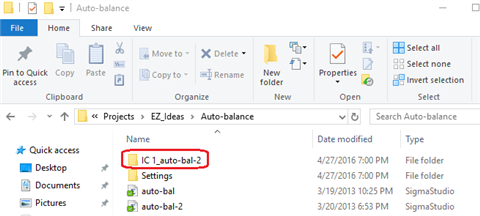
In the folder with your SigmaStudio project, open the folder shown:
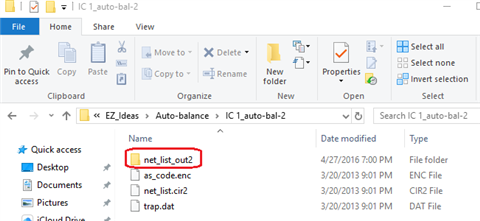
Then open this folder:
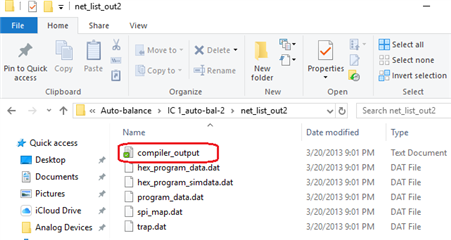
Then, this one ...
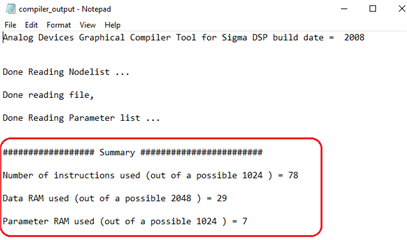
Finally, read the compiler_output text file:
As you know, your maximum instructions are 1024 (or about 1015 after allowing for overhead) at 48K, half that at 96K, half again for 192K.
Also, this post provides a spreadsheet listing instruction counts for many ADAU1701 algorithms.
Best regards,
Bob
Hello Jim,
You did not buy a new eval board recently by any chance?
Dave T
Gentlemen,
Thank you both for your rapid responses.
Bob, that should do it. I have the feeling I might have asked this before, maybe years before, but it must have wound-up in a 600-ohm termination somewhere in my brain. I'll print your concise instructions and pin them to the wall behind the monitor.
Actually, just fiddling with my circuit got it working properly. Very strange what I found, however. I use arithmetic functions for a feedback-mode audio dynamics processor, which requires a Sigma Feedback (1-sample delay) module. There's a string of other modules in the circuit, filters and gain blocks mostly, and my feedback module was the last link in the chain before the control signal went back to a multiplier in the audio signal path. When I simply moved the feedback module to an earlier place in the control signal chain, voilà, it behaved as intended.
Dave, no, my eval board must be several years old now. It has served well and continues to do so, but if there is an updated version with advantages, it would be good to know.
By the way, I had a chance to extol the virtues of Sigma Studio in an article I've submitted to a DIY audio magazine. I recounted my success using the 1701 in a project, and spoke highly of the development platform as a desirable addition to the audio experimenters' box of tricks. But whereas the eval board is easy to use for R&D, including the Sigma chip in a project, with the attendant need for memory, a controller, etc., is probably beyond the capabilities of most home experimenters. What would be very nice would be for someone to come up with a simple 'daughter board' that would become a permanent part of a project. Something simple, audio I/O only and with a PIC or whatever, that could accept a compiled project from Sigma Studio and maintain it in nonvolatile memory to load each time at startup.
I've seen white noise caused by feedback blocks as well, so thanks for the solution. For hobby projects, third-party boards such as SureDSP are available although I haven't tried any. Many hobby applications self-boot the -1701 instead of involving a uC.
Best regards,
Bob
That Sure DSP looks very much like what I was talking about; good to know and thanks! Also, thanks again for the info on determining 1701 resources overhead (although I feel like a dummy, needing this info again!). I find that my circuit is loafing at 25% or so.
The Sure Electronics Website descriptions and YouTube videos are not definitive on what's actually offered and needed, and are a bit hard to follow. I'll look around for a forum where someone's had some experience with these third-party offerings. Seems like a good intermediate solution on the road to integrating the 1701 permantently; just hope for AD's sake that the chips aren't counterfeit.
Hello Jim,
No, we have not updated the board except to add a wrong resistor value. (bit of sarcasm on my part and some frustration) We have a new supplier building the boards now and they improperly entered the part value in their database. We did not catch it right away so some went out with the wrong value stuffed.
Yes, this board is a great board for hobbyists. I have thought about doing a project with a simple PIC processor and then documenting it for an APP Note. It is just difficult to find time to do it.
Are you going to be at AES next month by any chance?
PM coming.
Please log in to reply.