Input cap values on ADAU1701
Dear All,
Can someone explain the function of the input capacitors on the ADC inputs for the ADAU1701. I'm new to electronics and I'm struggling to get hold of any 47uF capacitors at a reasonable price. I wondered what would be the effect of using a different capacitance? For example using a 22uF instead?
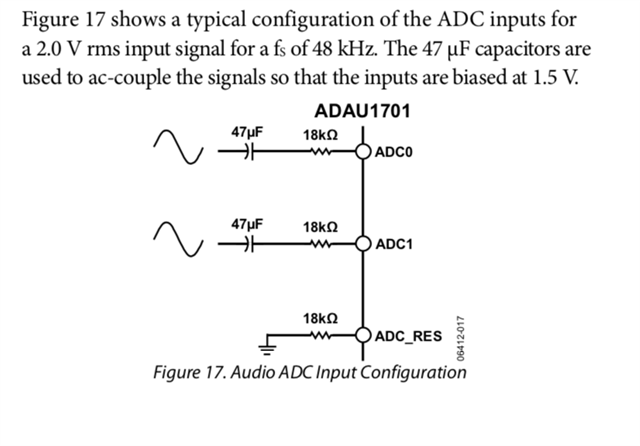
The datasheet says: "The 47 μF capacitors are used to ac-couple the signals so that the inputs are biased at 1.5 V".
Many thanks in advance,
Edit Notes
For example, using a 22uF capacitor instead?
[edited by: TFernandez104 at 10:12 AM (GMT 0) on 11 Apr 2019]
Audio Signal Processors
adau1701 filter
SigmaDSP Audio Processors
adau1701 adc
adau1701
Hello,
22 uF capacitors should work fine. Input coupling capacitors like these allow your AC audio signal through while blocking DC. This blocking action is needed because your input signal fluctuates around ground potential, while the ADC input pins operate at 1.6 V above ground. The caps allow only your input audio without this 1.6 V difference to appear across the 18 K resistors. In turn the resistors admit a fluctuating current into the ADC pins proportional to your audio signal, by Ohm's Law. The ADC converts this current to the numerical sample values which in turn drive your DSP signal flow.
The coupling capacitors must be sufficiently large in value to allow your low-frequency (bass) through. If the caps are too small, you'll lose bass response -- with a "tinny" sounding result. How much capacitor is enough? You can calculate the "3 dB point" (the frequency where about 70 % of the original signal gets through) with the formula: F = 1 / (6.28 x R x C). For 18 K and 22 uF, F = 1 / (6.28 x 18000 x 0.000022) = 0.4 Hz. This is much lower than 20 Hz, the lowest audible bass frequency. Thus 22 uF or even 10 uF is sufficient for most applications.
Best regards,
Bob
Please log in to reply.