ADAU1467 Low-Shelf filter How to calculate filter coefficient
Hi,
Please let me know how to calculate S(Large S) in the following formula.
Thanks and Regards,
Audio Signal Processors
ADAU1467 SigmaStudio SigmaDSP
adau1467
SigmaDSP Audio Processors
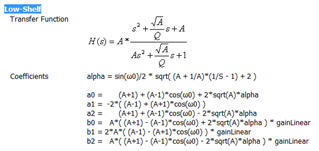
I believe that is a typo. S=2πf/Fs.
Hi Ken,
Thanks,
What you mean is S = 2 * pi * omega ., right ?
What do the "omega" mean ?
Not ω0 = 2*pi*f0/Fs but ω(omega).
Thanks and Regards,
Sorry. I've corrected my answer.
Hi Ken,
Thanks,
In conclusion, what is correct?
Regards,
I stumbled across this question and didn't want to leave it unanswered...
Capital "S" - in this case - is the abbreviation of a normalized tuning parameter called "shelf slope" that is related/analogous to the quality and/or bandwidth parameters of standard biquads. You could certainly put S in terms of either Q or BW, but it wouldn't have much real meaning.
Rather than write a bunch more, I'll only quote this:
When S = 1, the shelf slope is as steep as it can be and remain monotonically increasing or decreasing gain with frequency. The shelf slope, in dB/octave, remains proportional to S for all other values for a fixed f0/Fs and dBgain.
from here: http://shepazu.github.io/Audio-EQ-Cookbook/audio-eq-cookbook.html
Go there to find all of the good details.
Hi DJMaguire,
Thanks for detailed information.
I have one more question about "Crossover Filter".
There are crossover type options in following document page.
https://wiki.analog.com/resources/tools-software/sigmastudio/toolbox/filters/crossover
Please let me know, especially if you know the difference between each Linkwitz-Riley 12/24/36/48 .
Thanks and Regards,
Sorry for the delay. I am only just now seeing this. The choices for the Linkwitz-Riley crossovers of 12/24/36/48 should be simply the desired choice of dB/octave magnitude slope. It's simply an alternative to asking for order, I suppose.
Thank you.
Please log in to reply.