what the ADAU1701 processing is based on? sample or block?
if the processing is based on block , then how many are the less samples grouping one block? thanks!
Audio Signal Processors
SigmaDSP Audio Processors
adau1701
Hello,
The ADAU1701 performs sample processing. -- it streams incoming samples in real time. With a core speed of almost 50 MIPS, it can perform nearly 1024 operations in the 21 uS between a given sample and the next at 48K samples per second. Your entire schematic gets executed each sample period. Thus you can build signal flows which appear quite analog on the outside, yet function with digital precision on the inside. Or, as HP / Agilent used to say about their oscilloscopes: The look and feel of analog, the power of digital. Adding to the ADAU1701's analog feel is its built-in converters, self-boot and auxiliary ADCs.
The ADAU145x and -146x DSPs perform both sample and block processing -- they execute any block operations during idle times between samples.
Best regards,
Bob
thanks for your prompt answer!!
Since the double precision filter needs 10 instructions, can i simply get the number of casaded filters at most between a given sample and the next by the equation: 1024/10. The result is about 100. Is't it?
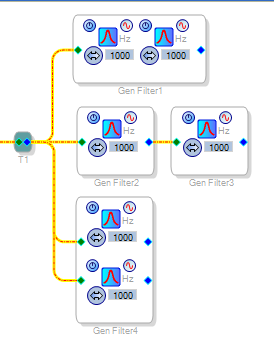
Yes, 10 instructions per filter. This applies to all double-precision filters whether cascaded or independent. Thus the six filters shown below total 60 instructions:
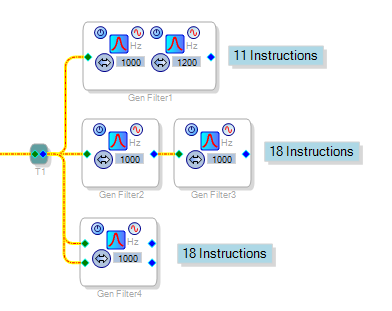
Some higher-end SigmaDSPs can optimize cascaded filters. For example, the same filters use only 47 instructions in a ADAU1452:
Best regards,
Bob
Hello ahihong sun,
You probably will not be able to get to 100 filters due to the other input and output circuits, some volume controls, and other processing you will have to do. Plus you will not be able to get to 1024 because of some overhead code that is inserted by SigmaStudio. However, your basic calculation is correct.
Dave T
Thanks for your reply. What i want to konw is the extreme condition, and you just gave me the definite answer. Thank a lot!
thanks a lot , gave me such professional reply!
Please log in to reply.