ADAU1701. Pop when power is turned off.
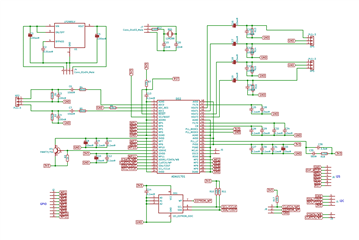
Hello! I apologize for my English... I have an Assembly on the ADAU1701 processor. When the power is turned off, the speakers pop. Is this a feature of the processor or an electrical circuit outside of it? And is it possible to deal with it?
Audio Signal Processors
SigmaDSP Audio Processors
adau1701
Hello Sashkashka,
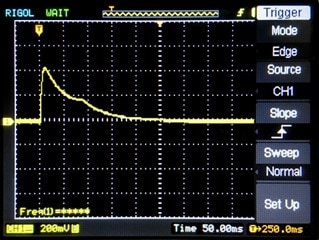
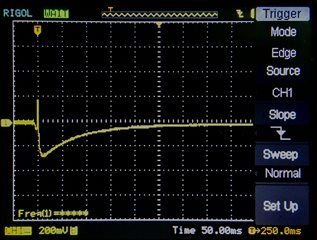
The -1701's DACs have no anti-pop output circuitry. Since they are biased at VCC/2, the coupling cap charging and discharging may create transients as high as VCC/2. The actual transients may be substantially lower depending upon your power source and output circuit components. For example, the ON and OFF traces below were made by powering up / down a ADAU1701MINIZ board with a 350 ohm load on its output:
The -1701 itself may help you form the beginning of an anti-pop circuit, because you can arrange one of its GPIO pins to produce an enable / disable logic signal. If your product is powered speakers, you can use this signal to enable your amplifier ICs (some such ICs have pop-free enable inputs). If your device outputs line-level audio to an external audio system, you could devise a method to disable these line outputs during the ON and OFF transient intervals. Once I built a wah-wah pedal for a young friend. Knowing that its user may not always turn down his amp before switching the pedal ON and OFF, I included a MOSFET in its output circuit to short out the audio during these transient intervals. However I don't know if a similar circuit will work here. Perhaps others who have designed around a -1701 may have some ideas.
Best regards,
Bob
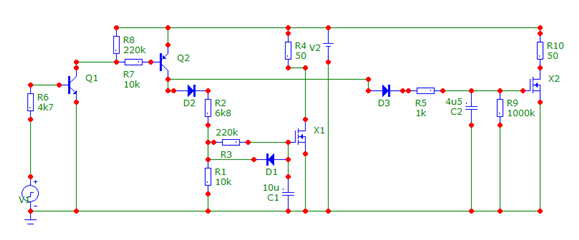
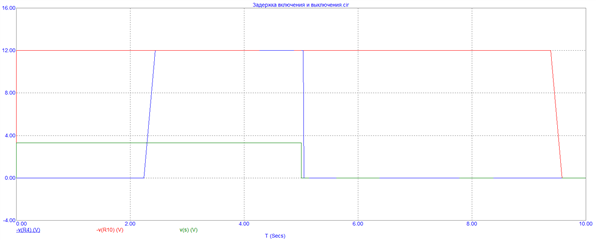
Your answers as always provide comprehensive information! Thanks! I have developed a small circuit that will provide a delay to turn on the amplifier and a delay to turn off the ADAU1701. In the software simulator, everything works well, but in fact ADAU turns off at the same time as the amplifier and gives a clap. Green line - signal 3.3 V REM, Red food ADAU before Converter LM7805, Blue REM amp. Do you see a fundamental error in the circuit, or do you just need to play with the capacitors?
Hello Sashkashka,
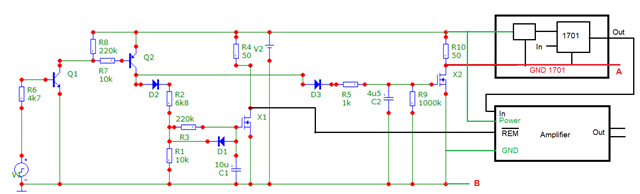
You did well in recognizing the audible pop problem and implementing a circuit to handle it. I may not fully understand your schematic diagram, yet we can figure it out together.
Here's what I see so far:
Signal 3.3V REM (green trace) goes Low to switch off the system. Then Q1 and Q2 turn off, and thus the voltage at Q2-Emitter goes Low also. X1 turns off first with the time constant of R1 * C1 = 0.1 second. This allows the blue REM Amp trace to go high, shutting off the amplifier (the Amp enable input appears to be negative logic). Then X2 switches off with a longer time constant of 4.5 seconds. When X2 cuts off, the top of R10 stays at V2, while the bottom of R10 rises in voltage to meet V2. Thus, the voltage across R10 goes to zero.
How is the rest of your system connected? My understanding so far is that you have X2 wired as a "low side switch" -- it switches the GND side of your ADAU1701 circuit, as shown below (if my assumption is incorrect, please reply with your actual wiring):
If this is the case, it's likely the source of your difficulty. Normally the grounds of the 1701 (point A) and the amplifier (point B) are connected together to complete the transfer of audio between -1701 and amplifier. This would short X2 so the 1701 never turns off. Even if not (perhaps you're using a differential input to the amplifier), low-side switching is not recommended. Instead, add a P-channel MOSFET, set up much like Q2, to perform high-side switching of the -1701 power.
Best regards,
Bob
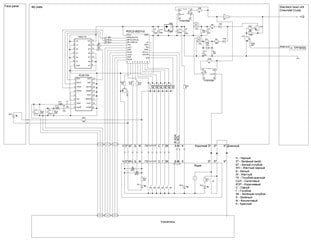
Dear Bob. I am guilty of not providing a complete diagram. I attach it below. It adds an optocoupler for power management of the rmc2-0027v3 Board (the diagram is attached in the first comment) and a REM amplifier. This is a way out of a situation where there is no P-channel transistor. On the layout, the delay in switching on the amplifier works correctly, but when you turn it off, you can hear a pop. This means that the ADAU1701 is turned off either at the same time as the amplifier or with insufficient delay. When I checked the circuit on the LEDs, one of them faded smoothly instead of abruptly shutting down. While in the simulator we can see the steep fronts everywhere. I guess I need to move in that direction. But, it is interesting to know the opinion of a professional.
Hello Sashkashka,
Actually I'm guilty of going ahead and guessing what your application involved instead of asking more about it. Sorry about that. Unfortunately the schematic diagram displays too small for me to read it -- and I'm not the best with hardware design anyhow. It's interesting that the On -- Off transitions measured on the hardware haven't matched up with the simulations. It reminds me of what the late (and iconic) Bob Pease formerly of National Semi (now TI) opined about computer simulations. Once asked about his favorite programming language, Mr. Pease replied, "Solder."
Best regards,
Bob
I'll answer when I figure out what's wrong with my scheme. Perhaps this will be useful to someone. And I don't understand why this isn't a popular topic. Thank you for your time and attention!
I appreciated the joke about the computer!) It's true!
Hello! I've solved my problem! The laid out scheme works correctly. The problem is with the amplifier itself, which gives a clap when turned off.
Please log in to reply.