Autobalance for surround channel
Hi,
I'm trying to do an autobalance. ADAU1701 processor. It should work as follows:
when the signal level of one channel changes, the gain of the other channel automatically changes to make both levels the same.
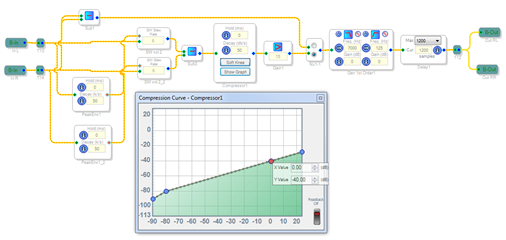
Below is my algorithm. Everything seems to work, but there is one problem. The output gain depends on the overall signal level. The signal level is multiplied. The dynamics level is like an expander. Therefore, at the output, I used the inverse function (the square root). Unfortunately, the result of the root algorithm is only positive numbers.
I also tried to use the algorithm from this link:
ez.analog.com/.../cheap-square-root-via-op-amp
It doesn't work, it makes noise.
What do I need it for?
I want to get a surround channel. Not literally. All I need is the sound that comes from the L-R channel difference. I want to avoid leakage of the dialogue signal into the surround channel, which occurs when the L and R levels are not equal.
Does anyone have an idea how to do this?
Thank you.
Audio Signal Processors
SigmaDSP Audio Processors
adau1701
Hello,
I had asked for help on auto-balance or rather auto un-balance but it was to generate left surround and right surround.
Dolby did have a block called auto-balance in their early decoder, but to the best of my knowledge it was analog in nature (using VCAs).
Vocals (and other content that you don't want to get leaked in the surround channel) have always been recorded with same amplitude and same phase in Left (total) and Right (total) channels, even in the pre-surround era. So, theoretically and practically, if its stereo, you should be able to get surround without dialogue leakage.
I can give you a few reasons why you could be facing issues:
1. If you use magnetic tapes/ cassettes, the tape head alignment will be the culprit
2. If you are using a ganged potentiometer to control the levels of left and right channels, then be rest assured, that it will never track the two channels perfectly. You need DC controlled volume!
3. Component tolerances in the analog pre-amplifier section can cause dialogue leakage. In my experience if you are careful, you can get away with 1% tolerance resistors and do not need anything more elaborate.
If you take clues from the above points, you should be good.
In cinema, during the film era, optical stereo was used which employed a stereo solar cell and an optical lens. Needless to say the sound quality depended on how perfectly you aligned your system. To overcome the problem of dialogue leakage, large delay was used to trick the brain. Same was done in home audio.
I did not directly help you with your algorithm but I hope this will still be useful.
Good luck!
Thanks for the answer. I remember your topic but I don't remember the ending. Did you get an offer from HDSX? How did you solve the surround channel separation? It's also interesting.
You're probably right. A simple L-R difference should be fine. I wanted to make something better. However, if you have an idea how to make digital autobalance, please write.
To moja ostatnia wersja algorytmu, która działa najlepiej, chociaż nie jest pozbawiona wad. Autobalans działa dobrze. Kompresor równoważący wzmocnienie jest również akceptowalny. Stany nieustalone są zniekształcone, ale w tej aplikacji nie jest to takie złe. Może komuś się przyda.
[Static gain sholuld be ca 50, not 15]
Please log in to reply.