Automatic Microphone Mixing
Do you know if the SigmaDSP has the capability to do a Dugan style "automatic microphone mixer"? I'd like to do as many as 8 microphones.
Thanks.
Phil
Hello Phil,
Mr. Dugan's Automixer algorithm adjusts overall gain consistent with the number of microphones in use, to provide that holy grail of live sound -- more gain before feedback. The amazing thing is that he designed his system back in the mid-70s, when microprocessor programming felt like a secret art and the electronics lab at my school still had some vacuum tubes. He made use of a diode's logarithmic V-I curve and the exponential characteristic of LED-CdS optocouplers to add and subtract dB (log-scale) gains. The result is this algorithm:
Each individual input channel is attenuated by an amount, in dB, equal to the difference, in dB, between that channel’s level and the sum of all channel levels.
His original patent has long expired, although of course I'm not qualified to comment on any legal matters.
The Sigma 300 DSPs (ADAU1452, etc.) include the log and exponential math which you'll need to implement the algorithm for this mixer. The rest is hardware design. The -1452 includes six Aux ADCs allowing for pots to control six channels -- you'll need two to handle the knobs for 8 mics + aux inputs. Plus enough codecs to implement your ins and outs. The -1452 can self-boot, yet you may wish to include a micro for additional functions (such as storing settings and calculating filter coefficients should you include user-adjustable EQ). From experience I suspect that the SigmaStudio work will be the easiest portion of the overall project.
By the way-- it was only about five years ago when I purchased two VTL-5C3 LED-CdS optos for use as control elements in a 100% analog Wah-Wah pedal I had built for a young friend. Only now are they finally discontinued, underscoring how useful these were.
Best regards,
Bob
Hello Bob, I extend my sincere greetings to you. The DUGAN SPEECH SYSTEM is a project I am currently working on. I need to develop a product, an eight-channel automatic mixer, which requires the use of DUGAN speech system technology. However, through simulation with SIGMASTUDIO software, I find the logical processing in the software quite difficult for me. If it is convenient for you, could you please provide me with some guidance? I would be extremely grateful. I am also a novice who has just entered the audio field not long ago. Oh, by the way, I am using the ADSP - 21489 chip, and I have also purchased ASHLY's DIGIMIX for reference, but I still feel at a loss as to where to start. Thank you, and I send my sincere greetings again.
Hello,
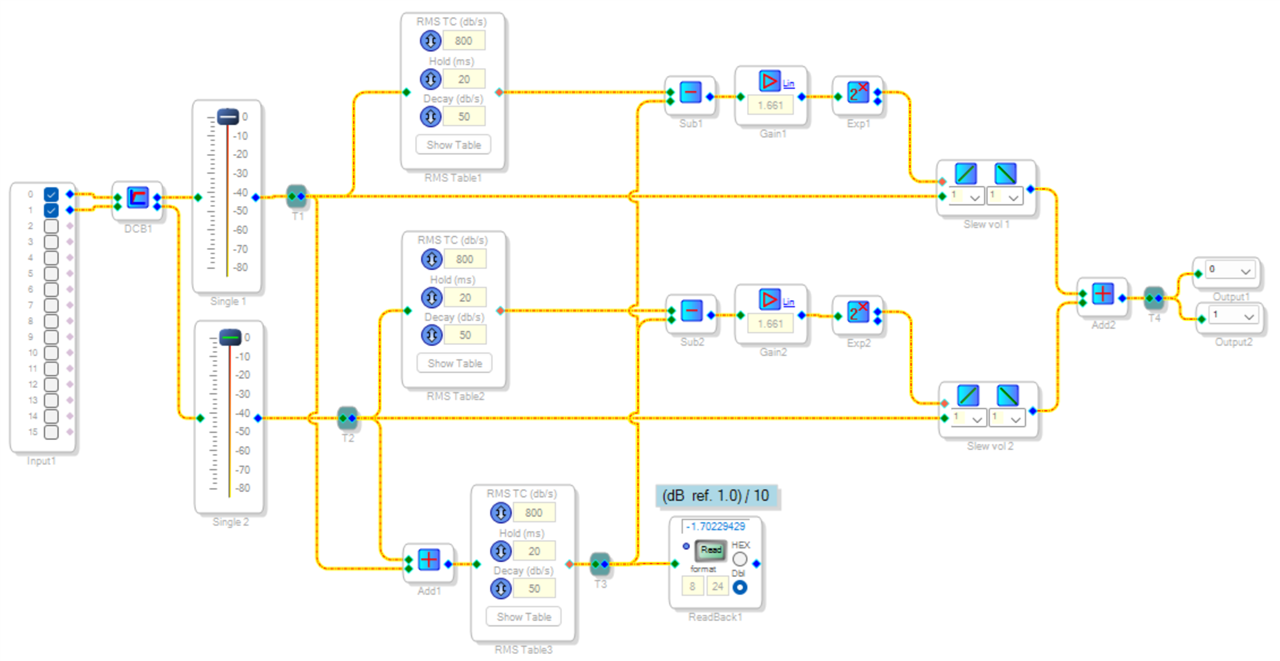
Figure 1 in Mr. Dugan's patent # 3992584 can be adapted into SigmaStudio blocks which perform the needed operations. A simplified example is shown below. To see it better, download the attached project and view in SigmaStudio:
First, the DC Block filter removes any DC component in the input. Sigma-Delta ADCs typically output DC at about -45 dB -- quite annoying in any project which involves measuring levels. The two volume controls simulate a mixer's front panel gain controls.
Mr. Dugan's patent figures the level ratios using analog logarithmic and antilog circuits. Here, the RMS Tables output decimal (8.24) numbers according to their input signals' levels. Table spacing is logarithmic in 3 dB steps from -93 dB to +3 dB. I have entered a sequence of output numbers from -9.3 to + 0.3 into the tables -- thus, these blocks perform log measurements of their inputs, scaled by 0.1 (1 = 10 dB) to keep the numbers within range. The measured levels go directly to the positive input of the subtract blocks.
A third RMS Table provides the level of the sum signal. This routes to the negative input of the subtractions.
The antilog function is performed directly by the 2^x blocks. The gain before these blocks set up the dB / 10 relationship. First, if the exponent blocks were 10^x, we would divide by 20 (a gain of 0.05). But since we only have 2^x, we have to multiply this by log2 (10) = 3.322, which makes 0.1661. Since the lookup tables figure dB/10, we multiply by 10 to get the final gain of 1.661
Each external volume control modulates the gain of each mic channel before the channels are mixed.
I tested this project on the original (old version) ADAU1452 evaluation board. Hopefully, this will get you started on your own development efforts. Please check out Dave Thib's YouTube videos for general help -- URL listed atop the forum. Also refer to the SigmaStudio doc wiki as needed.
1452-Dugan-Mix.zip
Best regards,
Bob
KJBob said:
个外部音量控制都会在通道混音之前调制每个麦克风通道的增益。
Thank you, Bob. Your answer has guided me like a flash of enlightenment. Thank you for taking time out of your help to guide me. Thank you again and send my sincere regards to you.
Please log in to reply.