How to create a rotary speaker type effect?
Hello I am new to the SigmaDSP thing and I would like to know how to create a rotary speaker/Leslie type effect
Hello Ferdinandstrat,
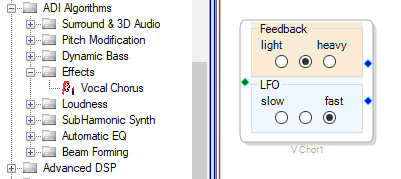
To start very simply, you could try out the Vocal Chorus block shown below:
You'll get some nice-sounding effects from this, although it won't sound much like a particular rotary speaker. The next step up would be to gather the characteristics of such a speaker,, then assemble a SigmaStudio project with blocks which operate similarly. For example, this Wikipedia article describes the dissimilar rotation speeds of a Leslie (R) speaker's bass and treble sections, which suggests different low-frequency oscillators modulating various blocks such as voltage-controlled delays and / or filters to achieve the effect. The complex interaction of the real thing's rotating horns and baffles create subtle variations, much of which won't readily translate into such a simulation -- yet you may hopefully produce a pleasing effect. The SigmaStudio blocks available to you as well as how many of them can you include in a project depends on which SigmaDSP you choose. Do you have a particular chip in mind?
Best regards,
Bob
I will be using the 1452 chip
Oh yeah, I dont have the vocal chorus algorithm for some reason
Hello Ferdinandstrat,
The -1452 is an excellent choice -- it's the first of the Sigma300/350 line of products with four cores and other advanced features. Despite this, its toolbox doesn't include the Vocal Chorus as described in this thread. This simply advances us to the more interesting world of designing a chorus effect from scratch. The linked thread also includes a simple chorus effect which I ported to the -1452 below. It works by having low-frequency oscillators modulate a voltage-controlled dual delay. Likely this isn't the best way to simulate a rotary speaker -- yet it demonstrates the basic concept while leaving you lots of room to design and experiment (that's where the fun is!).
Best regards,
Bob
5428.1452-BasicChorus.zip
Thanks man, I already saw this chorus schematic and hope to use it
From here I need two of these choruses, a crossover and amplitude modulation right?
That sounds about right. As you develop your project, feel free to ask questions. And of course if there's anyone on the board who has experience with this subject and willing to offer advice, feel free to chime in.
Thanks!
Also, how would one implement potentiometers for the chorus you presented? For rate, depth and such
Hello,
The -1452 has six Auxiliary ADC inputs. You can wire a pot to each one. 3.3V at an input translates to an integer value of 1023 within your project. Here's where you need to know about the fixed-point number formats of SigmaDSP -- have a look at this post. It really needs to be updated for the Sigma300/350 DSPs, which use a 8.24 decimal format and a 32.0 integer format -- yet you'll get the idea.
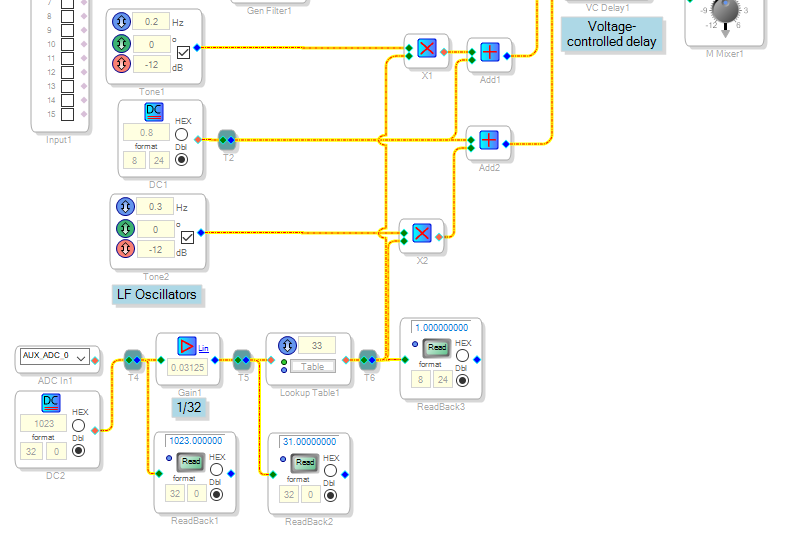
This example shows a depth control added to the design. It multiplies the Aux ADC 0 output by (1/32) to produce an integer number from 0 to 31 according to the pot position. This number selects a row in the Lookup Table, which contains output numbers from 0.0 to 1.0 decimal. Multiplying the oscillator outputs by this number adjusts the depth. As shown, source DC2 substitutes for the Aux ADC because my old eval board doesn't have pots. Readbacks help when troubleshooting the number formats and such. To see the contents of the Lookup Table, download the project and click the Table button.
To make a Rate control, substitute Voltage Controlled Oscillators for the fixed-frequency ones, driving these from a suitably scaled Lookup Table. Right away I noticed that with much higher rates than used for Chorus, the VC delays introduce nasty-sounding pitch changes -- suggesting that the large delays used for Chorus don't simulate a rotary speaker accurately. Thus you'll likely wish to do much smaller delays along with volume and filter modulation. To implement such effects look at these Wiki entries:
Ext Slew Volume Control
Lookup Filters
Best regards,
Bob
7331.1452-Depth-Chorus.zip
Please log in to reply.