ADAU1701-SigmaStudio generating odd/even harmonics
Hi Everybody, I am all new to this forum and only a bit of experience in SigmaStudio.
My aim is to simulate the famous tube sound in modern sound system.
My imagination says, this is not difficult to accomplish, because I only need to register a nonlinear transfer curve of second order that my signal undergoes.
But I can't find any promising parts in the ADI toolbox nor any hits in my research so far.
The first idea was to multiply the signal with itself to achieve a quadratic component, and once again for the cubic part. These multiplied with coefficients and added to a sum.
This should be the model to accomplish a non-linear transfer curve.
Am I right? Has anybody else done that already and how can it be made?
Thank you in advance!
Gufi
nonlinear
Audio Signal Processors
tube-sound
SigmaDSP Audio Processors
adau1701
Hello Gufi,
Sorry I missed your post last year. I just ran across it while searching for something else and thought I would answer it.
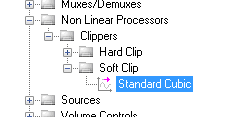
Have you looked at this?
This post in the Wiki explains what it does.
Standard Cubic [Analog Devices Wiki]
Perhaps this is close to what you are looking for?
Dave T
Dear Dave,
Thank you very much for your reply! I was already dissappointed, feeling to be the only one having this idea!
And actually yes, I came across these soft clippers, but believe I need something else.
The nonlinear curve should identically treat all level values according to a formula
y= a0 + a1 * x + a2 * x² + a3 * x³....
And this, from my point of view, would allow me to simulate non-ideal amplifier behaviour and thus create tube-like sound.
It might be possible to create a Lookup-Table or by multiplying the signal with itself, but the latter looks complicated.
Am I right?
Look forward to hear from you!
Cheers
Gufi
Hello Gufi,
Can you help me understand your formula?
What is X? a coefficient?
What is A0, A1, ...etc, Harmonics or delays?
If A0 is the fundamental harmonic then this will be difficult because the frequency will always be changing since the input will be an instrument and the harmonics will always be different and changing over time. It will not be one single frequency. So are you thinking the dominate or lowest frequency that is present?
I think you are using X as the input signal and you want to add ( or subtract ) the harmonics of X? So X2 is the second harmonic of X? Then the A0,A1 are simply coefficients correct? But then why do you have A0?
(Edit) I think I figured out A0. Because the first term is A0*x^0 and since X^0= 1 it drops out leaving A0.
Math was only my minor in college.
Dave T
Dear Dave,
Thank you again for your continued support!
The formula I stated was meant as a universal linear and nonlinear equation.
(likewise my math competence has slightly faded away over the decades...)
X is the input value, Y the output. a0, a1, a2... constant coefficients.
So the equation Y = a0 + a1 * x is fully linear with an offset. No harmonics are created.
The factors a2 * x² + a3 * x³ are adding odd and even harmonics.
When we set a2 = 0.02 for example and a3 = 0.05 we might achieve a THD Total Harmonics Distortion in the range of a percent. Slightly audible, if at all.
In order to accomplish a behaviour like this, we needed to multiply the input signal with itself and then with a constant factor. This was the square function. Multiplying the input signal three times with itself created the cubic fraction and so on.
Cheers
Gufi
I follow
It's very interesting
Please log in to reply.