SigmaStudio use of ASRC on SPORT OUT
Hello.
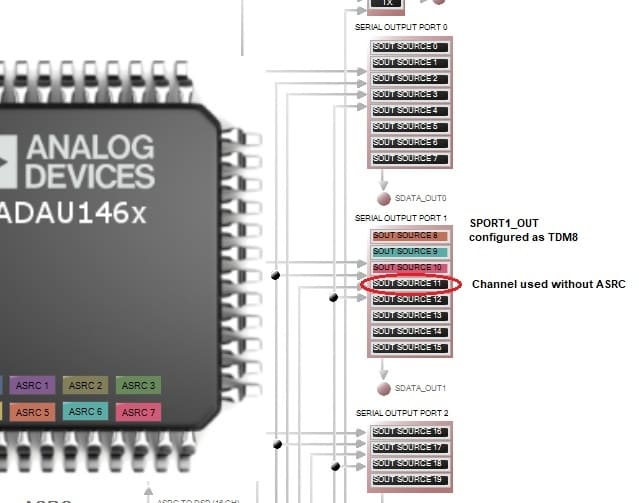
I my project I have an ADAU1466 streaming audio to a Sharc via a TDM8 channel. I use 6 of the 8 channels
The ADAU1466 works at 192KHz rate and the Sharc works on 48KHz.
The Sharc is master clock for the related SPORT1_OUT of the ADAU1466 so I have configured it at "fs" samplig rate and put ASRC for the 6 stereo channel involved in tihs comunication.
Then I wanted to use another stereo channel, the last one free on the SPORT1_OUT TDM, but I have finished the ASRC!
I have try to use anyway the last stereo channel without pass throught an ASRC and I have notice that it works!
My questio is:
When a SPORT_OUT is used ad TDM8, connected to a different sample rate device, is necessary use, for each channels contained in the TDM8, an ASRC for syncronization?
Thanks in adavance.
Have a good weekend
Audio Signal Processors
SigmaDSP Audio Processors
adau1466
Hello,
Sorry for the delayed response.
Asynchronous output signals (for example, serial outputs that are slaves to an external, asynchronous device) typically are routed from the DSP core into the ASRCs, where they are synchronized to the serial output port that is acting as a slave to the external asynchronous master device.You need ASRCs every time you want to change sample rates (or if you're going between devices with different MCLK sources). If DSP 1 and DSP 2 are running off completely separate MCLKs.
So we would suggest you to use ASRC and If you are curious about what is going on here, you might inject very high frequency signal and see what happens. So, you get better understand about ASRC.
Regards,
Lalitha.S
Hello Siro_78,
For the channels using the ASRC the SigmaDSP is feeding the ASRC with samples at a 192kHz rate and sending samples out at the 48kHz rate of the SHARC. So in the SigmaDSP serial output port you selected to pick up the outputs of the ASRCs for the first six data slots. So when the serial port goes to assemble the data for the TDM8, it picks up six channels from the ASRC and two directly from the core of the DSP.
What is happening for the two channels directly from the core is that the SigmaDSP is running at 192kHz and the SHARC is picking up the data at a 48kHz rate. So the DSP program calculates its output sample and places it into the memory location for the channel 7 and 8. However, the SHARC does not pick it up. Then the SigmaDSP calculates another sample and overwrites the first sample and the SHARC still does not pick it up. Same thing happens one more time then finally after the SigmaDSP calculates a sample for the fourth time the SHARC actually picks up the data. So you are only getting one out of every four samples being shifted out to the SHARC. So you will hear audio and it "works". However, if you look at an FFT of a tone you will see lots of harmonics. Also, if the SigmaDSP happens to output a frequency greater than 24kHz then it will alias down. The SigmaDSP running at 192kHz can output frequencies as high as 96kHz.
One thing you can do is put in a LPF set to ~22kHz ( depending on the order ) on outputs 7 and 8 of the core to filter out the higher frequency data and that will work reasonably well if they are both using the same master clock. I would still check the FFT to be sure the signal is clean enough for you.
Dave T
Please log in to reply.