Question before Purchasing EVAL-ADAU1466Z
Hello,
I am considering purchasing this evaluation board for my team's senior design project but I had a concern about it's sample rate limitation.
Our project requires a 192kHz sample rate in order to minimize throughput latency (my team plans to integrate the Cirrus CS4271 Codec with about 50us A to A group delay @192kHz).
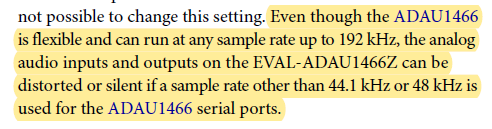
However, the data sheet for this board says
Would it be possible to run the board at 192kHz since we are using an external CODEC and analog signal path?
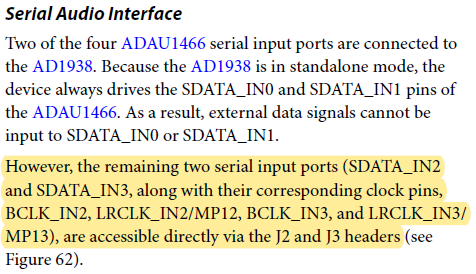
The section on the Serial Audio Interface would seem to suggest this is possible via the SDATA_IN2/3 pins
We are developing an Active Noise Control device for Rigid Barriers and are using the 1466 to run a Feed Forward ANC algorithm.
Any help or advice would be greatly appreciated.
Thank You,
John Waters
Audio Signal Processors
anc
i2s
Active Noise Cancelation
SigmaDSP Audio Processors
active noise control
EVAL-ADAU1466z
adau1466
Show More
Hi John,
This is a good question! The reason the datasheet specifies 44.1 kHz or 48 kHz for the analog path is because the AD1938 CODEC is wired in Standalone Mode on the evaluation board. And in Standalone Mode, the clocking system inside the AD1938 can only accept 44.1 kHz or 48 kHz input streams.
It is possible to rework the evaluation board to wire the SPI lines of the CODEC so you can bring the AD1938 out of Standalone Mode; then it will work at 192 kHz. This is considered outside the scope of DSP evaluation so not described in the user guide. I can show you the modifications to make if you are interested.
SDATA_IN2, SDATA_IN3, and all the SDATA_OUTx pins are not constrained. You can connect them to your other ADC/DAC and run those pins at any rate you want.
On the ADAU1467 evaluation board, you have more options. There, the I2C version of this CODEC (the AD1937) is used, and a switch on the eval board toggles between Standalone or I2C-controlled operation. The I2C port connects to the ADAU1467's master control port so the sample rate of the CODEC can be programmed at startup.
Good luck with your project!
Regards,
Joshua
Please log in to reply.