How to silently turn the ADAU1701 OFF?
Hello,
I have a power amplifier and the ADAU1701 processor both powered from the same transformer having multiple windings.
The amplifier on its own turns on and off silently but when the processor is powered and connected to the amplifier, it generates both turn on and turn off noise.
I have used a relay with delayed turn on. This allows the turn on transients to settle before the speaker gets connected to the amplifier. However I can't get the relay to open quickly enough to cut the turn off noise of the processor.
One way would be to derive the 3.3V from the amplifier rails but that would require a switching regulator. Is there any other way? Am I missing something obvious?
Switching regulators are not readily available online and I could do with some band aid in the mean while.
Thanks!
Audio Signal Processors
SigmaDSP Audio Processors
adau1701
Hi KKSL,
To avoid POPs in audio equipment, there are some options.
1) The amplifier must always have protection on the output to the speaker, the protection is usually obtained with the use of the integrated circuit UPC1237 which detects (short circuit in the speaker, output of the amplifier burned and also, prevents POPs timing the relay)
2) Some DACs like PCM5102a have internal suppression of POPs, whenever possible use them, because it avoids a lot of headache.
3) If the amplifier and the DSP are using the same power source, you can prevent POPs when turning off, using a diode and a larger capacity capacitor, which will keep the DSP working longer, turning off only when the amplifier is already is off.
4) You can try to detect the voltage of the power supply using an MP ( Multi purpose pin of DSP ), when detecting that the power is dropping, mute the DAC, I have not tested this procedure, but it may works.
Hello Rocha,
I will certainly take a look at approach outlined in 3 and 4, in your post, in more detail.
Thanks!
Hello KKSL,
Rocha has some good ideas so keep looking into those ideas.
My comment is that the relay should be wired such that the audio is muted when the relay is off and you have to energize the relay to allow the signal to pass. This will take care of the turn on transient.
The power off transient is more the issue. If you "know" when it is powering off then having a GPIO control of the relay would solve the problem but usually you cannot tell when power is going away. One way to do this is to have the power to the relay come from the main power supply and then either with diodes or another regulator, have a larger cap on the DSP power. This way the DSP will stay on for a little while longer than the relay will. This takes a bit of work to get the timing right. A relay is rather slow. You can always use FETs or analog switches to do the muting but some people do not like to use those.
If you move to a switching regulator then many of those have a Power Good output which can be useful for this problem.
These are my first thoughts on this. I hope some more people chime in on this thread.
Dave T
Hi DaveThib, as I don't have an oscilloscope at the moment, can you check what data adau outputs via I2S when it is muted? all zeros? or least significant bit is set to 1?
This question has to do with POPs at the time of turning on/off.
Thanks..
Hello Rocha,
When there is a mute block or a volume control set to maximum attenuation has the audio muted, the I2S will output all zeros. If it is not muted then it becomes a more difficult thing to answer. Most ADCs will have a DC offset. If you EQ this signal it can raise the DC offset. The DC Block cell does get rid of the DC but it can settle to a value of 00001 or one bit negative which is something like 0xFFFFFE. However, those values are so small that it should be lost in the offset error of any DAC.
The Pop you are seeing can be difficult to fully remove. It depends on the capacitance of the external circuits you might be using. The ADCs and DACs are up on a DC common mode voltage so if this voltage comes up fast you will hear a pop. If it comes up more slowly it will minimize this pop.
So look at the capacitance you have on the CM, FILTD and FILTA pins. Increasing the large bulk capacitor may help this a little. We state 47uf and 10uf for these pins. If you increase it to 100uf and 47uf respectively, it may help some. I do not expect it to fully eliminate it.
The best way is to design and external mute circuit.
Dave T
Thanks DaveThib,
For future versions of Sigma Studio, setting the mute in the module to ( 0x000001 instead of 0x000000 ) I know that mute like 0x000001 is a very low and insignificant value, so it would be MUTE anyway, it will help many people as for many DACs on the market, 0x000001 tells the DAC to start POP prevention internally immediately and then turn off its outputs.
This would need to be applied also to digital serial ports like I2C for example, not just related to the MUTE command
So, if this change is possible, it will be very well accepted by everyone.
Thanks again for this straight forward and accurate answer!
You could use a DC Input block to add 0x000001 to the signal after the Mute block. The output signal would have a very tiny permanent DC offset.
I tried this and it works!!
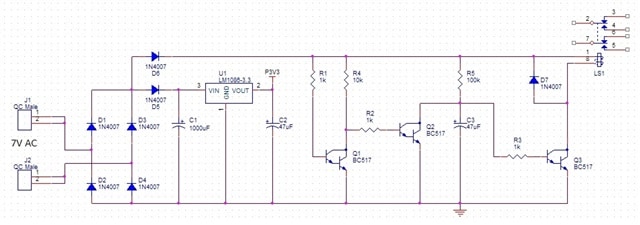
I have a transformer with two secondaries. One for the power amplifier and other for the audio processor power supply. The above modification to the processor power supply section delays energizing the relay connected to the speakers to prevent turn on noises and disconnects the speakers before the processor turns off thus preventing any turn off noises.
You may want to use this to short the 'MUTE capacitor' of the amplifier instead of driving the relay in which case depending on the charge on the mute capacitor, BC517 may be replaced by MPSA29. The relay coil rating is 5V
Do post your results or any further simplifications to this.
Note: Take due care as necessary. 3.3V regulator may need a very small heat-sink
Please log in to reply.