Need help with dipole compensation
Hi,
I did manage it some 10years or so ago, to create a 6db/oct from let's say 280hz and down to a 24th order filter at 30hz(to save my Dayton 15" IB woofers.
Now I can't for the life of me remember how I did it.
I have two DSP solutions, one is without a doubt, easier...that would be ADAU1701. Then I have a board with the ADAU1452, which I understand is a different beast all together,
English is not my first language, so I apologize for getting spelling etc, wrong.
Any help is grately appreciated, preferably as detalied as possible.
Thank you
EDIT: Oups, this was meant to be posted in some forum...I think. Not writter here before.
Edit Notes
added product and product category
[edited by: GenevaCooper at 6:43 PM (GMT -5) on 24 Feb 2023]
Audio Signal Processors
adau1452
hardware
ADAU1701 and ADAU1452
SigmaDSP Audio Processors
adau1701
Show More
Thanks for moving the question to the correct place
Hello,
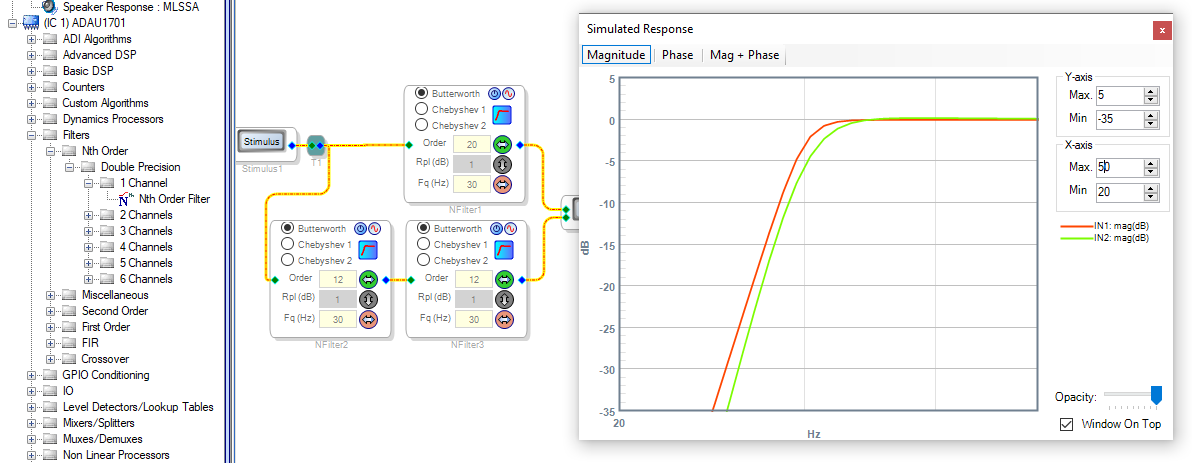
Today this may be easier than it was ten years ago, because recent SigmaStudio versions include a Nth-order filter. It goes up to 20th order, which may be enough to protect your woofers. Below, the red line shows its response -- it won't let much of anything through below 25 Hz. You could cascade two 12th order filters, yet that's a bit sloppier near the cutoff (green line).
For the 240 Hz portion you could use any of the General or Crossover filters as needed.
Best regards,
Bob
Hi, thank you!
It's mainly the dipole compensations (6dB/oct gain from a given frequency) that I haven't figured out yet.
Hello,
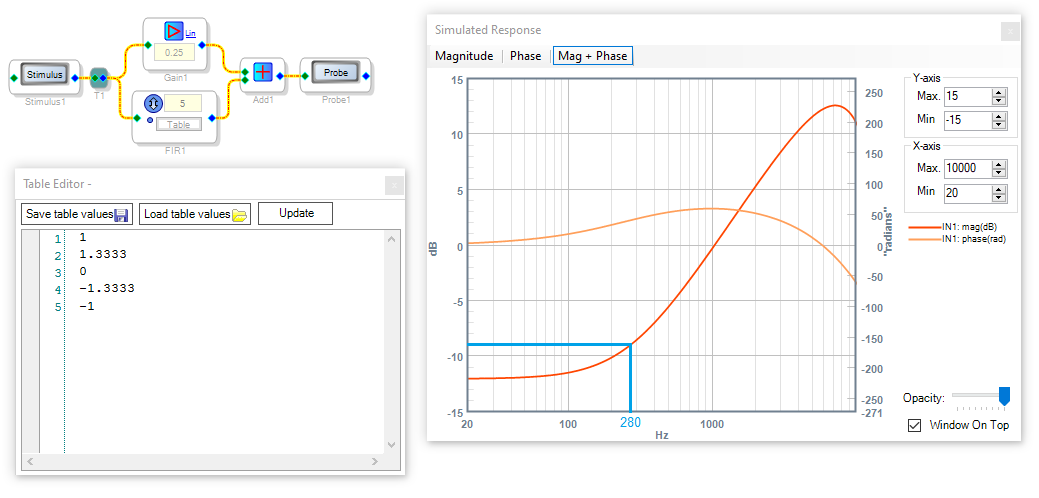
To achieve a response rising at 6 dB / octave, start with a differentiator. There's none built into SigmaStudio, yet we can easily make one using a FIR filter. The one shown below is a Lanzcos low-noise version (Lyons, Understanding Digital Signal Processing, p. 228). Its response continues to rise at 6 dB / octave until flattening out at around 5 KHz. Since your application is for a subwoofer, I'm assuming you don't need the response to keep rising above 5 KHz -- and there's advantages to having it stop rising at very high frequency. Otherwise, its gain of about 12 dB at 4 KHz would keep on rising, resulting in possible clipping. Also, since differentiators boost higher frequencies, they tend to boost noise as well -- so you're better off with a finite frequency range. However, we could make a less selective differentiator if preferred.
Since your need is for a rising response above 280 Hz, we can add a constant term equal to the differentiator's gain at this frequency -- this appears to be approx. -12 dB at 280 Hz. Once we add this in, we get a response that's 12 dB down for bass frequencies, rising to -9 dB at 280 Hz, and increasing further at higher frequency.
I'm not familiar with dipole compensation, so perhaps you could explain this term.
Best regards,
Bob
Have you solved the problem ? I would like to use a dsp for the dipole compensation + 24db/octave low pass + 12-24db/octave high pass to eliminate subsonic
www.audiodesignguide.com/.../index.html
Please log in to reply.