asymmetricsoftclipper and advancedclip formulas are simply wrong?
KJBob Hello, some time has passed since fooling around with Sigma DSPs. I'm now busy with ML stuff. I'm trying to port some of the clipping algorithms that are documented here into a pytorch library. Below an implementation of the advancedclip algo in python using numpy library
import numpy as np
import matplotlib.pyplot as plot
def advanced_clip(samples, threshold):
out = []
for In in samples:
theta = np.abs(In) - threshold / 1 - threshold
if np.abs(In) >= threshold:
out_ = (In * threshold + (1 - threshold) * np.tanh(theta))
out.append(out_)
else:
out.append(In)
return np.array(out)
start_time = 0
end_time = 0.004 # To show 4 periods
sample_rate = 48000
time = np.arange(start_time, end_time, 1/sample_rate)
theta = 0
frequency = 1000
amplitude = 1
sinewave = amplitude * np.sin(2 * np.pi * frequency * time + theta)
clip_out = advanced_clip(sinewave, 0.5)
plot.plot(time, sinewave, color='g', label='sin')
plot.title('Clipper output with sine input')
plot.xlabel('Time')
plot.ylabel('Amplitude')
plot.plot(time, clip_out, color='r', label='clip')
plot.legend()
plot.grid(True, which='both')
plot.savefig('test_clipper.png')
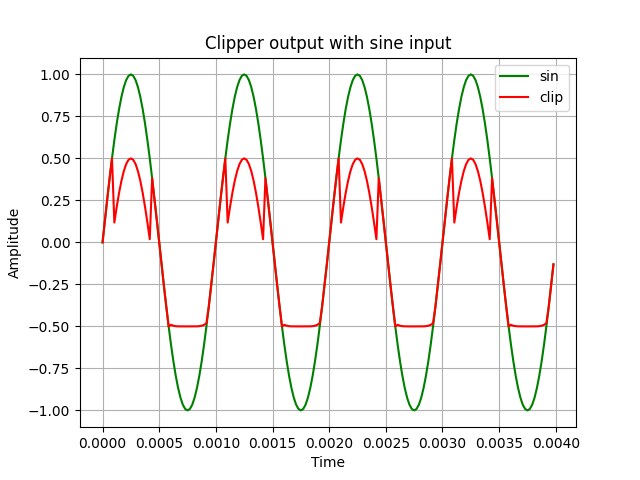
as you can see I'm obtaining pretty much odd results. I'm not asking to debug my Python code. I've tried several parenthesis combinations, for example (threshold / (1 - threshold)) obtaining even more odd results. I'm reporting
here the original formula as outlined in online doc https://wiki.analog.com/resources/tools-software/sigmastudio/toolbox/nonlinearprocessors/advancedclip. My question is simple: someone has ever tested the formula that is provided in the previous link? See an excerpt below
The input is compared with the threshold value, if input is less than threshold the input is pass trough to output. If input is greater than or equal to threshold then (In * threshold + (1 - threshold) * tanh(thetha)).
Where thetha = abs(in)- threshold / 1 - threshold
advancedclip #tanh #python
software
Hello,
I made a few spreadsheets to play with the wiki formula. The result below represents the original formula after fixing its negative excursion. The corresponding file is Clip-1.xlsx.
Just as you have found, we see a jump each time the input crosses the threshold. The formula in the wiki is simply wrong as you said. I made two modified spreadsheets (Clip-2 and Clip-3) in an attempt to get a smooth clip. Clip-2 goes into clipping very smoothly, but not very strongly and worse, it doesn't respond well to threshold adjustments. Clip-3 does respond to threshold adjustments but isn't as smooth. Hopefully, a SE who knows the algorithm can chime in on this topic.
Best regards,
Bob
Advanced-Clip.zip

Hi MaxAudioDSP,
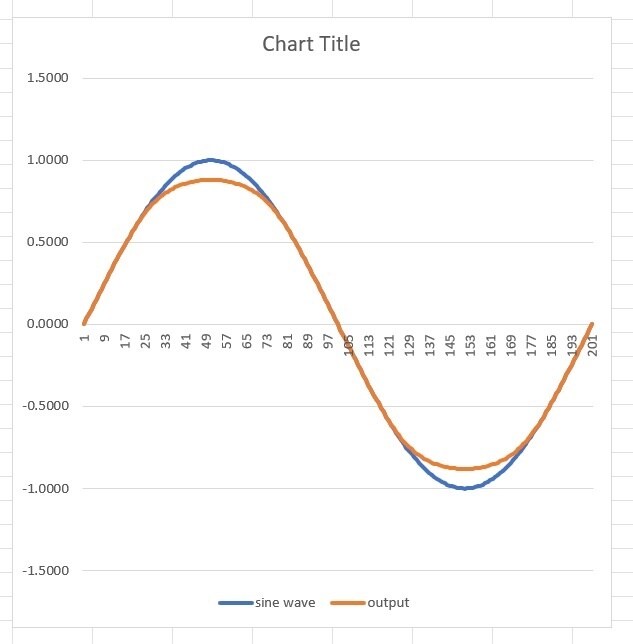
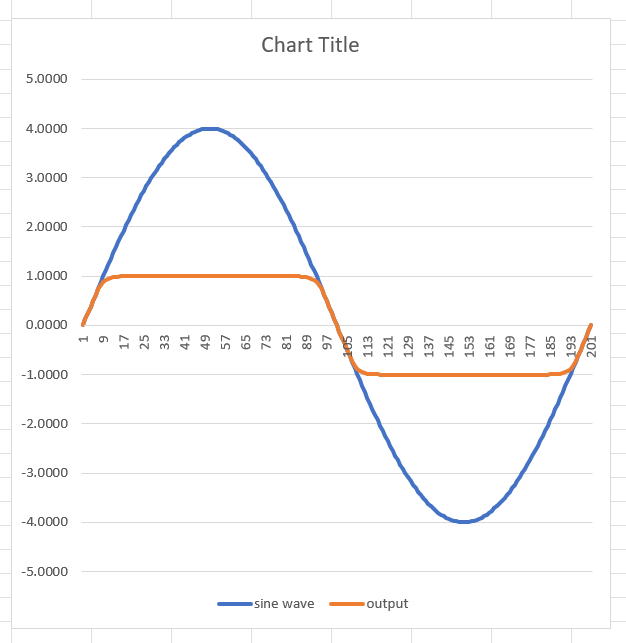
This version, Clip-4, goes smoothly into clipping (that is, both the output function and its first derivative appear jump-free). The two graphs below show that clipping begins almost imperceptibly with the input signal just above threshold, then progressively gets stronger for higher input levels. At 24 dB above threshold, it appears like a hard clip -- except that even here, we can see a curved transition to/from the flat portions of the waveform. Does this match the performance of the Advanced Clipper block itself? I can't compare it because although I have a -1787 eval board, I can't figure out how to get audio through it (its User Guide didn't make sense to me).
If this is what's desired, the wiki's description for the advanced clip might read:
If abs(input) <= threshold, output = input
Else,
If input > 0, output = threshold*(1+tanh(theta))
Else,
output = - threshold*(1+tanh(theta))
theta = (abs(input)-threshold)/threshold
Thanks to you, now I understand why these chips include a complete set of "scientific calculator" functions.
Best regards,
Bob
Clip4.zip
KJBob you're my hero here just for you to know! This is my pytorch WIP implementation github.com/.../networks.py
Hi MaxAudioDSP,
Your code appears quite impressive. I understand that Python is a powerful scripting language, yet I have yet to learn it. There were vacuum tubes in the lab when I went to school.
Best regards,
Bob
KJBob hironically, the whole scope for the above script it to use ML to obtain a "clone" of the sound of a real tube amplifier. So you see, you pretty much fit! If you remember my Aida DSP prj years ago, it eventually turned into something like this https://aida-x.cc. No spam, I sincerely like to share stuff with you since you're one of the very best there, thanks a lot again!
Please log in to reply.