csr867 i2s connection with adau1401 not working properly
I have a CSR8675 Bluetooth module with I2S output that is connected to my ADAU1401.
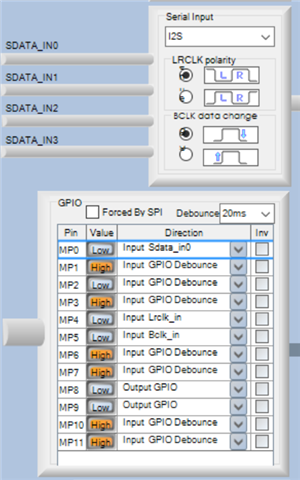
Data is connected to MP0, LRCK to MP4, and BCK to MP5.
I have then configured the GPIO in sigma studio.
When I connect and disconnect there is a sound but it is highly distorted and has a high noise floor but I don't get audio when I play music.
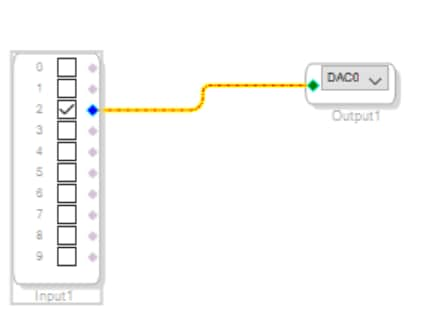
Also if I connect the DAC to one of the other outputs such as 0 then I don't get any sound effect as expected but I get a coil whine sort of sound when connecting/disconnecting Bluetooth, it seems as though the sound effect is introducing noise on other channels.
I tried using a sine generator within sigma studio and the output sounds fine.
Have I configured something wrong or is my hardware faulty?
Any help would be much appreciated as this is driving me crazy.
Thanks
Audio Signal Processors
CSR8675
Audio Products
hardware
adau1401
i2s input
sigmaStudio 4.7
sigma studio 4.7
i2s
SigmaDSP Audio Processors
Show More
Hello ACAV352,
The ADAU701 is one of our older parts but is still a useful part. Where its age shows is that it does not have a built in sample rate converter and no ability to run the core start pulse from an external source. This means that the clocks coming into the serial port MUST be synchronized or derived from the same master clock source. If it is not then it mutes the DACs. It will mute the DACs even if you are not using the digital input and are sending clocks to the port. If it sees clocks it tries to use them and when the counters discover the frequency is wrong it mutes.
We have newer parts that solve this but then the other parts do not have the same number of converters.
I looked at the listing link you provided and it seems like the Bluetooth module does not have a master clock output. This will be a problem. The bit clock will most likely be usable as a master clock but this requires you to switch the master clock, wait for it to lock and then unmute the audio. You would require some switching ICs and a system controller to do this. If the 1701 is setup for a master clock of 256x fs, then the minimum frequency for the PLL to lock to is 2.049MHz. The bit clock for a 44.1kHz signal will be 2.822MHz. Just inside the acceptable range.
If you are only using Bluetooth as a source then it will simplify this and you will not need any switching. The analog input will still work but the Bluetooth module will always need to be putting out clocks.
Dave T
Hello Dave,
Thank you for your help.
I ended up buying a different Bluetooth module that has a master clock output and now it works great.
A note to anyone that might buy that Bluetooth module: on the main connector, the ground is red and +5v is black for some stupid reason. Just go off what the PCB says not the wire colour.
Thanks,
Adrian
Hello Adrian,
Glad you got it working. That is strange about the wire colors! It must have been designed by an electrician not an electrical engineer. Because in electrical house wiring here in the USA the wire colors are white and black. White is neutral and black is hot. The electricians remember it as the black wire is death! Either that or the designers have been watching too many movies where they try to disarm bombs by cutting a wire and it usually is the black wire. LOL
Dave T
Please log in to reply.