Attenuation in High Frequency without using any Filter
Hi,
I'm trying to implement a crossover filter in th DSP ADAU1467Z. For checking the frequency response without taking into account any filter I measure with and without the DSP and I have found that in High Frequency there is some attenuation around 10 dB from 7k Hz until 24k Hz, and I don't know from the DSP where is it coming from. Because I thought that it might come from the aliasing filter but actually I'm using the input serial ports and my sampling frequency is 48k Hz. So, I don't know where I can look into in order to not have this problem in high frecuency. Nevertheless, for the measurments in low and medium frequency I do not have this problem.
Thank you for you future help.
Audio Signal Processors
hardware
adau1467
SigmaDSP Audio Processors
Hello Electroacoustic,
Could you please explain your issue a little more? How did you measure the signal? Scope shots or screenshots of the measurement would help us understand your issue better.
Here comes the important thing. I have no idea about what filter you are using and what settings, your signal flow, what's your frequency response, hardware registers etc. So kindly attach your project.
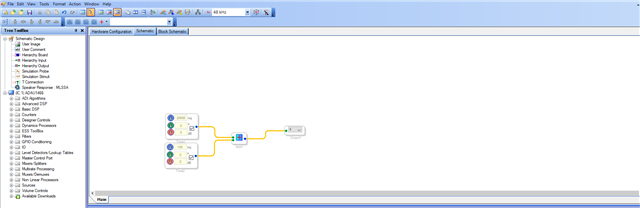
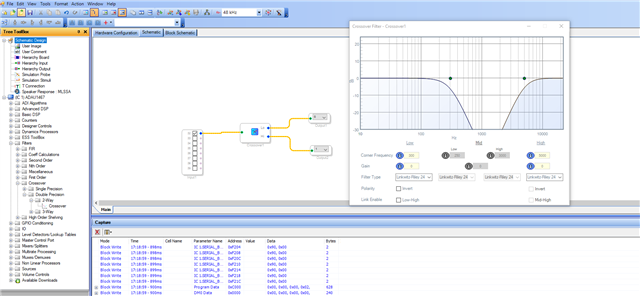
I have quickly tested a project with the crossover filter, and it seems to be good.
I have sent the signal using an AUX cable from one board (board 1) to another and performed the filter operation and measured the output in the second board.
Signal source:
output
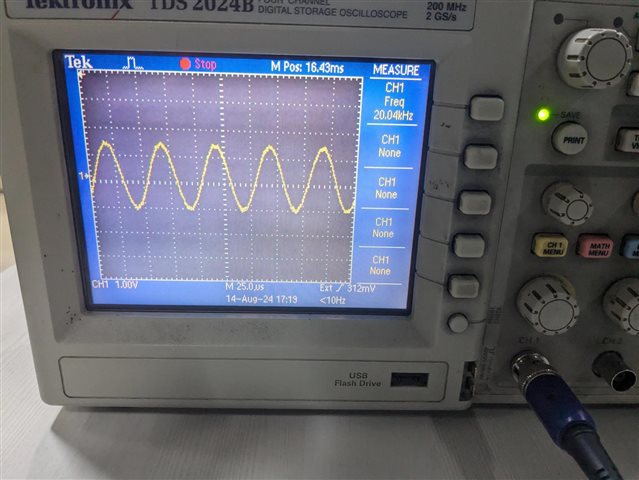
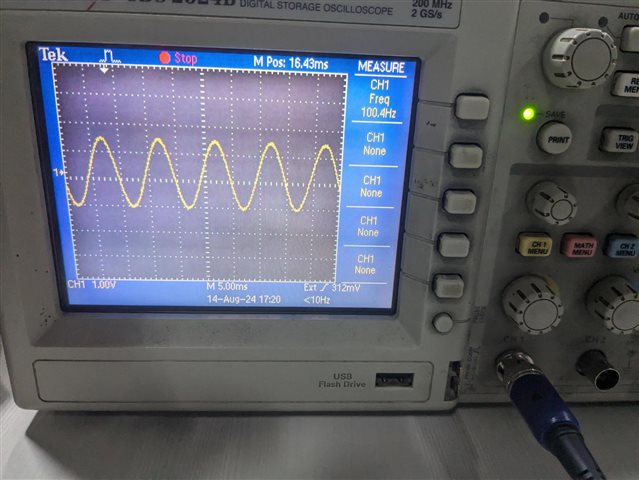
Please find the scope shots below for high and low bands.
I see no attenuation in the high frequency, it almost looks like a full-scale signal.
I apologize if I didn't understand your issue well, a little more explanation and measurements with a project would help in assisting you better.
Regards,
Harish
Hello Electroacoustic,
Harish and I frequently "tag-team" responses. Thanks Harish for performing the quick tests and confirming that the loss is not in the DSP although we cannot not know that for certain if you do not include your project. Please follow what Harish asked for and mentioned.
I want to ask and mention a few more things. I have seen where some ADCs or DACs have a pre-emphasis curve register setting. This will cause a roll-off. Check your converter register settings.
Then there is always a possibility of a roll-off happening due to good old analog impedance matching and coupling caps not being correctly designed. So a hardware schematic of your system may show the issue.
One more VERY important thing... (if you can watch my video about using SigmaStudio for troubleshooting on YouTube) You need to split this problem in half to narrow down where the problem is located.
Place some meters on the input audio path right where it comes into the DSP core. See if the loss of level is happening on the ADC/input side.
Then put in a switch on the input to select between your normal input source or an oscillator inside the DSP. If you watch my "starter Project" video you see I do that on all my projects. This way you can select an audio source that is known good and at a known level. Send that out of the DSP to the DACs and see if the loss of level is seen there. Split the problem in half, is it the input, the output or I suppose a third possibility which is something in the program running in the core? You can also put in a bypass switch to directly send the input to the output bypassing all of your processing.
SigmaStudio is a powerful troubleshooting tool. Use it!
Dave T
Hi Harish,
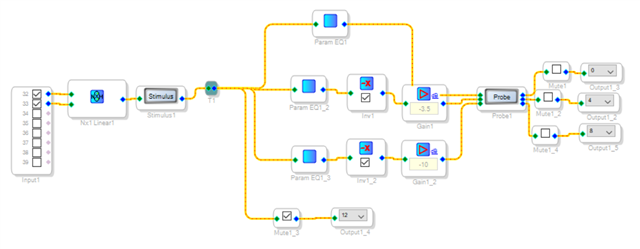
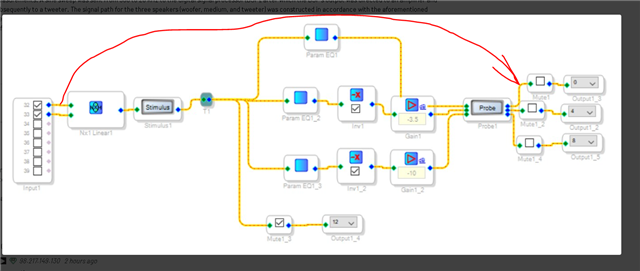
I offer my sincere apologies for the lack of clarity in my previous explanation of the measurement procedure. Accordingly, I am utilising the Klippel for the measurements. A sine sweep was sent from 500 to 20 kHz to the digital signal processor (DSP), after which the DSP's output was directed to an amplifier and subsequently to a tweeter. The signal path for the three speakers (woofer, medium, and tweeter) was constructed in accordance with the aforementioned methodology. I did check from input to output without any filter and using the DSP and I have the attenuation in high frequency in the frequency response, also before doing this step I bypass the filter corresponding to the output 8 and it was the same result. For other reasons I can't add the plot of the measurements.
In regard to the filters utilized for each case, a parametric equalizer is employed, wherein a combination of low pass, high pass, peaking, low shelf, and high shelf filters are utilized. The aforementioned configuration is intended to satisfy the requirements of the desired filter.
Thank you for your help
Hello Electroacoustic,
There is a lot of places this roll-off can occur.
Provided you do not see it when you use the stimulus and probe then it is NOT happening in the DSP core. It is either with the converters or something else in the system.
Going with what I said earlier, put in a switch and drive the output directly with the signal coming in. Just be certain to adjust your sweep frequency to not blow up the tweeter. Something like 5kHz to 20kHz.
Setup meters and use a steady state tone instead of sweep unless you can slow down the sweep so you can watch it on the meters.
Put meters into your project!!!
Put in a switch like this:
Dave T
Please log in to reply.