SuperBass Algorithm
1. From testing I understand the algorithm will filter out frequencies below the cutoff frequency, is it known the type of filter and the slope?
2. For the bass gain, I understand that it allows the signal below the cutoff frequency to be boosted. Since it's stated as being a linear multiplier, does a value of 1 essentially retain the original signal below the cut off, and below 1 is reduces it? Is this gain applied before or after the algorithm applies the high pass filter?
3. Let's say for example the crossover frequency is set at 80 Hz, if the algorithm encounters a 30 Hz signal, it will then create a 60 Hz harmonic, but since that is still below the cutoff, will it then re-encounter that 60 Hz signal and then create a 120 Hz, and attenuate the 60, or will it only create the 60 but then attenuate it with the high-pass filter?
4. Another interesting effect is the phase shift of the entire output of the algorithm seems to depend on the cutoff frequency, I had a measurement of the effect, but it was lost, if I have a chance I will re-measure the effect. I'm curious why this might be. I understand usually SuperBass might be used for a full range speaker system that lacks a subwoofer, however if we want to use a small sub 2.1 system and harness the effects of SuperBass, the phase shift of the sub output could cause problems with integrating with the mid-woofers.
I appreciate any knowledge that might be relayed.
Audio Signal Processors
software
SigmaDSP Audio Processors
adau1701
Hello CoastalSouth,
You are asking good questions. I have been planning on making a video testing this algorithm using a Audio Precision to generate an FFT and also showing the frequency response of the output. I do not have time to do this today. I will try to get this done by the end of the week. Hit this thread with a response to bump it up if you do not hear from me soon.
Dave T
Hello,
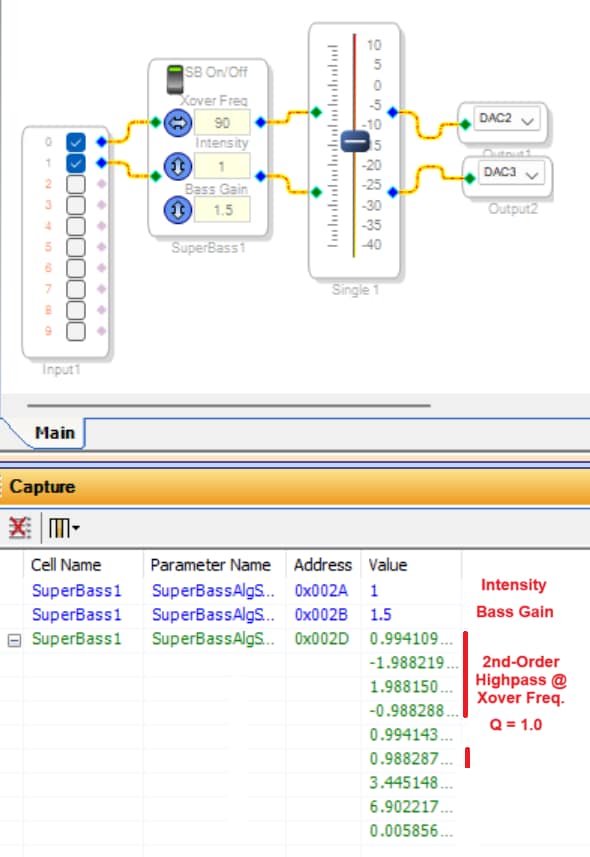
The SuperBass block's combination of algorithms makes it rather difficult to analyze. Looking at the Capture Window as we change its settings helps unravel some of its functions:
The first two parameters are simply the two gain figures. The next four & the 6th are the coefficients for a 2nd-Order Highpass Filter at the Xover Frequency. This suggests that the input bass is rolled off at 12 dB / octave. I haven't been able to make sense out of the remaining parameters.
In an old post of mine, I measured SuperBass's response -- it shows that the block rolls off the bass at 12 -- 18 dB / octave. It doesn't continue to re-multiply its own generated frequencies.
Generally, the phase shift of these filters is the most pronounced at frequencies where they're active. Keeping the SuperBass Xover Freq. apart from other crossover frequencies may minimize any problems. Since the benefit from SuperBass is psychoacoustic, listening tests with your speakers will help evaluate the results.
Best regards,
Bob
Hi Dave,
Looks like we were working on this one simultaneously. Looking forward to your video.
Bob
Hi Dave,
That sounds great! Looking forward to your findings.
Hi Bob,
Thanks for the explanation and the link, agree that listening tests will ultimately be the best verification of system integration with a sub. Hopefully I will have time to set that up this week and take some measurements as well. If I do I'll post them as a new reply on this post.
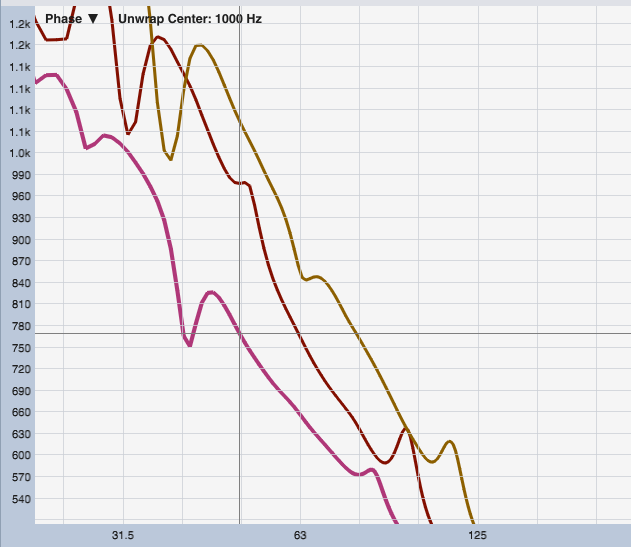
I was able to measure the phase shift. Here the lowest trace is SuperBass bypassed, the middle is SuperBass with cutoff of 50 Hz, intensity 1.5 and bass gain 1, and the highest is cutoff of 90 Hz, intensity 1.5 and bass gain 1.
Looking at the phase at 50 Hz, the net difference between bypassed and 50 Hz cutoff is about 150 degrees, where the net between 90 Hz cutoff and bypassed is about 65 degrees. The worst case would be if the phase shift of the subwoofer output is 90 degrees from the satellites, since a simple polarity inversion of the satellites would not make them in phase.
Please log in to reply.