Regarding the memory of the ADAU1772, ADAU1777, and ADAU1787
Hi ADI,
I would like to know the memory size of the ADAU1772, ADAU1777, and ADAU1787,
or how many Gen filters can be written into the IC from SigmaStudio.
Currently, I can write 80 Gen filters into the ADAU1787,
but based on the specs of the ADAU1772 and ADAU1777,
I'm not sure how to compare them.
Additionally, if the memory is insufficient, is there a way to expand it?
Please help, thanks,
Edit Notes
others
[edited by: ElvisJheng at 12:44 AM (GMT -5) on 24 Nov 2024]
hardware
adau1772
Integrated/Special Purpose A/D Converters
and ADAU1787
adau1777
Audio CODECs
Show More
Hello Elvis,
You are not quite thinking properly. It has nothing to do with memory size at all. These are not general purpose DSP processors. The ADAU1772 came out first and the DSP core is not a general purpose core at all. I describe it as a filter engine. All it does is calculates BiQuad filters VERY fast. One BiQuad per instruction cycle and the instructions are done one for every system clock cycle. This is the internal system clock that the PLL puts out. If you bypass the PLL then it is whatever is coming into the MCLK in pin and there is a divider as well. But I digress...
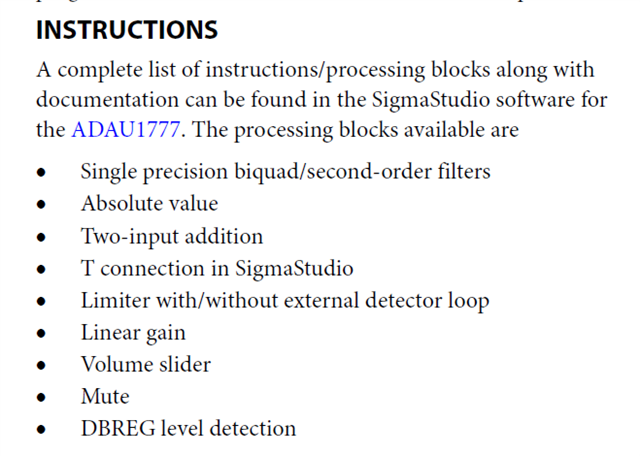
The ADAU1772 can calculate 32 BiQuads in one sample period. You must have a system clock fast enough to do this and that is not difficult to do. The "Instructions" that can be done by the core are all things that a BiQuad can do and we also have a couple of hardware accelerators to do the limiter and the DB conversion register. These are listed in the datasheet.
This screenshot is for the ADAU1777 but the ADAU1772 is the same,
The ADAU1777 was a follow-on part that is pretty much exactly the same with a few exceptions. It can operate at a higher sampling rate and it also had an additional coefficient bank for swapping coefficients and it is in a different package.
The ADAU1787 is the next part in the series where we made some improvements and increased capabilities.
This part has two DSP cores. The Fast core and the SigmaDSP core.
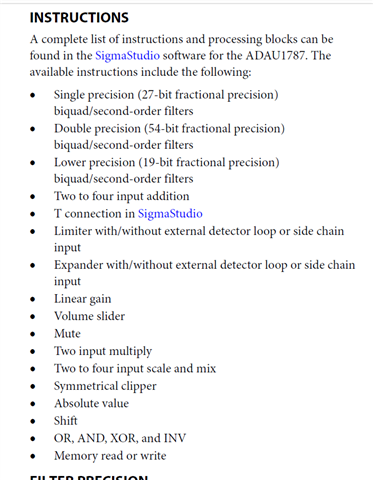
The fast core has twice the number of instructions per frame so twice the number of BiQuads it can calculate in one frame. 64 is the answer.
We also added a few more instructions but still mostly what you can do with a hard coded BiQuad filter and some hardware accelerators.
Now we get to the SigmaDSP. This is a 50MHz SigmaDSP core. This is still not quite a general purpose core but it can do a lot more. It is designed to process audio efficiently so it can do some general purpose DSP tasks but it may not be super efficient at it.
This core cannot run as fast as the fastDSP core so we have synchronous sample rate converters built into the part to allow signals to be exchanged between the cores. So you can add some more filters in this core which is probably how you are getting 80 filters when the limit in the fast core is 64.
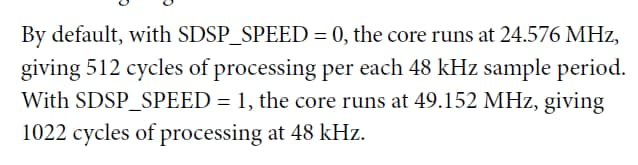
The program running in a SigmaDSP core executes completely every sample period. If you setup the clocking properly you will have up to 50MIPS available. This is explained in the SigmaDSP section of the datasheet:
This core takes more than one instruction for a filter, The compiler will help you manage the remaining instructions.
There is no way to expand the instructions beyond the system clock rates and you cannot overclock the part. You would be asking for problems.
Dave T
Dave, thank you for your explanation, but I still have some questions.
You said, 'It has nothing to do with memory size at all.'
So, if I use many BiQuads(maybe 80) in SigmaStudio, they can still be written into the DSP(ADAU1772 or 1777), but the processing speed will be relatively slower (latency increases). Is my understanding correct?
Hello ElvisJheng,
No, in the 1772 you can only get 32 bi-quads that is it. It is a processor that calculates 32 biquads in every core sampling period. It is hardware based, I guess you could call it firmware? Or like a state machine done using gates in hardware? It calculates 32 biquads. There are no more. I do not know of another way to put it. You have a basket of 32 biquads, use them as you like. But, if you use all 32 then there are no more in the basket.
With the 1787 there are two DSP cores. The fixed function fast core that only calculates Biquads , but in this part we doubled it to 64 biquads. and then you have the SigmaDSP core. In the Sigma core you can implement more biquads because those are general DSP instructions. The limitation there is the amount of instructions you have in a sample period. So you could run the audio through the fast core, process it with 64 filters then pass the audio over to the SigmaDSP core and implement some more filters. I would have to study this further to see how many more filters you could do. I also assume there would be other functions required like volume controls and possible audio switching etc. That would take up some instructions of course.
Dave T
Hi Dave,
I think I need some time to digest and understand this. If I have any further questions, I'll reach out to you.
Thank you very much for your explanation.
Please log in to reply.