adau1701 max in and output
Hello!
I would like to know more about the capabilities of the ADAU1701.
The DSP can handle 6 inputs and 6 outputs at the same time? I would just put a delay on some output channel. In addition, I would like to mix one input with another two inputs and send it out to only two channels.
I do know that I would need an extra 2 digital (I2S) stereo inputs and one digital output, because the chip can do 2 adc and 4 dac channels.
However, in principle it can handle 8 incoming and 8 outgoing channels, but I haven't found a project where it has been used in this way.
Can the processor handle the task described above? How well does 2 analog + 4 digital inputs or 4 analog + 2 digital outputs seem to be a workable solution?
Anyone done anything similar?
Thanks in advance!
Audio Signal Processors
maxcapacity
hardware
maxoutput
SigmaDSP Audio Processors
adau1701
maxinput
Show More
Hello IBarnabas,
The part has two ADCs so obviously those are two inputs.
The serial digital port is capable of up to eight channels in. These can be seen on the Input block.
The first two that are checked in this screenshot are the two ADCs. (always use a DC block to remove he DC offset)
The other eight I highlighted with the red line are the eight digital inputs.
Then for the output there are four DACs so those are four outputs.
Then there is the digital serial port that can output up to eight channels making the capability of 12 output channels total.
You select it with the pull-down on the output block.
You asked if anyone has used it like this in the past. The list would be rather long!
The important thing to add is that if you send the clocks to the 1701 from some other part, then the clocks MUST be derived from the same MCLK. If it is not then the part will mute all the outputs. If you are getting an input from a BlueTooth receiver then it will be a problem and will not work unless you can obtain an MCLK from the BlueTooth module.
Dave T

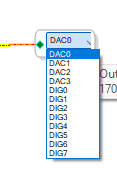
Thank you for your reply! Everything is clear.
I would like to ask for some more help:
The remaining 4 inputs would also come from analog signals (jack, rca, etc). What should I look out for? How should I connect the remaining 4 analog channels (I2S ADC or other solution), what are the best options and practices?
Thanks in advance for any help.
Hello IBarnabas,
As with many designs there are a lot of different ways to do this and the best decision will depend on your application details.
If you need to do a lot of actual DSP processing and could use more AUX-ADC or GPIO inputs then you could actually use two ADAU1701 parts but that would only get you two more inputs. I doubt three would make sense.
The easiest way is to add a quad ADC chip. We have a family of quad ADCs that differ in input levels and a few other little details but basically they are the same. This would be the ADAU1977, ADAU1978, ADAU1979. I think the 78 or 79 would most likely fit for you.
You can also add a codec like the AD1938 which will give you four ADCs but also eight DACs. You did not mention the need for more outputs but the price of the part is good.
You can look at the ADAU1372 which is a quad ADC and stereo DAC/headphone output and is low latency. The advantage of this part is that it actually has sample rate converters on the digital input and output ports. So you could us that to bring in Bluetooth receiver. Anyhow, topic for another discussion.
So these are a few choices.
Dave T
Please log in to reply.