the coefficients of biquad do not match
Hello! I'm writing code for a microcontroller, and I've reached the stage of equalization, but I'm facing difficulties.
In the sigma studio window, the coefficients differ from the generator built into the program. Why is this happening, and how can I calculate it correctly?
Biquad Coefficient
software
adau 1701
Sigma Studio v4.7
Hello Fell1987,
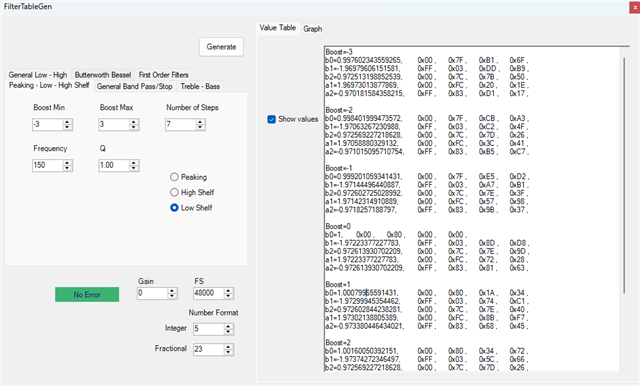
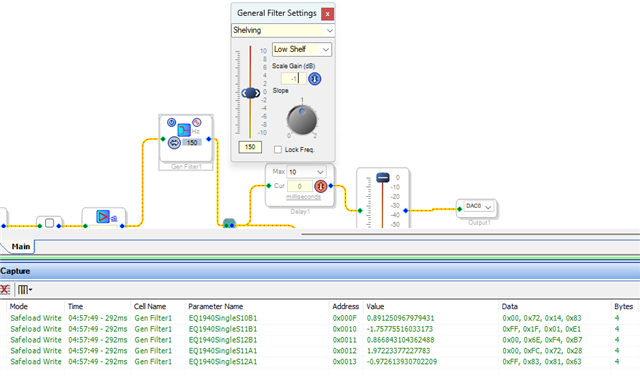
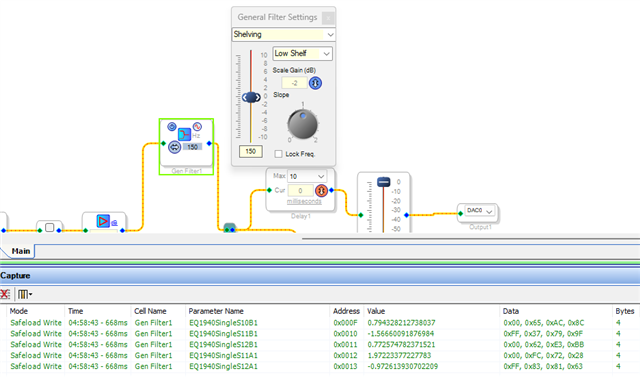
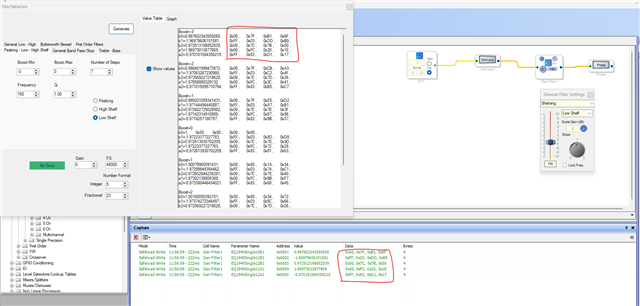
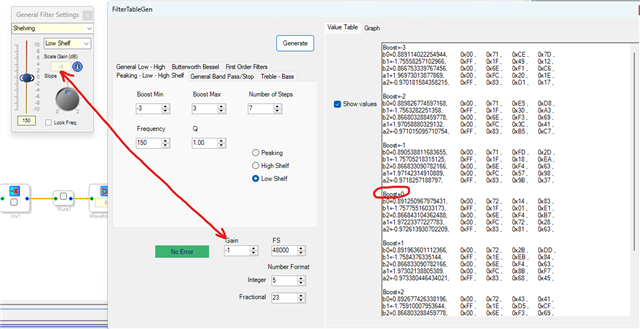
I have tried with same parameters in filter block and filter table generator; I ended up getting the same results.
Please have a look below and try with same parameters.
I tried with the same parameters as you did and ended up getting the expected results.
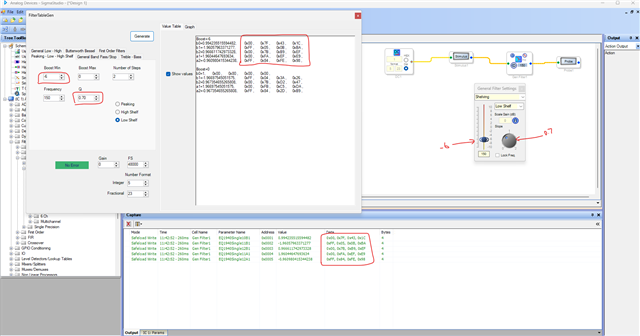
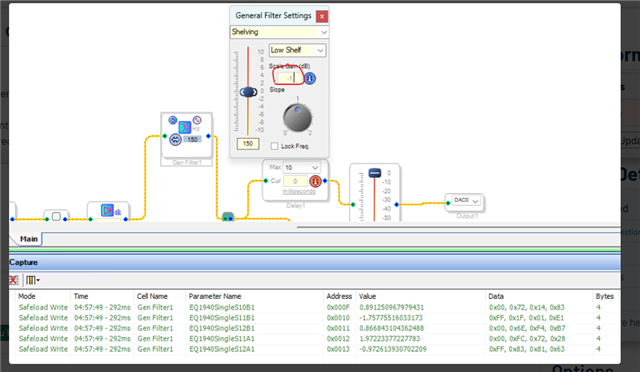
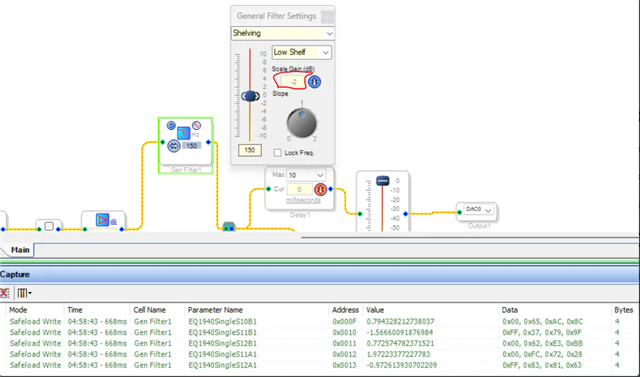
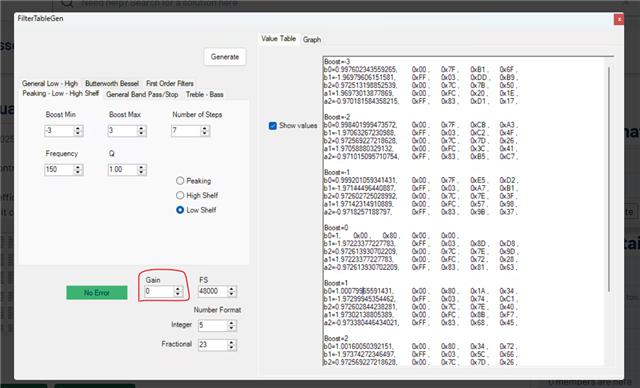
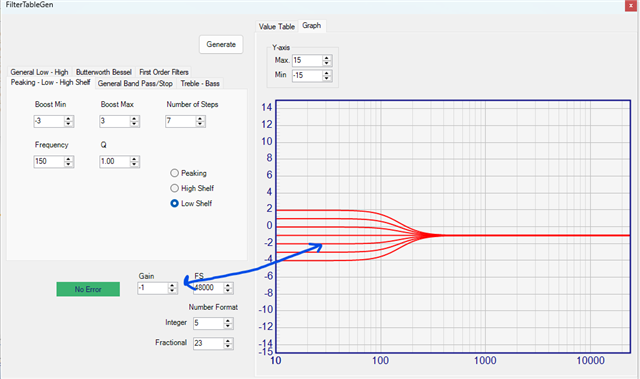
I have noticed in your screenshot that your filter block's gain (named as 'scale gain (dB)') is set for -1dB and -2dB whereas in the filter table generator window, the gain is set for 0dB. So, that mismatch in the parameter causes these differences.
Below are your screenshots, where I marked the mismatches.
Regards,
Harish
Thanks for the quick response!
Apparently, I'm confusing boost and gain.
In order to control the EQ curve, I need to pass the gain values that I'm adjusting to the function. Boost always = 0
Correct assumption?
Here's my function
void SigmaDSP::EQsecondOrder(uint16_t startMemoryAddress, secondOrderEQ_t &equalizer)
{
float A, w0, alpha, gainLinear;
float b0, b1, b2, a0, a1, a2;
float coefficients[5];
A=pow(10,(equalizer.boost/40)); // equalizer.boost is '0' always
w0=2*PI*equalizer.freq/FS; // 2*PI*freq/FS
gainLinear = pow(10,(equalizer.gain/20)); // exactly what I adjust with the gain knob
//********next, just the calculations********//
switch(equalizer.filterType)
// Parametric
case parameters::filterType::parametric:
// Peaking
case parameters::filterType::peaking:
default:
alpha = sin(w0)/(2*equalizer.Q);
a0 = 1 + alpha/A;
a1 = -2 * cos(w0);
a2 = 1 - alpha/A;
b0 = (1 + alpha*A) * gainLinear;
b1 = -(2 * cos(w0)) * gainLinear;
b2 = (1 - alpha*A) * gainLinear;
break;
// Low shelf
case parameters::filterType::lowShelf:
alpha=sin(w0)/2*sqrt((A+1/A)*(1/equalizer.S-1)+2);
a0 = (A+1)+(A-1)*cos(w0)+2*sqrt(A)*alpha;
a1 = -2*((A-1)+(A+1)*cos(w0));
a2 = (A+1)+(A-1)*cos(w0)-2*sqrt(A)*alpha;
b0 = A*((A+1)-(A-1)*cos(w0)+2*sqrt(A)*alpha)*gainLinear;
b1 = 2*A*((A-1)-(A+1)*cos(w0)) * gainLinear;
b2 = A*((A+1)-(A-1)*cos(w0)-2*sqrt(A)*alpha)*gainLinear;
break;
// High shelf
case parameters::filterType::highShelf:
alpha = sin(w0)/2 * sqrt((A + 1/A)*(1/equalizer.S - 1) + 2);
a0 = (A+1) - (A-1)*cos(w0) + 2*sqrt(A)*alpha;
a1 = 2*((A-1) - (A+1)*cos(w0));
a2 = (A+1) - (A-1)*cos(w0) - 2*sqrt(A)*alpha;
b0 = A*((A+1) + (A-1)*cos(w0) + 2*sqrt(A)*alpha) * gainLinear;
b1 = -2*A*((A-1) + (A+1)*cos(w0)) * gainLinear;
b2 = A*((A+1) + (A-1)*cos(w0) - 2*sqrt(A)*alpha) * gainLinear;
break;
// Lowpass
case parameters::filterType::lowpass:
alpha = sin(w0)/(2*equalizer.Q);
a0 = 1 + alpha;
a1 = -2*cos(w0);
a2 = 1 - alpha;
b0 = (1 - cos(w0)) * (gainLinear/2);
b1 = (1 - cos(w0)) * gainLinear;
b2 = (1 - cos(w0)) * (gainLinear/2);
break;
// Highpass
case parameters::filterType::highpass:
alpha = sin(w0)/(2*equalizer.Q);
a0 = 1 + alpha;
a1 = -2*cos(w0);
a2 = 1 - alpha;
b0 = (1 + cos(w0)) * (gainLinear/2);
b1 = -(1 + cos(w0)) * gainLinear;
b2 = (1 + cos(w0)) * (gainLinear/2);
break;
// Bandpass
case parameters::filterType::bandpass:
alpha = sin(w0) * sinh(log(2)/(2 * equalizer.bandwidth * w0/sin(w0)));
a0 = 1 + alpha;
a1 = -2*cos(w0);
a2 = 1 - alpha;
b0 = alpha * gainLinear;
b1 = 0;
b2 = -alpha * gainLinear;
break;
// Bandstop
case parameters::filterType::bandstop:
alpha = sin(w0) * sinh(log(2)/(2 * equalizer.bandwidth * w0/sin(w0)));
a0 = 1 + alpha;
a1 = -2*cos(w0);
a2 = 1 - alpha;
b0 = 1 * gainLinear;
b1 = -2*cos(w0) * gainLinear;
b2 = 1 * gainLinear;
break;
// Butterworth lowpass
case parameters::filterType::butterworthLowpass:
alpha = sin(w0) / 2.0 * 1/sqrt(2);
a0 = 1 + alpha;
a1 = -2*cos(w0);
a2 = 1 - alpha;
b0 = (1 - cos(w0)) * gainLinear / 2;
b1 = (1 - cos(w0)) * gainLinear;
b2 = (1 - cos(w0)) * gainLinear / 2;
break;
// Butterworth highpass
case parameters::filterType::butterworthHighpass:
alpha = sin(w0) / 2.0 * 1/sqrt(2);
a0 = 1 + alpha;
a1 = -2*cos(w0);
a2 = 1 - alpha;
b0 = (1 + cos(w0)) * gainLinear / 2;
b1 = -(1 + cos(w0)) * gainLinear;
b2 = (1 + cos(w0)) * gainLinear / 2;
break;
// Bessel lowpass
case parameters::filterType::besselLowpass:
alpha = sin(w0) / 2.0 * 1/sqrt(3) ;
a0 = 1 + alpha;
a1 = -2*cos(w0);
a2 = 1 - alpha;
b0 = (1 - cos(w0)) * gainLinear / 2;
b1 = (1 - cos(w0)) * gainLinear;
b2 = (1 - cos(w0)) * gainLinear / 2;
break;
// Bessel highpass
case parameters::filterType::besselHighpass:
alpha = sin(w0) / 2.0 * 1/sqrt(3) ;
a0 = 1 + alpha;
a1 = -2*cos(w0);
a2 = 1 - alpha;
b0 = (1 + cos(w0)) * gainLinear / 2;
b1 = -(1 + cos(w0)) * gainLinear;
b2 = (1 + cos(w0)) * gainLinear / 2;
break;
}
// For Sigma DSP implementation we need to normalize all the coefficients respect to a0
// and inverting by sign a1 and a2
if(a0 != 0.00 && equalizer.state == parameters::state::on)
{
if(equalizer.phase == parameters::phase::nonInverted) // 0 deg
{
coefficients[0] = b0/a0;
coefficients[1] = b1/a0;
coefficients[2] = b2/a0;
coefficients[3] = -1*a1/a0;
coefficients[4] = -1*a2/a0;
}
else //if(equalizer.phase == parameters::phase::inverted) // 180 deg
{
coefficients[0] = -1*b0/a0;
coefficients[1] = -1*b1/a0;
coefficients[2] = -1*b2/a0;
coefficients[3] = -1*a1/a0; // This coefficient does not change sign!
coefficients[4] = -1*a2/a0; // This coefficient does not change sign!
}
}
else //if(equalizer.state == parameters::state::off)
{
coefficients[0] = 1.00;
coefficients[1] = 0;
coefficients[2] = 0;
coefficients[3] = 0;
coefficients[4] = 0;
}
safeload_write(startMemoryAddress, coefficients[0], coefficients[1], coefficients[2], coefficients[3], coefficients[4]);
}
Hello Fell1987,
The Gain parameter is an overall gain factor that will be applied to the entire signal whereas the boost parameter sets up the EQ curve to boost a particular frequency.
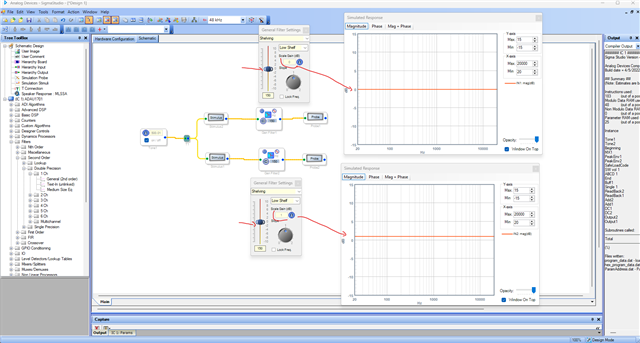
Below I set the boost (slider) to 0dB (input will be unaffected (magnitude level) by the filter) and set the gain to '0dB' in one example and '1dB' in another example.
You can see above that the entire spectrum is boosted by 1dB.
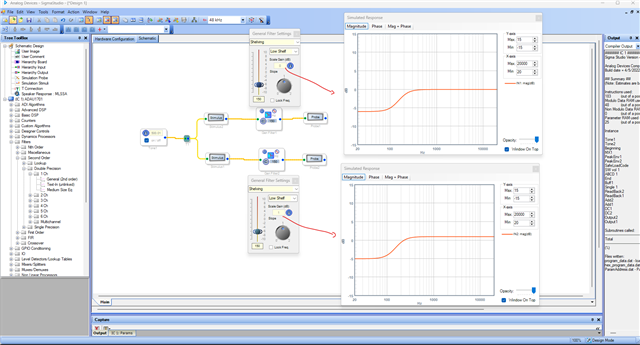
When I set up the low shelf filter to -6dB at 150Hz, you can see the difference in the plot between gain = 0 and gain = 1.
I have explained this in detail in the below thread
difference between boost and gain of Medium EQ - Q&A - SigmaDSP Processors & SigmaStudio Dev. Tool - EngineerZone
Regards,
Harish
Please log in to reply.