Second-Order Medium EQ Filter Output Observations
Hi Team,
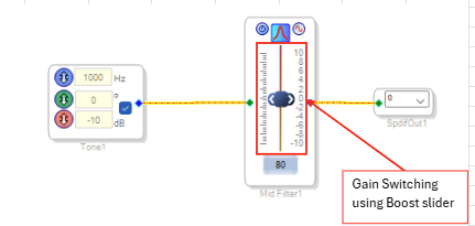
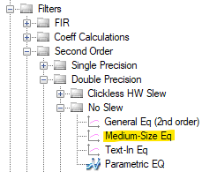
We are working on the EVAL-ADAU1452REVBZ board using a second-order filter implemented with a Medium-Size EQ filter in double precision mode (without slew). When we vary the gain, we observed a distorted output. We have attached the code and related waveform below.
code snip:
Module Parameters:
Fc: 80 Hz Q: 0.60
Filter Type: Peaking EQ
Module path:
Test Steps:
Switch the Gain level sequentially: 0 dB → –10 dB → +10 dB → 0 dB.
Observed Behavior:
Please provide your feedback regarding this behavior.
software
4.5

Hello dns,
Have you tried with the slew version of the filter?
If not, can you please try with the slew version and observe the result?
Regards,
Harish
Dear Team,
We have not tried the slew version of this module, as it is not the intended module. We would like to confirm whether the disturbance observed in the output while changing the gain is expected behavior of this module, and if so, what the cause of it.
Regards,
Dns
Hello Dns,
I will add to what Harish said.
This is classic zipper noise when you change the gain. What makes this a little different is that it is not just a gain factor change but filter coefficients that need to be changed. So there will be some drastic changes when the filter coefficients are changed. This is exactly why we have the slew versions! So thanks for showing why the slew versions are needed! Depending on your application you will probably need to use the slewed version.
If your application can mute the audio, change the filter and then unmute then use the version you are using. If your application requires real time changes while listening to the audio then you must use the slewed version. What it does is slowly changes the coefficients every sample period until it matches the desired new setting. Making these changes with no audible artifacts.
Dave T
Please log in to reply.