Extremely low acoustic sensitivity and loud white noise on ADAU1787 PDM input - Is it caused by CLK ringing?
Hi ADI Support Team,
I am currently evaluating the ADAU1787 using its evaluation board, interfacing it with an external Infineon IM72D128V01 PDM microphone (Clock at 3.072 MHz). I am routing the PDM input directly to the J23 DAC output for monitoring.
The Issue: The recorded audio contains an overwhelmingly loud white noise. More strangely, the acoustic sensitivity seems extremely low.
Normal office conversations (~60 dB SPL) cannot be picked up at all.
I can only hear the acoustic signal if I place an iPhone playing a 600Hz tone at 1cm distance from the mic, or if I speak a loud "Ah~" directly into the mic port at 1cm. (Even then, the recorded voice is relatively quiet compared to the noise floor).
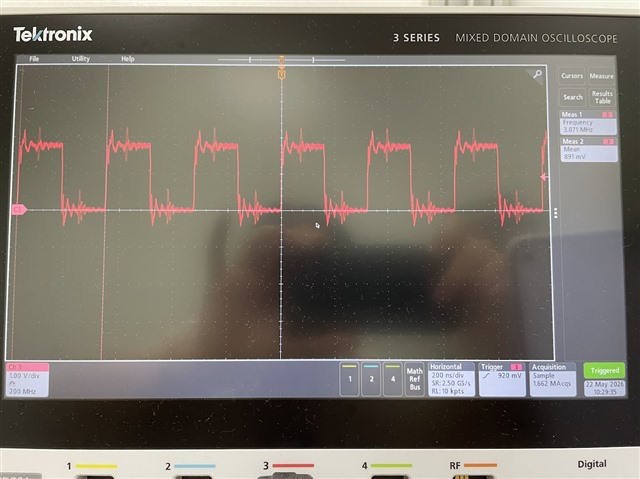
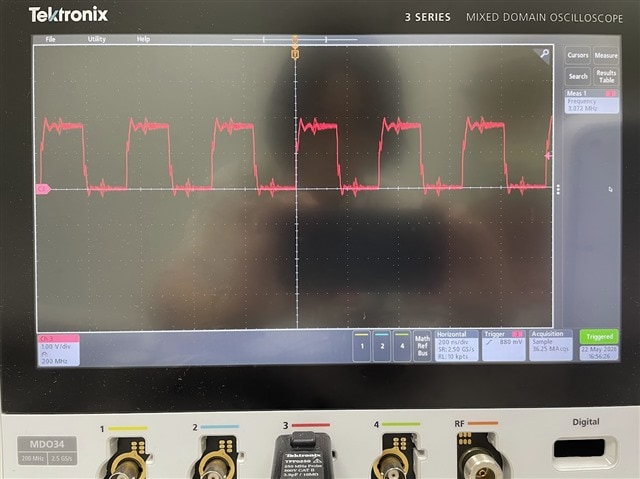
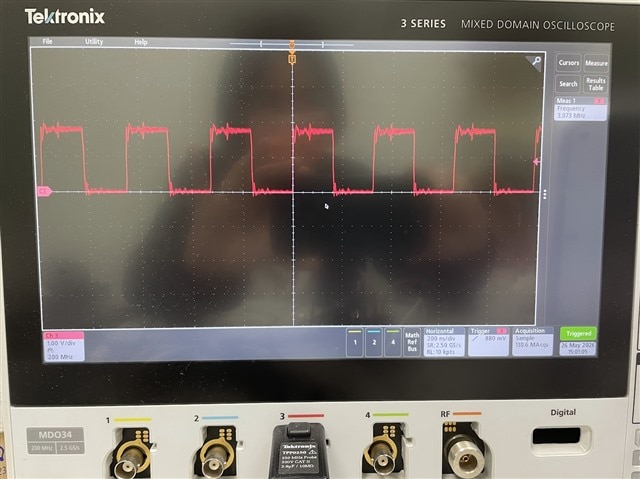
Troubleshooting & Signal Integrity (See attached images): I suspected that signal integrity issues on the PDM Clock line might be causing bit errors (which manifest as white noise and destroy the dynamic range). I captured the CLK signal using an oscilloscope under 4 different wiring conditions:
30cm DuPont wire (Severe ringing)
10cm wire
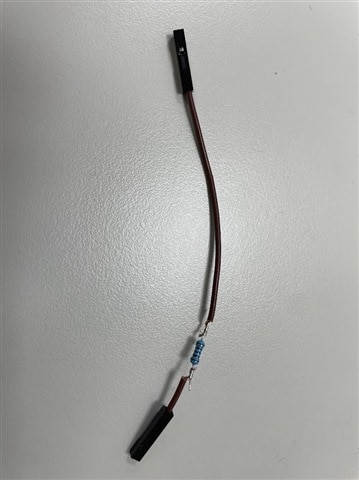
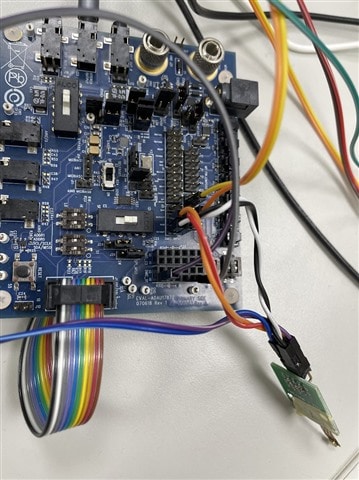
10cm wire + 100-ohm source termination resistor at the DSP CLK pin this is what the wire looks like:
10cm Twisted Pair (CLK twisted with GND) and the final setup:
I have attached the .dspproj file and the 4 oscilloscope comparison images for your reference.3175.ADAU1787_REW_Bypass_dmic.dspproj
My Questions:
Can CLK ringing and non-monotonic edges cause the ADAU1787 PDM decimation filter to output severe white noise that essentially masks normal acoustic signals, requiring extremely high SPL to punch through?
Could you please review my attached .dspproj? Are my DmicCtrl settings (e.g., EDGE, FCOMP, DEC_ORDER) and PDM PGA gain configured correctly for standard voice passthrough?
About the 30cm wire length and Coaxial Cables: Are there any recommended hardware practices for routing PDM signals over a 30cm distance? I came across the mention of using coaxial cables for PDM in this thread ( Long digital MEMS microphone PDM line recommendations ) — could you elaborate on what this is and whether it would be applicable/helpful in my setup?
The 100-ohm Source Termination Artifact: Currently, I tried soldering a 100-ohm resistor directly to the DuPont wire connected to the DSP's DMIC CLK pin (see the attached photo of my soldering setup). However, as shown in the oscilloscope capture, this specific setup introduces a noticeable tick during the rising edge of the wave. I suspect this non-monotonic edge is causing false triggers or double-clocking. Is this a sign of incorrect resistor value or purely a limitation of the DuPont wire's parasitics?
Alternative Microphone Recommendations: Lastly, are there other types of microphones better suited for this specific application? I understand that digital MEMS microphones are the industry standard for in-ear ANC headphones (which have very short trace lengths). However, I am working on Active Noise Cancellation inside a larger enclosure/box where the microphone needs to be placed about 30cm away from the DSP. Would an analog MEMS microphone or an electret condenser microphone (ECM) be a more reliable choice to avoid these high-speed digital transmission issues over this distance?
TRANSLATE with x
English
Arabic
Hebrew
Polish
Bulgarian
Hindi
Portuguese
Catalan
Hmong Daw
Romanian
Chinese Simplified
Hungarian
Russian
Chinese Traditional
Indonesian
Slovak
Czech
Italian
Slovenian
Danish
Japanese
Spanish
Dutch
Klingon
Swedish
English
Korean
Thai
Estonian
Latvian
Turkish
Finnish
Lithuanian
Ukrainian
French
Malay
Urdu
German
Maltese
Vietnamese
Greek
Norwegian
Welsh
Haitian Creole
Persian
TRANSLATE with
COPY THE URL BELOW
Back
EMBED THE SNIPPET BELOW IN YOUR SITE
Enable collaborative features and customize widget: Bing Webmaster Portal
Back
hardware
ADAU1787
mems mic
Active Noise Cancelation
processors and dsp
SigmaDSP Audio Processors
Processors and Microcontrollers
Show More

cindyhsieh,
1) If there is severe enough ringing or reflections such that DMIC_CLK voltage crosses the hsyteresis threshold twice in short amounts of time, then it is possible to double-clock the same data and throw the data out of alignment with the clock moving forward, permanently corrupting the data. Based on the scope captures seen in the post, it does not appear this is happening.
2) If using DMIC sample rate of 384kHz, performance will improve if the clock is set to 6.144MHz for DMIC_CLK. In the "Schematic" tab of SigmaStudio project, for the DMIC input block, do you right-click and ensure the "Set Sampling Rate" is also set to 384kHz? If not, volume coefficients will be calculated incorrectly for the FDSP.
Along those lines, your FDSP sample rate currently doesn't match the DMIC rate. If DMIC is directly routed to FDSP at 384kHz, we need FDSP to be 384kHz as well. Otherwise we need decimator or interpolator to get sample rates matching up again. Currently FDSP_RATE_SOURE = ADC0/1 which is only 48kHz. So I suspect the filter coefficients are not being set correctly by SigmaStudio currently. Similarly, this FDSP ouput is routed direct to HPOUT, which is also sampling at 48kHz. You need to either set DMIC_FS to 48kHz, or set everything else to 384kHz.
3) If routing over a long distance, series termination resistors on both ends of the DMIC_CLK and DMIC_DATA can help to eliminate reflections. Likewise the drive strength and slew rate of the DMIC signals is configurable in the 1787.
4) ideally termination resistors are on both sides of the trace, and 100ohm may be large. We often use 22ohm or 33ohm for these types of signals.
5) I think the acoustic overload, SNR and DR are all good. If the microphone is almost a foot away from the speaker, the sensitivity should be tweaked in my opinion. A sensitivity of -36dBFS is typical for voice mics on earbuds/OTE headsets where the speaker is very close to the microphone. For an application where the speaker is farther away, I think we'd want a higher sensitivity. Analog mics would remove the signal integrity issues but your plots do not show severe degradation from what I see.
6) One other question: How are you gaining up the mics? For the sensitivity chosen I would expect greater than approx. 5dB for total digital gain. A mic with such low sensitivity and only 4.875dB DMIC_VOL increase would result in a pretty low-level signal. One other note, if using analog MEMS mics you can leverage the PGA's, as their gain increases, the input referred noise of the mic goes further and further down. This helps preserve the SNR of the microphone across the full signal range.
Hi galvinpjg,
Thank you! You hit the nail on the head. The root cause was indeed the Sample Rate Mismatch, not the signal integrity.
Once I changed FDSP_RATE_SOURCE to follow DMIC01 (384kHz) and updated DAC_FS to 384kHz in the registers, the severe white noise disappeared completely. The acoustic sensitivity is fully restored, and I can now clearly record normal environmental sounds. I have a quick clarification regarding the SigmaStudio UI: I noticed I have to set the hardware registers to 384kHz AND manually right-click the DMIC block in the Schematic to "Set Sampling Rate" to 384kHz. Just to confirm: the Config sets the physical hardware clocks, while the Schematic setting ensures the compiler calculates the correct filter coefficients for the FDSP, correct? Can the global SigmaStudio sample rate dropdown remain at 48kHz for the SDSP while the FDSP runs at 384kHz?
(Side note: I also get 1kHz ringing from recording and it was actually USB micro-frame noise from a cheap USB sound card. Switching to a better audio interface completely eliminated it.)
Thanks again for your spot-on support!
TRANSLATE with x
English
Arabic
Hebrew
Polish
Bulgarian
Hindi
Portuguese
Catalan
Hmong Daw
Romanian
Chinese Simplified
Hungarian
Russian
Chinese Traditional
Indonesian
Slovak
Czech
Italian
Slovenian
Danish
Japanese
Spanish
Dutch
Klingon
Swedish
English
Korean
Thai
Estonian
Latvian
Turkish
Finnish
Lithuanian
Ukrainian
French
Malay
Urdu
German
Maltese
Vietnamese
Greek
Norwegian
Welsh
Haitian Creole
Persian
TRANSLATE with
COPY THE URL BELOW
Back
EMBED THE SNIPPET BELOW IN YOUR SITE
Enable collaborative features and customize widget: Bing Webmaster Portal
Back
此頁面是英文語
翻譯成繁體中文
丁卡語
世界語
丹麥文
亞塞拜然文
亞美尼亞文
亞齊語
伊博語
伊洛卡諾語
伊班語
俄語
保加利亞文
信德語
俾路支語
倫巴第語
僧伽羅語
克丘亞語
克克奇語
克羅地亞文
克里奧爾語
克里米亞韃靼語
克里米亞韃靼語(拉丁文)
冰島語
別姆巴語
利古里亞語
加利西亞文
加泰羅尼亞文
加語
努爾語
匈牙利語
北索托語
北薩米語
南非荷蘭語
博傑普爾語
卡努里語
卡納達語
卡西語
印地語
印尼語
古吉拉特文
吉爾吉斯語
哈卡法拉姆語
哈薩克語
喬治亞文
因紐特語
因紐特語(拉丁文)
圖瓦語
圖盧語
土庫曼語
土耳其語
埃維語
基加語
基孔戈語
基隆迪語
塔吉克語
塔馬齊格特語
塔馬齊格特語(拉丁文)
塞爾維亞語
塞索托語
塞舌爾克里奧爾語
夏威夷文
多格拉語
大溪地語
奇切瓦文
奇盧巴語
契維語
奧克語
奧塞梯語
奧羅莫語
奧里亞語
威尼斯語
威爾士語
孔卡尼語(拉丁文)
孟加拉文
宗加語
宗卡語
宿務文
富拉語
寮語
尤卡坦瑪雅語
尼泊爾語
尼瓦爾語
峇里語
巴什基爾語
巴塔克托巴語
巴塔克西馬隆群語
巴塔克語
巴斯克文
巴烏萊語
巴達維語
巽他語
布列塔尼語
布里亞特語
希伯來文
希利蓋農語
希臘文
帕皮阿門托語
庫爾德語(庫爾曼吉語)
庫爾德語(索拉尼)
弗留利語
弗里斯蘭文
德文
德頓語
恩德貝勒語
恩科巴姆巴拉語
恩道語(辛巴威)
意第緒語
愛沙尼亞文
愛爾蘭語
托克皮辛語
拉丁語
拉特加萊語
拉脫維亞語
挪威語
捷克文
提夫語
提格雷尼亞語
撣語
文達語
斐濟語
斯洛伐克語
斯洛維尼亞語
斯瓦希里語
斯瓦特語
旁遮普語
旁遮普語(阿拉伯文)
日語
普什圖語
景頗語
曼尼普爾語/米泰語(曼尼普爾文)
曼島語
望加錫語
東貝語
林加拉語
林堡語
查莫洛語
格陵蘭語
桑塔利語
桑塔利語(拉丁文)
桑戈語
梵語
楚克語
楚瓦什語
模里西斯克里奧爾語
比科爾語
毛利語
沃洛夫語
法文
法羅語
法語(加拿大)
波斯尼亞文
波斯語
波蘭語
泰盧固語
泰米爾語
泰語
洪茲里克語
海地克里奧爾文
湯加語
烏克蘭語
烏德穆爾特語
烏爾都語
烏茲別克語
爪哇語
牙買加克里奧爾語
班巴拉語
瑞典語
瑪姆語
瓜拉尼語
瓦瑞語
白俄羅斯文
盧干達語
盧旺達語
盧森堡語
盧歐語
祖魯語
科克博羅克語
科米語
科薩語
科西嘉文
立陶宛語
簡體中文
米佐語
米南佳保語
粵語
約魯巴語
納瓦特爾語
索馬里語
紹納語
維吾爾語
緬甸語(緬甸文)
繁體中文
羅姆語
羅馬尼亞語
義大利語
艾馬拉語
芬蘭文
苗語
英文
英文(美國)
茨瓦納語
荷蘭文
菲律賓文
葡萄牙語
葡萄牙語(葡萄牙)
蒙古語
薩摩亞語
薩波特克語
藏語
蘇格蘭蓋爾語
蘇蘇語
西班牙語
西西里語
西里西亞語
豐語
豪薩文
越南語
車臣語
迪尤拉語
迪維希語
通布卡語
達里語
邁蒂利語
邦板牙語
邦阿西楠語
阿僑利語
阿姆哈拉語
阿布哈茲語
阿拉伯語
阿法爾語
阿爾巴尼亞語
阿瓦德語
阿瓦爾語
阿盧爾語
阿薩姆語
雅庫特語
韃靼語
韓語
馬來語
馬來語(阿拉伯文)
馬其頓語
馬拉地語
馬拉雅拉姆語
馬爾他語
馬爾瓦利語
馬紹爾語
馬達加斯加語
馬都拉語
馬里語
高棉語
始終將英文翻譯成繁體中文
永不翻譯英文
永不翻譯ez.analog.com
Please log in to reply.