Reverb
Hi,
How to achive Cathedral Reverb Effect using ADAU1466
software
sigmaStudio 4.7
processors and dsp
Processors and Microcontrollers
adau1466
Hello Bedar,
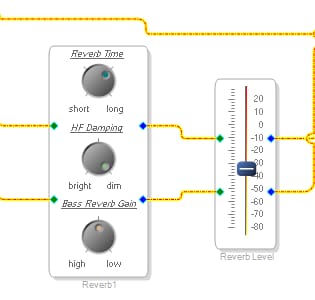
I assume you have tried the Reverb block from the library correct?
This one:
Have you tried to use two of them cascaded?
Another technique is to apply a delay to the audio going into it. This helps to increase the reverb time and in a cathedral you do not get reflections until later.
There may be some other tricks I could suggest. I just need to know where you left off and what you have done?
Feel free to attach your project.
Thanks
Dave T
Hello Dave,
I tried the Reverb block
tried two of them cascaded
tried to add pre-delay 20ms before the reverb block
tried to add feedback with volume control
and tried all of them once but still got no Cathedral Reverb
can you help me Mr Dave
Thanks
Beder
Hello Beder and Dave,
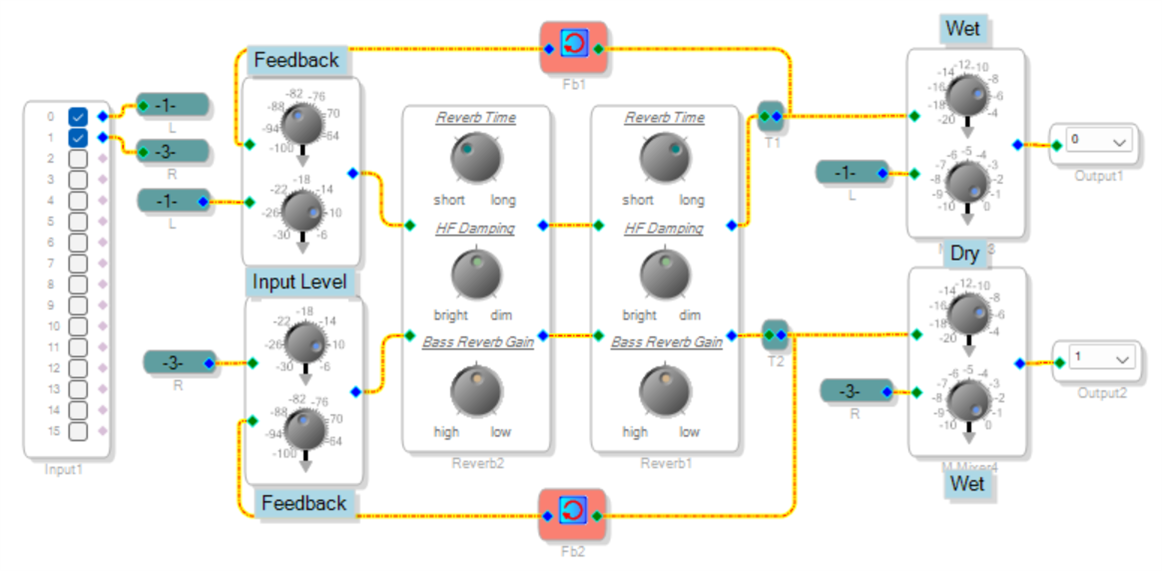
It appears that you have tried something much like the one I did below. It sounds really fine to me, yet still doesn't meet your requirement:
I attached the project below anyhow, since it can serve as a point of reference for both you and Dave.
By "cathedral reverb," I assume you mean the reverberation we might experience inside a cathedral. I imagine that such a venue is rather large, with correspondingly long reflection times according to the speed of sound. Also, many surfaces are quite reflective, affording little damping so the reverberant sound decays rather slowly. A setup like the one above can be adjusted to provide a rather long reverb time, yet still not simulate the desired cathedral reverb. So, may I ask: What distinctive characteristics do we expect to hear from a cathedral reverb? In what specific ways does it sound differently from a generic reverb like the one above? If we can't describe it well, we can't build it.
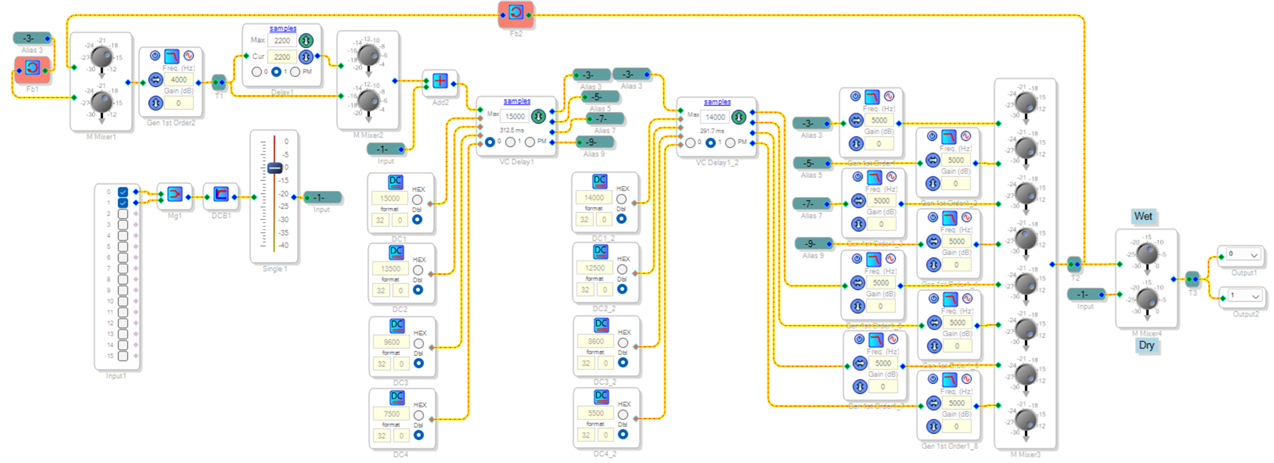
The AD stock reverb blocks used above are quite efficient, using relatively small amounts of delay memory. Yet, the cathedral's size suggests that much longer delays are required. Thus, I attempted to build a reverb from scratch using most of the -1466's delay memory. If we use only one huge delay, it would produce a single echo as if yelling into the Grand Canyon. Instead we tap the delay line at several points to simulate the multiple reflections inside the cathedral.
To my ears, the cascaded stock reverbs sound better than this project. Yet it may possess some desired characteristic of a cathedral reverb -- this would confirm that more delay helps the cause.
This project simulates multiple reflections by taps separated by delays of several thousand samples apiece. What would happen if we took this to the extreme -- have many, many thousands of one-sample delays, all with taps contributing specified amounts to the output? We would certainly have near-infinite control over the sound. In fact, the sound not of some random cathedral, but the exact one desired. You may already know where this is going -- it's called a convolution reverb.
The convolution reverb performs a mathematical transformation, convolving the incoming audio with the impulse response of the target reverberant space. To make one, first we need a huge array of one-sample delays with taps -- fortunately, the FIR Filter in the toolbox is exactly this. Unfortunately, the filter has to be long enough to cover the entire time of the cathedral's reverberation -- which may be several seconds. This won't fit into a -1466.
Here's the project files for my endeavor:
LotsaReverb_1466-sel-ser-fbk.dspproj
LotsaReverb_1466-multitap.dspproj
Best regards,
Bob
Hello Dave
Thank you, I will try it and let you know the results.
Hi Dave,
I tried the multitap and it did not work at all
I tried the the other one you sent me, It worked but still got some metallic noise in the back ground, How to reduce it
another question
Is there any other way to create Reverb effect that can control pre-delay, decay, etc. by building it through some sort of delays, feedback and filters
Thanks,
Beder
Hello Beder,
KJBob posted this a while back which might give you some good ideas. It is for a different DSP but the basic theory still applies.
(1) Guitar reverb and ADAU 1701 - Q&A - SigmaDSP Processors & SigmaStudio Dev. Tool - EngineerZone
Dave T
Hello Dave and Beder,
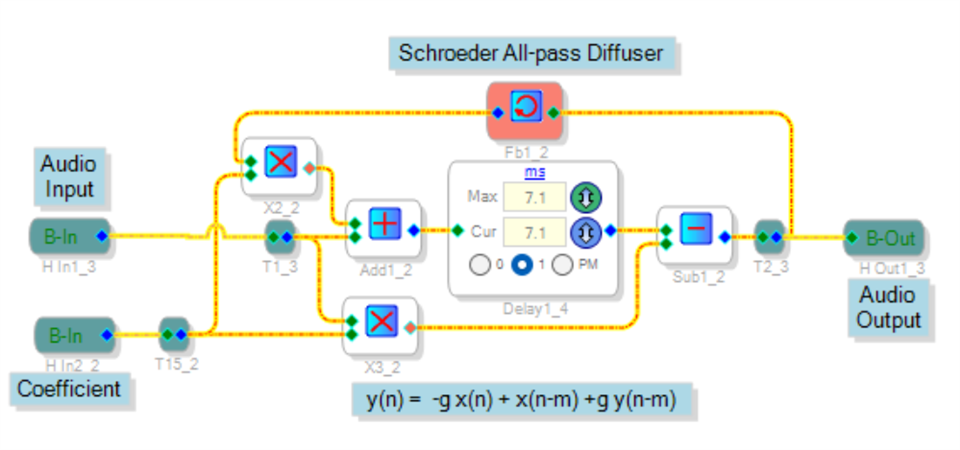
I did a bit of research to find how digital reverb is generally done -- as it turns out, you need some All-pass Diffusion Filters to produce a lush sound, Invented by Manfred Schroeder at Bell Labs in the early 60s, these spread ("diffuse") the delays so they don't sound like canyon echoes. When implemented in SigmaStudio, the All-pass Diffusion Filter looks like this:
Credit: Zolzer, DAFX: Digital Audio Effects
I worked up the circuit attached below with several of these, a typical reverb delay tank, and one stock ADI reverb. Because it only uses one of the stock reverbs with no feedback around it, the "metallic" sound is minimized. The main reverb delays are mono to conserve delay memory; a stereo effect is restored near the output. There's controls for feedback, wet vs. dry sound, and damping.
Reflector-Diffuser-Reverb.dspproj
A slightly improved version -- for some reason, the forum software won't let me edit the previous reply above:
Diffuser-Reflector-Reverb.dspproj
Please log in to reply.