What is the best AD Integrated circuit to start developing Guitar and Voice effects?
Hi to all,
I'm an electronic developer and audio designer, I'm looking for start to modeling audio processors for guitars, bass, keyboards and voice.
I'like to use Sigma studio to do this.
What's the best AD integrated circuit to start this development?
At the time I saw ADAU1701 and ADAU1452 but I don't know if there's some better.
I'm looking for one who have the eval board available and not so much expansive.
Thanks a lot.
Elia from Italy.
Audio Signal Processors
adau1452
start code
noob
guitar
music
pedalboard
voice
newbe
SigmaDSP Audio Processors
effects
SigmaDSP
audio
adau1701
Show More
AD146x or Adau1452
Hello Elia,
To add to what mmmike said, The ADAU1701 eval board is very low cost and is a good way to start learning how to program the DSPs using SigmaStudio. It can do some interesting but fairly basic guitar processing. Then if you are looking to work on much more complicated designs then you will have to move up to the ADAU146x or the ADAU145x processors. These are a little more complicated because there are no built in converters so you have to have a codec involved. The eval boards for these are not too expensive so your decision will be based on what the cost of the end product needs to be and how complicated your algorithms will be. You power budget is also important.
Dave T
I agree with Dave; the best chip to cut your teeth on is the ADAU1701 (sorry for the idiom, I've been spending way too much time in a dentist's chair lately). Its internal converters and self-booting makes it easy to apply towards a finished stand-alone product. It's the perfect chip to make all your beginners' mistakes on (as we all have before you), while developing the confidence which comes from making simple projects which actually work. As you make progress with your designs, you may find you need more instructions per sample than the approximately 1000 available on the -1701 at 48 KHz sample rate. By then you'll be ready for the ADAU1452. Or else you'll find ways to squeeze more into a -1701, which is a lot of fun in itself. For instance, with only enough data memory for a 42 mS delay, the -1701 simply cannot make a decent reverb -- but see the downsampling trick at Guitar reverb and ADAU 1701 . If you're looking to make a battery-operated stomp box, consider the ADAU1761 since it's low power.
Unfortunately, none of the more powerful chips all all the -1701's conveniences. The -1761 has converters but no self-boot, so you'll need to program an external microcontroller to boot it when not connected to SigmaStudio. The -1452 self-boots but has no converters, so you'll need to add an external codec to any custom board you design.
Best regards,
Bob
Is it possible to perform a double pitch shift with the 1701 pedal? That is, to produce a two-octave guitar sound as a double pitch, just like with Whammy transpose pedals.
Hello Japon18,
You could certainly try ADI's Pitch Shift algorithm. Max out its Delay Reserved (about 2000 samples, depending on what else your project contains). Adjust its slider to the right until it doubles the pitch. Then mix the doubled result with the original "dry" sound. See if it works to your satisfaction.
Because of the interest in this project I've been trying to squeeze the alternating dual delay method into a -1701. So far it sounds awful and it remains to see if it can be fixed.
Best Regards,
Bob
Once your work is complete, could you please send me the pitch shifter transpose as an E-mail or MP3 audio file so I can listen to it? I'm really curious about the result, and it's great to follow in the footsteps of masters like you. Cheers, my friend.
Hello Japon18,
I'm no genius, only an old engineer with a desire to help.
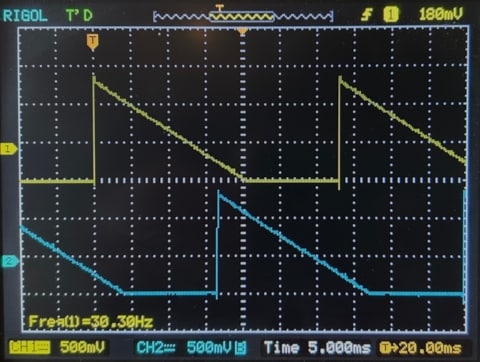
Both the -1452 and -1701 versions of the alternating delay pitch shifter are now functioning according to the Matlab paper cited above. Getting the delay ramps right is critical. The best way to check the ramps is to output them to DACs via Signal Invert blocks (the -1701's DACs invert polarity). Then observe the ramps on a scope:
Unfortunately, it still doesn't sound as good as ADI's Pitch shifter. As imperfect as that is, it appears to use the -1701's meager Delay RAM more efficiently. The attached Zip file compares the sound of the two algorithms:
Octave-Shift-Comp.zip
The guitar piece is Love And Pain in A Minor by Darren Hirst. Each MP3 begins with only the "dry" sound, then the octave shift adds in. So as you can hear, I've found no magic in this alternating-delay algo.
Best regards,
Bob
Hi, Could you please share the algorithm file?
Please log in to reply.