ADAU1701 as audio (synth) oscillator
Hi,
I could not derive this from the datasheet, but can this DSP be used as a oscillator (sinus, square, sawtooth ...) in a synth setup?
Cheers,
BC
Audio Signal Processors
SigmaDSP Audio Processors
adau1701
Hello BC,
The ADAU1701 data sheet describes the chip's ins and outs, but to see what audio functions it can perform, download SigmaStudio: SigmaStudio | Analog Devices
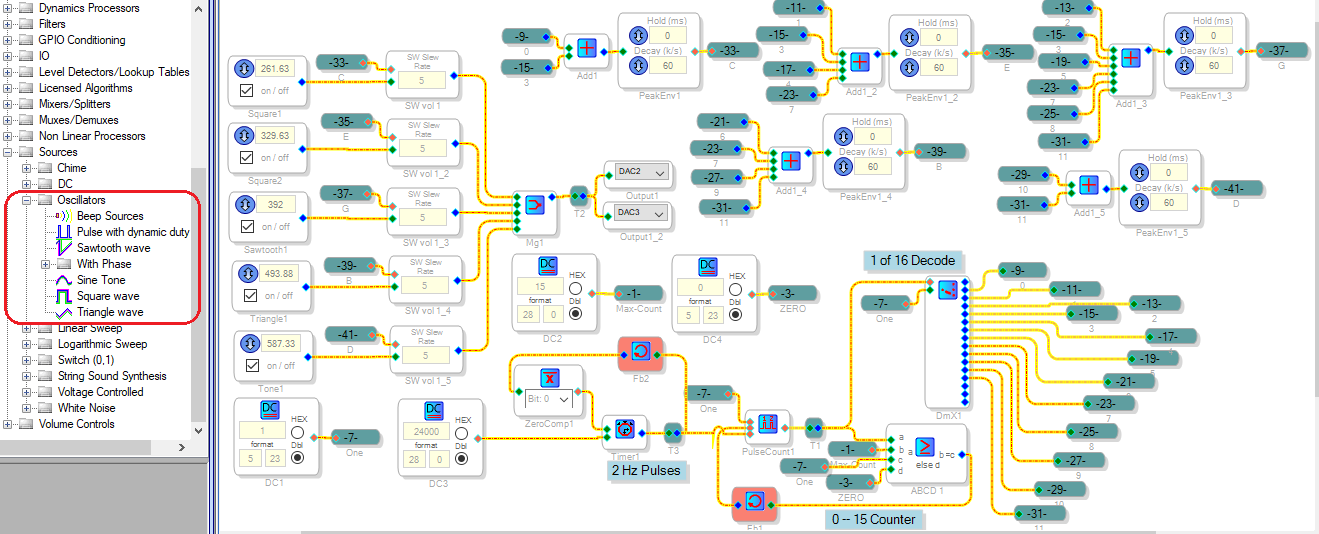
You'll find sine, square, triangle, and sawtooth oscillators (the latter uniquely includes both odd and even harmonics). The example project below uses five oscillators and some rudimentary sequencing to produce C, Em, and G chords. It uses 406 instructions out of the approx. 1010 usually available (1024 minus overhead):
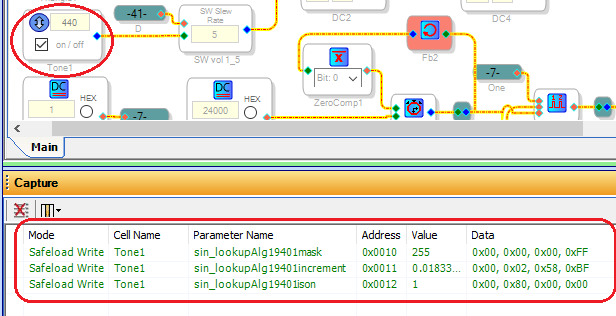
A complete synthesizer might use a microcontroller to first load compiled SigmaStudio code into the ADAU1701 and perform other initialization functions at power-ON. Then it would go about scanning the keyboard and/or MIDI interface to find the notes to be played. For each new note played it would assign and set up a free oscillator, adjust attack and decay dynamics, and other audio functions in the -1701's program. The major work is hardware design (where the data sheet comes in), as well as programming the microcontroller and interfacing to the -1701 via I2C or SPI. All this is of course beyond the scope of my simple answer here -- it would take a bit of research just to figure whether this idea is even feasible, given for example how fast the I2C bus can update all these functions in real time. Searching this forum will help with some of this. As a quick example, below I have changed the frequency of oscillator Tone 1 to middle A -- SigmaStudio's Capture Window shows that it sent three words (4 bytes apiece) over I2C to the -1701 to make this change. Your microcontroller would have to do the same to get this result. In general, a particular oscillator's parameter addresses depend upon where the SigmaStudio compiler placed them:
I attached the project (which runs on the stock ADAU1701MINIZ eval board). In case you don't yet have hardware, I also attached a short mp3 file of the sound it makes.
Best regards,
Bob
Bob,
thanks for your elaborate answer. I feel energized by the multitude of possiblities of this DSP. I ordered an eval board and I hope to start experimenting soon. This cencerns a modular synth project, which has the advantage that it contains single building blocks, making things a tad simpler. Hopefully I do not run into I2C performance issues, time will tell,
Cheers,
BC
By the way: are there any SigmaStudio tutorials?
BC
There's some examples and tutorials here:
Tutorials [Analog Devices Wiki]
Nothing beats experience, though. Just dive in and try small projects. When running into problems, search this forum or ask for help. ADI support engineers and active members like me are here to help.
Best regards,
Bob
Dear Bob,
Thank you so much for link. I'm already checked some of them :-)
Please log in to reply.