How to design Shelf and Butterworth HP or LP 6db/oct, 12db/oct filter?
Hello everyone,
I search the SigmaStudio wiki, and I still not figure out how to make a filter that contain db/oct design
If I want to design a High or Low pass Shelf / Butterworth filter with db/oct design, which block should I use (I am using AD1701)?
I only find the butterworth design in the Crossover block.
sorry I am noob on SigmaStudio EQ design
Hope you guys can help me!
Thanks!
Regards,
Alvis.
Hello Alvis,
Here's what blocks to use in order to implement these filters:
Lowpass & Highpass
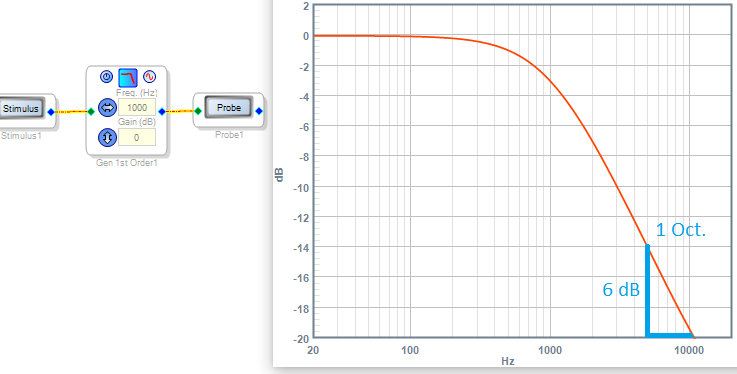
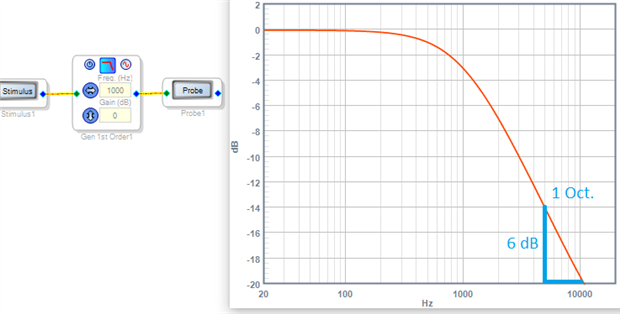
Six dB per octave filters can be implemented with the First-Order Filter Block:
By definition these are Butterworth filters ("maximally flat in their passband."). They're analogous to the simple RC filters in the analog world.
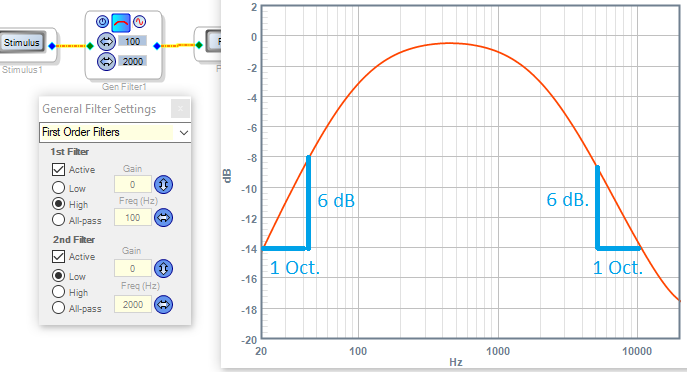
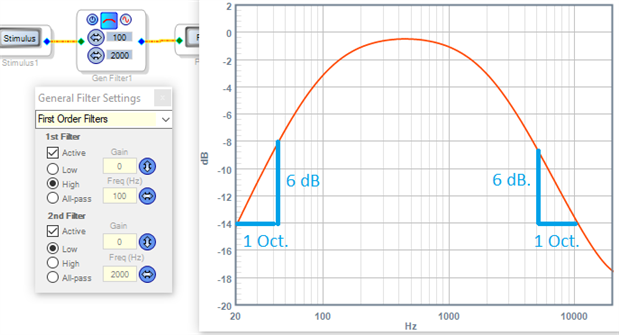
You can also do these filters with the General Second-Order Filter block. Here you get the advantage of two selectable filters in one -- for example, a Lowpass and a Highpass together:
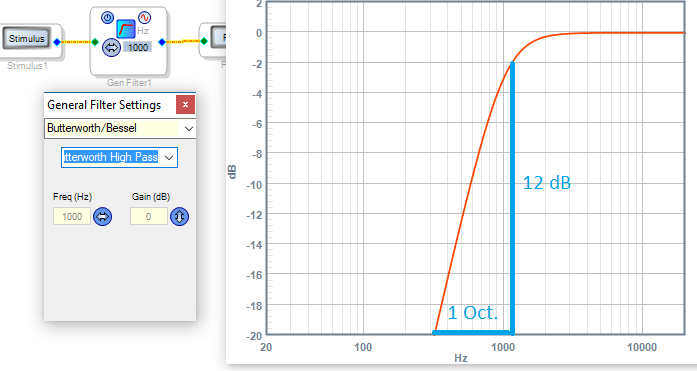
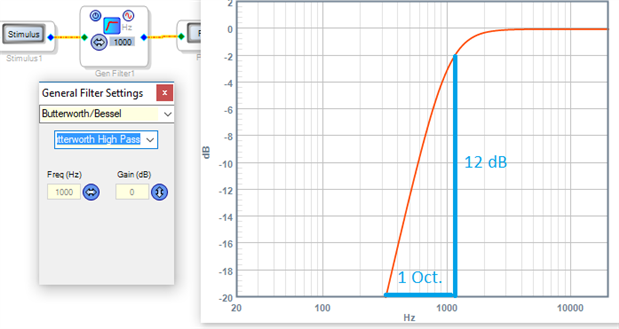
If the General Second-Order Filter has enough "horsepower" to build two 6 dB filters, it's reasonable to expect it could make one 12 dB filter. And it does! Here we can select a Second-Order Butterworth filter:
The "horsepower" comes from a more sophisticated algorithm involving two delays and two feedbacks (compared to one each for the First-Order filters). With the whole block dedicated to one filter, it becomes analogous to Second-Order analog filters which include either an inductor or an extra cap plus an op-amp.
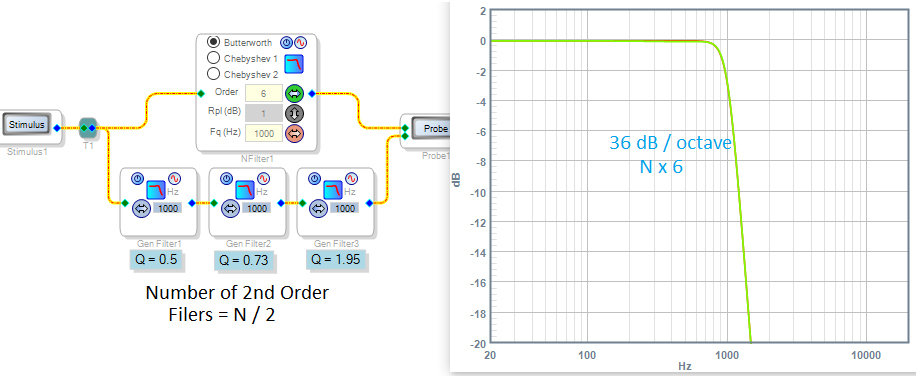
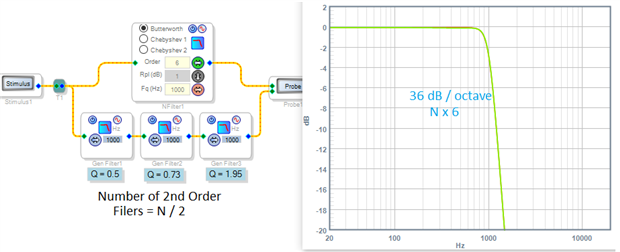
Need even more dB per octave? You can cascade several filters. Though you can do this manually, you'll need to choose differing Q and sometimes frequency for each section to get optimal results. The Nth-Order Filter block does this math for you. The last time I looked it only works for even-numbered N -- in other words, it cascades only Second-Order filters, although the theory allows you to mix First-Order and Second-Order filters.
Shelving Filter
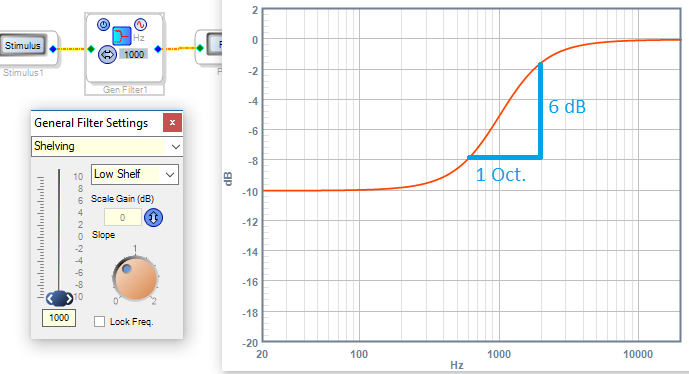
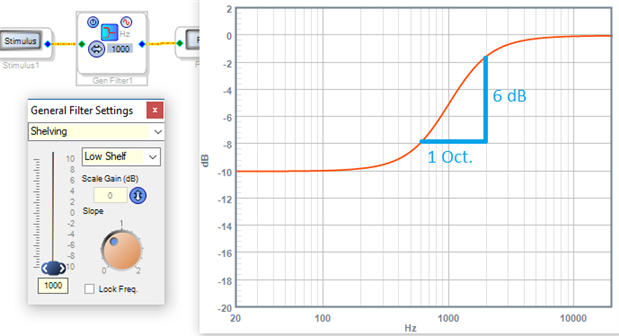
Choose the General Second-Order Filter and set its drop-down menu to Shelving. You can change the slope with the knob as shown below. Likely there's a formula to translate dB per octave to the setting of this knob, but it hardly matters since the slope cannot be entered numerically anyway.
Best regards,
Bob
Hello Bob,
This is very useful information for me! Big thanks!
I have another question about shelf EQ, last question is HP/LP Shelf filter, this only adjust the Frequency and Gain value
If I want to make a "HP/LP Shelf EQ", this can adjust the Frequency, Gain and Q value, but the General filter only give me shelf filter and I can not enter the Q value which I want, the only way is using "Slope" .
Any suggestion for the Shelf EQ? or using Parametric filter with General HP/LP filter to simulate the Shelf EQ?
Thanks,
Regards,
Alvis.
Hello Alvis,
The relationship between slope factor S and quality factor Q is rather complicated. Robert Bristow-Johnson's reference http://www.musicdsp.org/files/Audio-EQ-Cookbook.txt provides this formula relating them:
1. 1/Q = sqrt((A + 1/A)*(1/S - 1) + 2)
2. where A = 10^(dBgain/40)
We can solve this algebraically for S:
3. S = (A + 1/A) / { (1/Q^2) - 2 + A + 1/A }
It appears from the reference that dBgain in Equation 2 refers to the position of the slider in the filter (the "boost"). I don't see why either the boost or the static gain of the filter would enter into the relationship between S and Q -- since Q relates to the sharpness of the filter, not its gain. On the other hand, dB per octave slope is definitely affected by these -- a shelving or parametric filter with zero boost has a flat response without any visible slope! If we set dBgain to zero (unity linear gain), then Equation 1 simplifies to:
4. S = 2 * (Q^2) Example: Q = 0.707, then S = 1.
This could be the most useful formula for you to work with. S = 1 is a good setting for a shelf EQ -- it's the highest slope factor (sharpest filter) without overshoots in the response curve (akin to a Butterworth response).
Best regards,
Bob
Hello Bob,
I have some new questions about db and octave relationship.
Sometimes I see some Amps spec has "1/36 octave steps" in some parts of Low/High pass filter,
what does "1/36 octave steps " mean?
My opinion is 36 db/octave (Nx6 order, N is 6, which means there are 6 first order block chaining), anything wrong on this? Can you help me to realize the real meaning about "1/36 octave steps"?
Second question is:
How to mapping the LP/ HP filter type 12 or 18 db/octave Bessel and Butterworth to the 12 or 24 db/octave Linkwitz Riley 4th or 8th order? (any example?)
The above condition, I think it is using crossover block to implement it, but I am not really sure about it.
Please help me answer these two question, Thank you!
Best regards,
Alvis
Hello Alvis,
I've got time for your first question before heading to work.
One octave is defined as a pitch range from a given frequency to double that frequency -- for example, middle A is 440 Hz, while 880 Hz is one octave above middle A. I'm no musician for sure, but I believe the term stems from the eight notes in a scale covering this span.
A piano has 12 keys covering an octave because its extra notes allow for all scales, not just C-major (the white keys). The frequency of each note is the twelfth root of two [2^(1/12)] above the previous one. Equalizers and such with 12 bands per octave use the same formula.
Thus, a filter featuring 36 per octave steps has 36 frequency choices in each one-octave range. To do this evenly, start with the lowest frequency and keep multiplying by 2^(1/36) or approximately 1.019441. You'll end up with frequencies like: 20, 20.4, 20.8, 21.2, 21.6, 22.0, 22.4, 22.9 ... You can easily calculate these with a spreadsheet (or MATLAB -- but that would be like using a cannon to kill a housefly).
Best regards,
Bob
As for the order of filters in typical parametric equalizers, they're typically the second-order parametric filter regardless of the frequency resolution offered. Typically higher Q's are used where filters adjacent in frequency with differing boost values are needed.
I'm afraid I haven't designed with crossovers so I'm only vaguely familiar with their basic principles. An excellent primer on crossovers including Linkwitz-Riley is found here: Linkwitz-Riley Crossovers: A Primer
This was put out by Rane, a true pioneer in the field -- it's quite amazing how freely they share their knowledge in a field which has become increasingly competitive with stuff made all over the world.
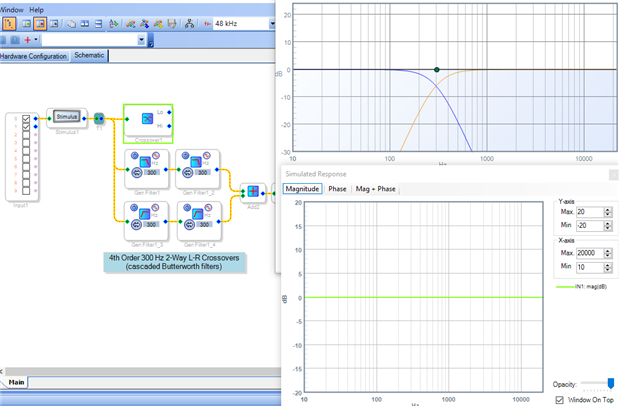
I'd suggest you just use ADI's crossover filters because they're already figured out for us. If you would like to experiment with "homemade" crossovers, you can always test them out with the Stimulus-Probe tool. For example, the two crossovers shown below produce identical responses in their summed outputs:
Best regards,
Bob

Hi Bob,
Thanks for your easy way to let me understood the db and octave relationship.
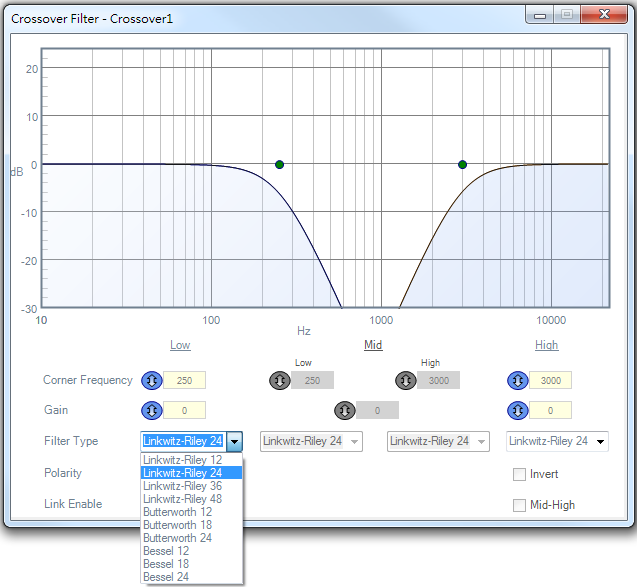
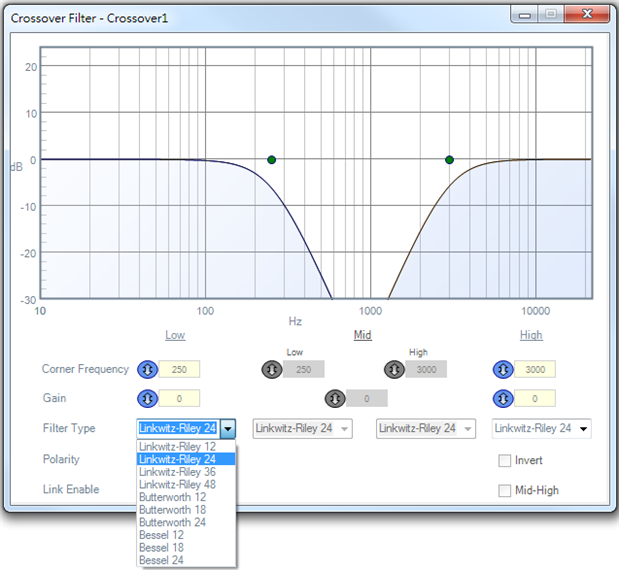
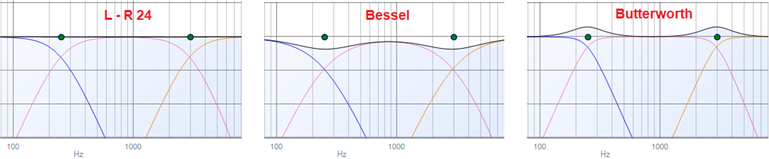
About the second question, if 12, 24 and 48dB/octave Linkwitz Riley 4th or 8th is like below figure?
Linkwitz Riley 4th is Linkwitz Riley 24? and Linkwitz Riley 8th is Linkwitz Riley 48?
LP/ HP filter type 12 or 18 db/octave Bessel and Butterworth is Butterworth / Bessel 12 18 24(in the picture)?
There are the different thing? Bessel and Butterworth and Linkwitz Riley?
Thanks for your reply!
Regards,
Alvis
Hello Alvin,
You're correct with the filter order and dB/octave -- a 4th order filter has a 24 dB/octave slope, while an 8th order filter's slope is 48. Generally, the slope is the filter order times 6.
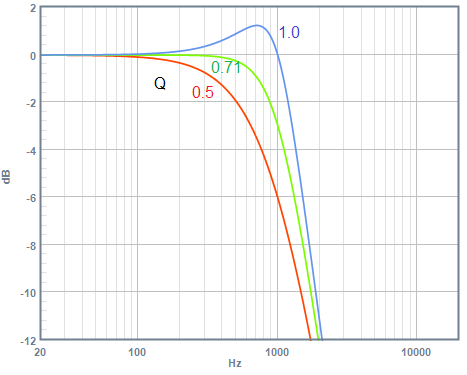
The various crossover filters differ in their sharpness or "Q" value. This graph shows three 1KHz second-order lowpass filters with different Q. Increased Q makes a sharper response but too much Q causes an overshoot:
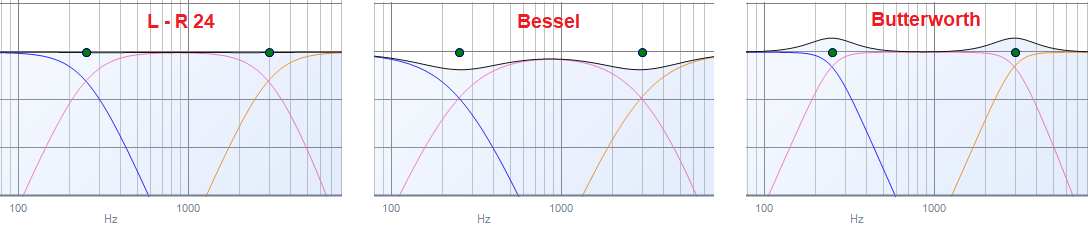
Comparing the three crossover types shows that the Bessel has the lowest Q, the Butterworth has the highest Q, and the Linkwitz-Riley is in-between. Otherwise they're pretty much the same.
Best regards,
Bob
Hello Bob,
Sorry for the old question again, I think I need to ask at this post.
I got one request is about the "half-order" which means the filter need to use "3dB/oct".
As I know, in the SigmaStudio, the basic filter for the HP or LP is first order(6dB/oct),
so I am really confused on how to make the 3dB/oct.
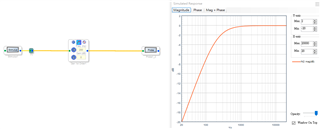
I do this simulation for the first order(6dB/oct) as below:
200Hz -6dB/oct HPF:
How to implement the 200Hz -3dB/oct HPF?
Thanks!
BR.
Alvis
Please log in to reply.