Parallel analog I/O for better performance?
This is primarily with regard to the ADAU1701. Some of the high-end A/D convertors have an option to combine a pair of ADC together to improve SN and/or distortion performance and it has me wondering if the same would hold true for an all-in-one bug like the 1701. If I recall correctly from one of the datasheets, the improvement in SN is on the order of almost 3db over a single ADC which sounds like the self noise is basically random between the two channels. If the noise has some correlation (ps noise etc) then we would expect the advantage would be smaller. Unless! the two inputs/outputs were used in a differential configuration. It seems that this would be an ideal thing to do if there are inputs or outputs that would otherwise go unused. So, my question is if there is a good probability that performance could improve by paralleling inputs and/or outputs?
Audio Signal Processors
parallel
SigmaDSP Audio Processors
sn
adau1701
Hello chmed,
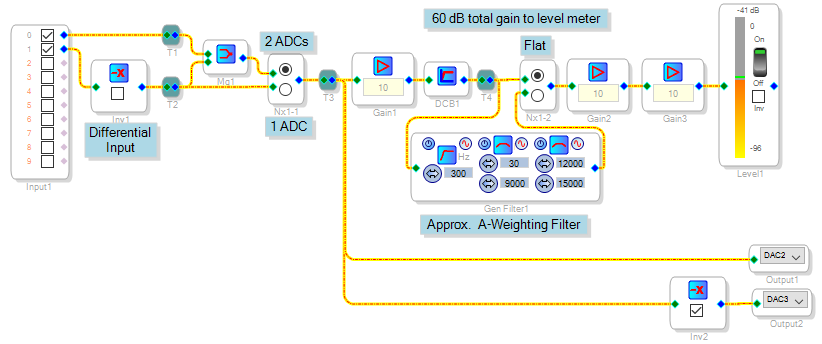
Likely the theory providing a 3dB improvement is correct. To make sure I measured the noise from the project shown below with no input. The Signal Merger includes a 6 dB loss to make up for the two DACs worth of signal, providing a direct comparison of noise levels. The 60 dB gain brings the noise up to a measurable level, and I included a homemade A-Weighting filter to see if it makes any difference.
dB ref to full output (60 dB gain accounted for):
Flat A-Weighted
One ADC -99 -104
Two ADCs -101 -107
Differential -101 -107
You may also wish to use two DACs to feed each following amplifier differentially -- this helps minimize distortion caused by the power amplifiers' ground return currents (which must be carefully accomodated in any case).
Best regards,
Bob
As usual, KJBob, thank you for working on this! I recognize that it isn't a fully exhaustive test but I think it confirms the idea. I have a project that really only needs one output and I may try to mix them all together with some small value resistors instead of just using one output.
Please log in to reply.