Filtered NLMS filter
Hi! I am interested in using FxLMS for the purpose of ambient noise reduction by active noise cancellation, and I noticed that the filtered NLMS filter had been added to SigmaStudio 3.13. However I can't figured out how it is supposed to work. I am guessing that for a feed forward ANC setup, signal from the reference microphone should go to pin0 and error microphone to pin1 of the FxNLMS. However what does pin2 do and what is the procedure to obtain an estimate of the correction for secondary path? Thanks!
Hello,
I was going to start answering this but then realized I needed to know what DSP processor you are working with?
Dave T
Dear Dave,
Thanks for looking into this! I am working with the ADAU1452, in particular, the EVAL-ADAU1452 evaluation board.
CY
Hello CY,
The help file is well hidden in the Wiki. I managed to find it.
https://wiki.analog.com/resources/tools-software/sigmastudio/toolbox/Filters/FilteredNLMSFilter
Have you seen this?
Dave T
Dear Dave,
This is the first time I am seeing this help file. I have been to the filter wiki page, but the NLMS filter link there is broken. The info in the link you provided answered my question. Thanks!
CY
Hello CY,
That is what I suspected. I did notice that broken link as well. I will see about getting that fixed.
I found the page by clicking on the cell in SigmaStudio to highlight it, then I pressed F1.
Dave T
Hello Dave,
I really need the correct documentation of NLMS for ADAU1761. Could you please give me some references? There are a lot of threads but with different versions and different results. I am working with 3.14 version.
Thanks!!
Hi Dave T,
Is this the only help file related to the FxLMS block? I am trying to implement an ANC system and was looking for any other documentation that would help with using the block in SigmaStudio.
Any help greatly appreciated.
Regards
C Mac
Hello CMAC,
I understand the need for a more comprehensive guide and will work towards that goal. I have put it on the list of items that need attention but I am not certain how soon I can complete the task.
I will try to get at least part of this document soon.
Dave T
Hi Dave,
Unfortunately its my dissertation project in which the deadline soon . If you could help me with something in particular?
How do I implement the secondary path required for the Filtered Reference Input?
Regards,
Cameron
Hi Cameron,
You can derive the secondary path coefficient experimentally, such as described in http://www.geocities.ws/ranjit_raphael/FXLMS.html (Fig. 8). I found that using white noise does not necessary gave good result for the secondary path estimation due to accumulating errors. If you run into the same problem, you can try replacing the white noise source with a pulse source consisting of the range of the sine components you are interested in.
Hi Tancy,
Thanks for your reply. As an example, if I was aiming to cancel primary noise between 50-150hz, a noise signal generated within sigma studio put through a band-pass filter set at 50-150hz that is connect to the Filtered Ref input would work? The documentation talks of 'training' the system and computing the co-efficents before updating them when implementing in C. Does the FxLMS block carry this out automatically upon compiling the project?
Best Regards
Hi CMAC,
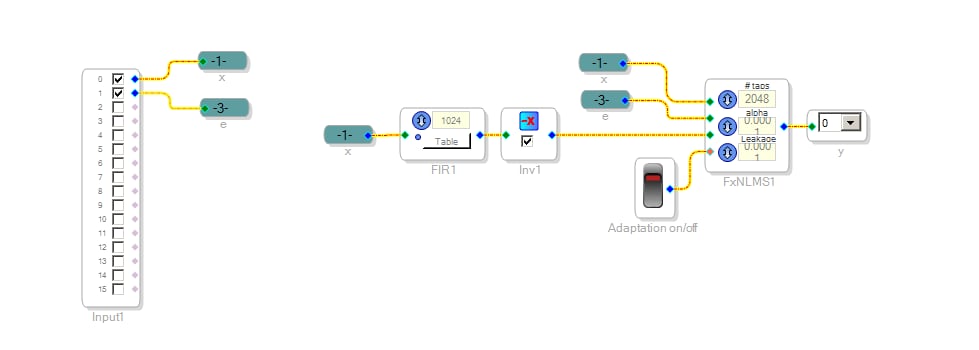
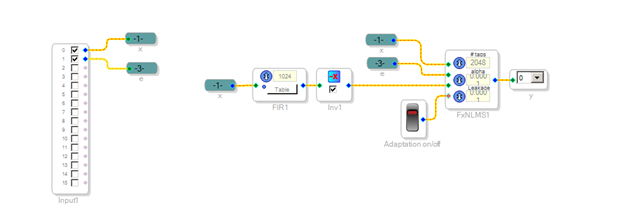
There is no built-in block to get the secondary path estimate. You will need to obtain/derive the secondary path estimate. The secondary path estimate can be an IIR or FIR filter. If you are obtaining the secondary path estimate experimentally, you will need to write another separate SigmaStudio program and save/export the coefficients to the actual program. Below is a figure showing an example of the FxLMS with a 1024 tap FIR filter (the block with FIR1 label) as the secondary path estimate.
Thank you for the prompt response.
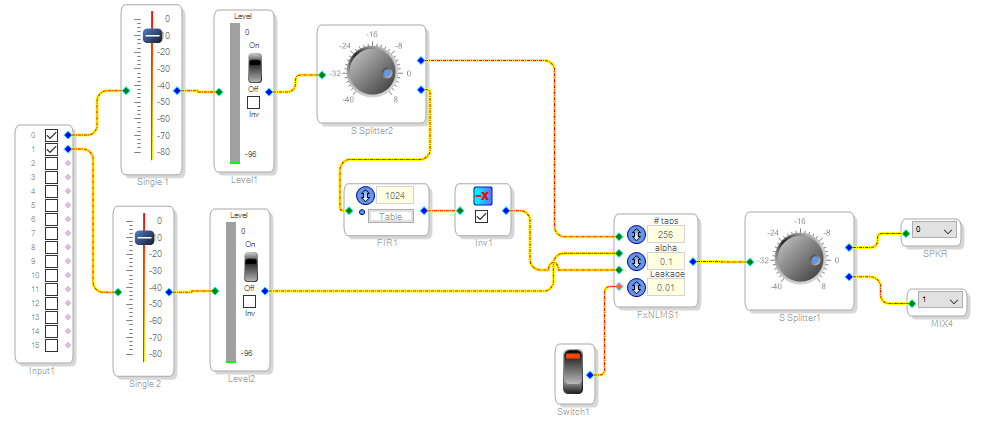
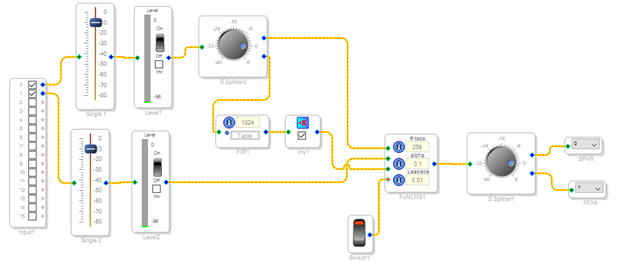
If I understood correctly this is the patch required to implement the FxLMS. However, a separate 'offline' project needs to be carried out to calculate the required co-efficents of the FIR filter for the secondary path which are then copied into the table of co-efficents for the filter in the main project file?
The reason for a split on the output being to allow me to take a copy of the boards output anti-noise to be recorded for analysis.
Thanks, Cmac
Dear CMAC,
Yes, another "offline" project/program is required to obtain the coefficients.
You can also use the "T connection" block, which does not use DSP resource, to replace the splitter.
I have another question, are there any plans for adding FxNLMS block for ADAU1442 chip?
Hi Tancy,
Thanks again for your replies. So for establishing the coefficients for the FIR filter, a separate patch in which a noise signal is generated in sigma studio - fed through the board to the secondary loudspeaker - and then the signal from the error microphone is fed into the FIR filter?
I understand the concept of the secondary path its just the implementation to model FIR impulse response in sigma studio. Any suggestions greatly appreciated.
Regards CMAC
Hi Tancy,
For what reason do you have the signal invert function after the FIR filter?
Regards
Dear @tancy
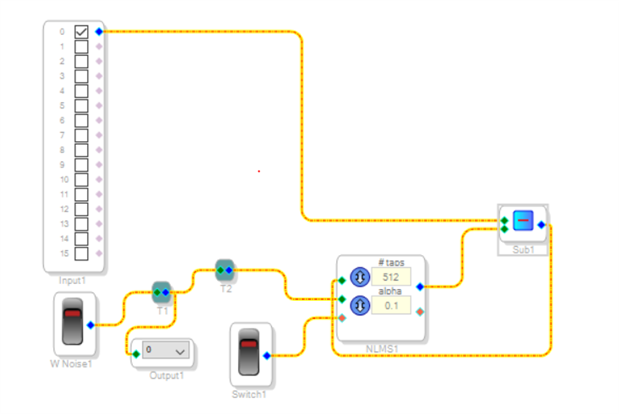
Based on figure 8 in the link you provided, I've build this setup.
But several problems arise. SigmaStudio won't compile and download to my board (ADAU1466) because of illegal feedback loops detected. Secondly, it is not possible to save the filter coefficients in the LMS filter.
What improvements do you suggest?
Thanks!

Hi JDWinne,
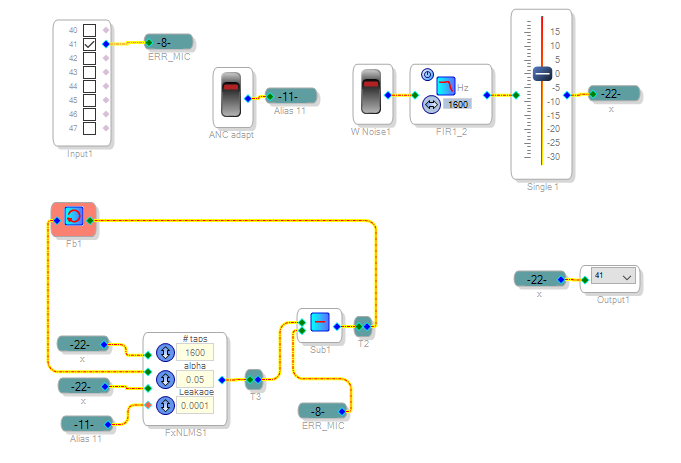
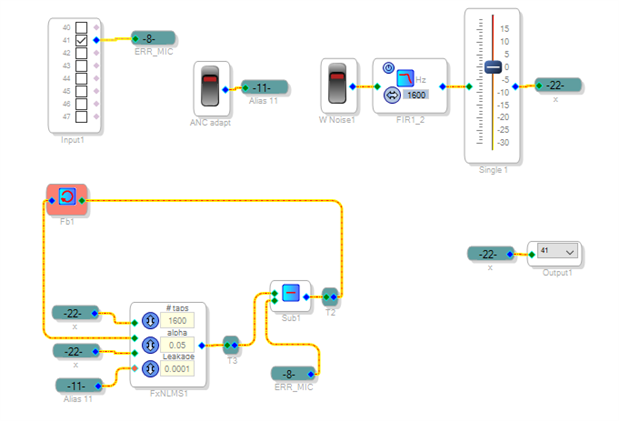
You will need to use a feedback block (see here). I have also attached an example in the diagram below.
Note that the NLMS block is for microphone/echo control type applications and cannot be used for active noise cancellation (ANC). See this thread for example of how the NLMS block is used. For ANC, you can use FxNLMS block as a LMS filter by feeding x into the f(x) "Filtered Reference" input. Also see here for details on implementation of the FxNLMS in SigmaStudio.
As for saving the coefficients, please check this thread. There is a short Perl script at the end of the thread which will extract the coefficients from the save file.
Please log in to reply.