Zoltzer Filter
Good day,
How can I use a potentiometer to control the Zoltzer or the NF Filter in the sigmastudio ? , I want to use an external potentiometer to make adjustments to Gain , Frequency , Q using the auxiliary ADC GPIO
Thanks in advance
Hello,
For GPIO control you would need filters with control input "pins." Unfortunately, the only such filters presently available are the State-Variable filters, which are unsuitable for general EQ application.
Up to now, SigmaStudio has not included external-control EQ filters because their bilinear coefficient calculations are rather complex to do at runtime inside the DSP. However, the -1452 could change all this. In fact, I just noticed in Beta version 3.12.4, a filter featuring runtime coefficient calculations!
Since this is arguably the most difficult portion of the work needed for a General Second-Order filter with external inputs, perhaps such is on its way (of course I'm only speculating...).
Yet this is still not what you're asking for (Zoltzer or NF filter). Honestly I have no idea what these are. Perhaps I could ask you what a Zoltzer filter is, and what advantages it might have over other filters.
Best regards,
Bob
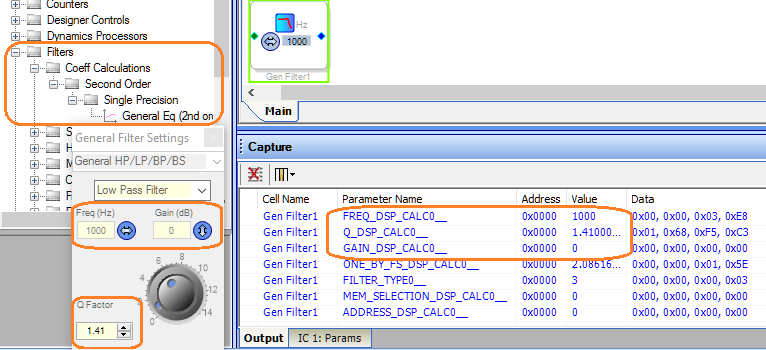
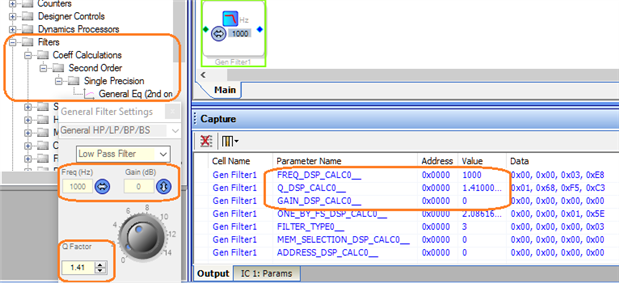
Look under custom algorithms./ second order
Thanks
Yet this is still not what you're asking for (Zoltzer or NF filter). Honestly I have no idea what these are. Perhaps I could ask you what a Zoltzer filter is
I would guess a misspelling for Zölzer filter, which is one of many topologies possible for second-order (biquad) filters. I'm not sure about NF, but it might be short for Normal Form, which afaik is a synonym for the Gold-Rader topology.
The filter topology specifies how exactly the filter (viewed as abstract mathematical operator on the space of signals) is implemented in terms of delay and gain primitives. Different topologies may also require different coefficient calculation to get the same results. If the filters were implemented with real numbers then the topology would be largely irrelevant, but quantization makes the filters perform differently in practice, and quantization of coefficients also limit which filters you can construct with a particular topology in practice. Different topologies also react differently to runtime changes to filter coefficients.
The most common topology for biquads in audio is DF1 (Direct-Form 1), but there is also DF2, the transposed direct forms DF1T and DF2T, and "coupled form" topologies such as Gold-Rader, Kingsbury, Chamberlin, and Zölzer. There are also lattice and ladder topologies which are primarily for allpass filters but can be adapted to general second-order use. There's also the state-space topology, which at first sight seems to be highly redundant (9 coefficients instead of 5) but apparently it was intended to be used with particular coefficient calculations that ensures all internal nodes are nicely scaled. I'm still looking for a good description of this.
There are descriptions of most of these topologies in chapter 2.5 of Robin John Clark's thesis, "Investigation into digital audio equaliser systems and the effects of arithmetic and transform errors on performance". Diagrams for the Gold-Rader and Zölzer topologies can be found on page 30, although I wonder whether the input-output delay (2 samples) of all three topologies depicted on that page was already there in the original publications. I'm also pretty sure they could be drawn more elegantly (note that the feedback portion of the Gold-Rader topology is one complex multiplication).
and what advantages it might have over other filters.
Coupled-form topologies in general are expected to suffer less from quantization (both of audio and of the filter coefficients) for low-frequency (especially high-Q) filters. You can find some analyses in the thesis mentioned above.
A more future-proof link would be https://dx.doi.org/10.24382/1373 .. However, I've also noticed that the document you get from these updated links is an obnoxious 144MB scan of the printed version, so you may be better off just grabbing an archived copy of the 7MB pdf I originally linked.
Also, at the bottom of the page it erroneously claims to be available for Sigma300/350 (ADAU145x/146x), when actually the entire "Custom Algorithms" category is specific to SigmaStudio for SHARC. There isn't even any IDE or compiler for Sigma300/350 processors in which you could develop custom algorithms, these cores are programmed exclusively though SigmaStudio (which generates assembly directly).
Please log in to reply.