EVAL-ADAU1701MINIZ cant get the microphone signal
Hi,
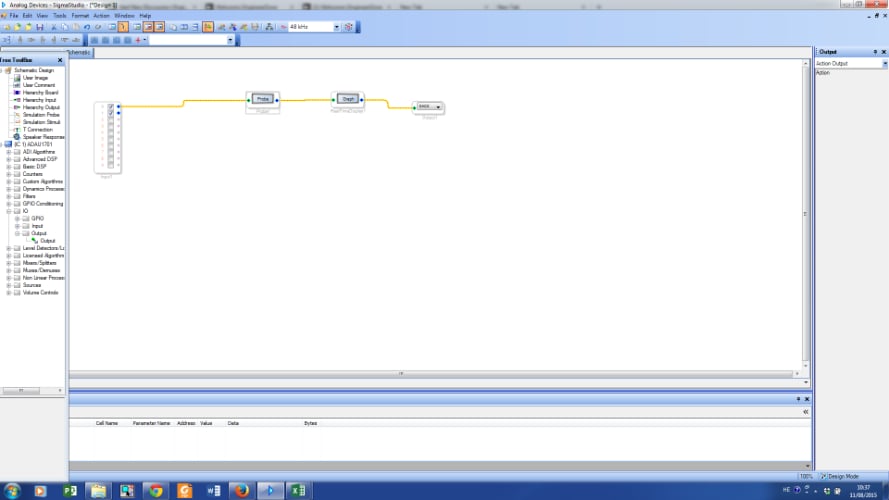
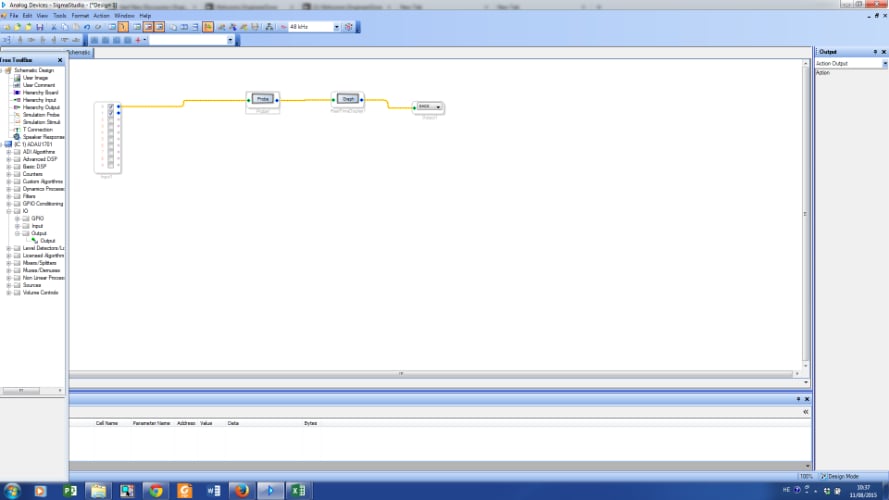
I am new with Analog Device and I am using the Mic + Real time plot display
I am using sigma studio 3.12
1. when I pass a sine signal to the input from generator I get an output to speaker but nothing on the Real time plot display
2.I cant get or pass a signal with the microphone to the speaker or get any measurement
attached the project
can someone please help me?
Thanks!!
Hello,
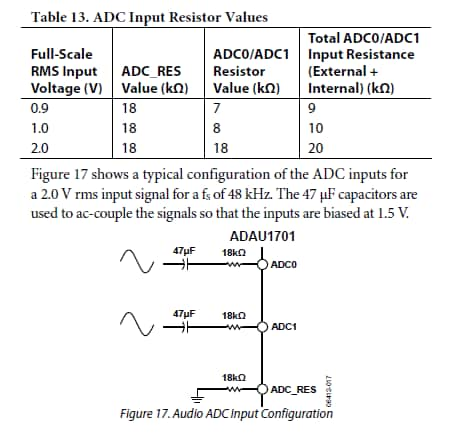
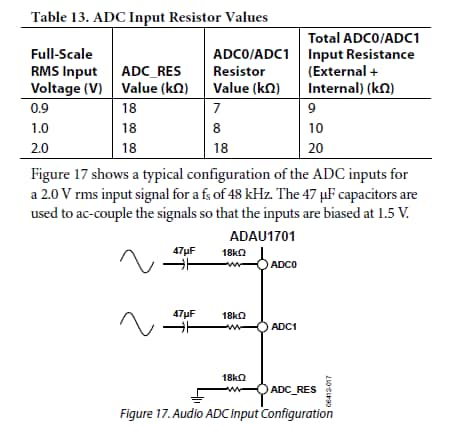
The ADAU1701's ADC inputs are described on Page 20 of the data sheet (a portion shown at left). They accept a 100 uA RMS full-scale input. Together with the usual 18 K ohm series resistor and approx. 2 K internal resistance, this means we need about 2 V RMS input to fully drive the ADC. Microphones typically output in the millivolt range, thus cannot directly feed the -1701. You need a preamp between the mic and the ADC input.
The Real-Time Display works by taking multiple readbacks over the I2C bus, which is too slow for audio data. It's only good for slowly moving signals of a few Hz or so -- such as a level reading from a Running Average block (as opposed to its audio input).
Best regards,
Bob
thanks a lot bob!
sorry that I am new to this board
I tried to add gain in the SW but with no success...
how do I put resistors and preamp and how can I bias to 1.5V...
I am using PylePro PLM3 Wired Lavaliere 3.5mm/ 1/4'' Uni-Directional Microphone
can you please attach a simple project with mic->speaker with the pre amp inside?
it will help me a lot
thanks!
Dear @bob
regarding the Real-Time Display and in order to get samples in higher frequency(up to 5kHz) with the Real-Time Display is it possible to put a capture buffer before the Real-Time Display that can capture 40kSamples and then to get the info slowly?
what is the maximum samples it can capture?
Thanks a lot!
Hi Net,
Did you solve the problem?
I am having the same issue and I try to add the resistors and capacitors
but shouldn't it be connected directly with the 3.5mm jack?what about an internal pre amp?
what is the suitable pre amp you would recommend for the
adau-1701?
kindly send me the file with the connection instructions
lobo
Hello,
As you found out, adding software gain after the ADC in your project doesn't work very well. I've been able to get an audible but quite noisy result this way. If your main purpose is simply to get a microphone-originated signal into your -1701 mini eval board for developing a signal flow, you may wish to look into a low-cost packaged mic preamp such as those from Stellar Labs. If you wish to lay out a custom PCB for a product, then go ahead and design a suitable preamp. There's some fellow engineers on this board who could help you much better than I could. I suggest you ask your preamp question in the Audio forum, where they are more likely to be found.
The actual preamp design will vary according to what's needed:
Mic location & cabling -- Mic cables more than a few feet long need to be two-wire plus shield, balanced. The preamp would need a differential, instrumentation amplifier -- like front end.
Power voltages available -- the ADAU1701 board runs on 5V, so likely you would wish your preamp also run on a 5V single supply. High-end preamp chips often use + 15 and - 15 V split supplies, since these voltages are often available in mixing consoles and such. Other chips are designed for single supply operation with somewhat reduced performance.
For your other question -- I know of no way to have the Real-Time Display operate with higher-frequency inputs via a buffering memory arrangement, because the ADAU1701 cannot perform any multi-rate processing. Given an input waveform that repeats at a fixed frequency, I've sampled it at a slightly lower frequency to achieve an "equivalent time" result on the Real-Time Display -- but this only works with fixed-frequency inputs.
See https://ez.analog.com/message/114296#114296
Best regards,
Bob
thanks a lot @Bob for the answer it helps me a lot!!
I will try to purchase a pre amp after dicussing with the audio forum as you recommended
can you please attach the basic project with mic to speaker even if it noisy?
I just want to see that I am not missing a basic thing in the software
Best,
Attached is the simplest electret mic input I can think of. The pot gives you variable gain. I included a RC filter on the mic supply, since any noise there will couple into the ADC. Use +5V if you have it, otherwise the +3.3V AVDD on your board. I would not use +1.8V as electret mic capsules perform better with higher voltage, and the digital supplies are likely noisier.
In my input circuits I always use an opamp to buffer the electret mic input. AD8606 is a good choice. Then I control gain at the opamp rather than varying the mic input sensitivity.
Thanks Jon!
I was hoping you could jump into this thread, but I didn't want to volunteer you. An electret mic element, having built-in amplification, can make quite a good self-contained solution for Net and for others who wish to get voice signals into a -1701. What manufacturer or model of electret capsule works well here (or does it matter much)?
Best regards,
Bob
The manufacturer doesn't matter too much, but some capsule models won't be as suitable for that circuit. Generally, unidirectional capsules tend to be less sensitive and might require more gain than is available that simple circuit. I would select capsules with high sensitivity for this application.
This question has been assumed as answered either offline via email or with a multi-part answer. This question has now been closed out. If you have an inquiry related to this topic please post a new question in the applicable product forum.
Thank you,
EZ Admin
Please log in to reply.