ADAU1701 audio ADC noise
Hi,
I found there is big noise in ADAU1701 audio ADC. I set the ADC current is near 100uA rms, according to the datasheet.
Please give me a hand on how to use ADC of ADAU1701. The noise is really quite big. It is common issue for all samples of our products. Thanks.
BR,
Jackie
Audio Signal Processors
SigmaDSP Audio Processors
adau1701
Hello Jackie,
Sorry to hear you're experiencing this difficulty. Since I'm not familiar with your application, please bear with me as I cover some possibilities you may have already considered.
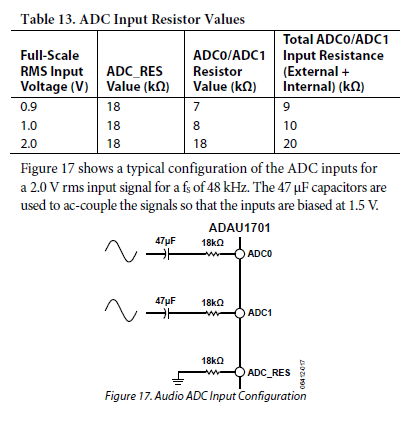
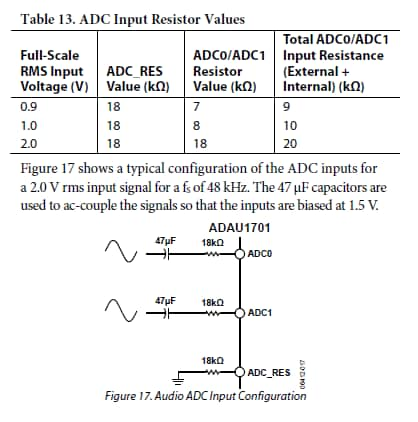
What are the resistor values for your ADC input circuit? As shown at left (from page 20 of the data sheet), the ADC_RES resistor is always 18 K ohms while the input resistors ADC0 and ADC1 can range from 7 K ohms to 18 K ohms. Using an input resistor well below 7 K ohms in order to allow a lower voltage input may invite some extra noise.
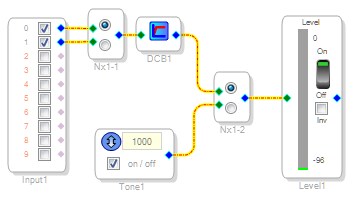
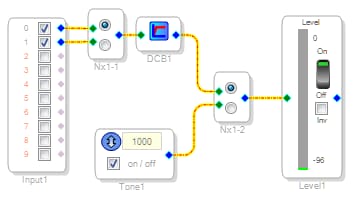
With a current input of 100 uA RMS you should be getting a full-scale digital output from the ADC. You can check this by comparing the ADC block's output with the full-scale output of an oscillator in a test circuit like that shown below. You can also measure the ADC output with no input signal, to get a rough idea of the available S/N. How bad does your noise measure?
If you haven't already, run the noise into a spectrum analyzer -- the frequency characteristic may suggest a possible cause for the noise. Check the ripple on your 3.3V supply. Also make sure your PLL components (at pin 35 of the -1701) are correct -- we had a mixer prototype suffer added noise from an oscillating 3.3V regulator, as well as a wrong resistor value in the PLL.
Bob
Hello Bob,
Below is the PLL circuit.
And below is the ADC circuit:
The input is a moving-coil microphone. mic_out is connected to ADAU1701 ADC.
When the ADC pin of DSP is left open, we can hear a little bit noise, but it is much less than connected to AMP.
Any comments? Thank very much in advance!
Jackie


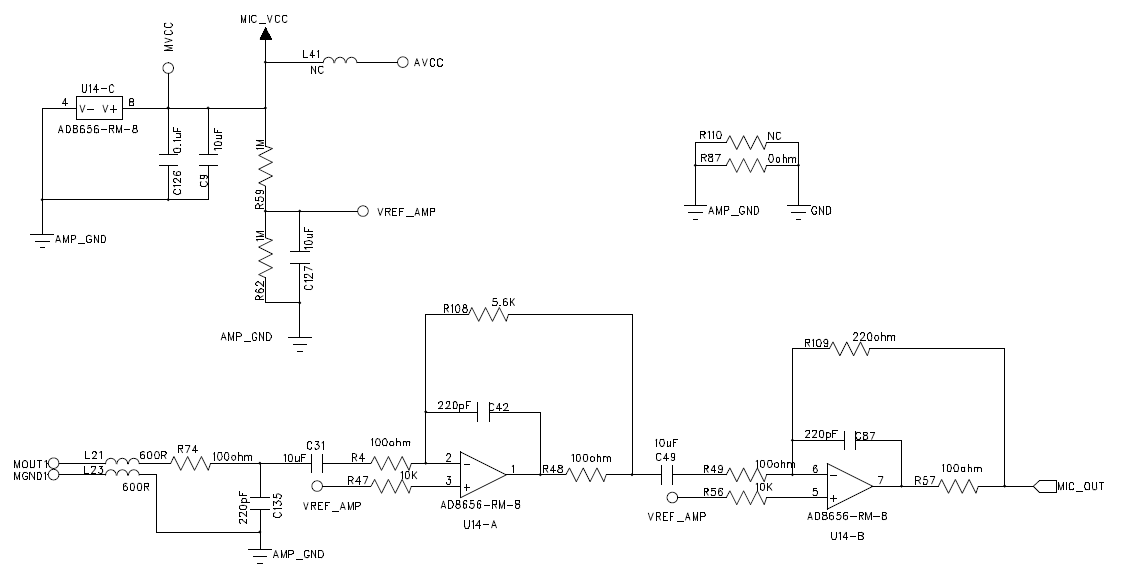
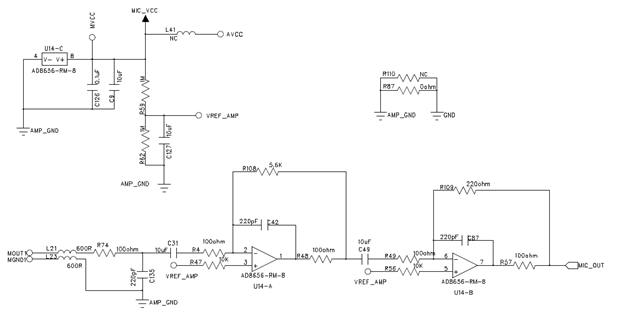
Is MIC_OUT connected directly to the ADC, or across a resistor as referenced by KJBob in the datasheet?
I suspect you need more gain than you have in those two amp stages. If you have only 100R to the ADC, then full-scale input will be about 200mVRMS. As drawn, your circuit has gain of about 40. Depending on how loud your source is, a moving coil mic might only output 1mVRMS, so you'd want gain of up to 1000 (split between the two stages) for full-scale input of 1VRMS with series resistance as specified of 8K.
Also, your input impedance is only 200R (and 100R at C31, which is too small for that load if the full audio bandwidth is desired), which could load your microphone excessively, causing degradation of SNR. Another problem is you have 10K resistance at your noninverting inputs, which is feeding its thermal noise + gain into the ADC.
I'd suggest changing the first stage (or both) to noninverting. The second stage impedance can be higher. Currently, you have MIC_OUT at the junction of R57 and R109, such that second-stage gain at MIC_OUT is 1.5. You should increase R49 by a factor of 10 and R109 as required for additional gain, then supply ADAU1701 across the specified 8K.
You might also consider one of ADI's instrumentation amps instead, which will make your input circuit much simpler. I can recommend AD8429.
Hi Jackie,
Your PLL is correct. Jon has some good ideas for the mic pre.
Best regards,
Bob
This question has been assumed as answered either offline via email or with a multi-part answer. This question has now been closed out. If you have an inquiry related to this topic please post a new question in the applicable product forum.
Thank you,
EZ Admin
Please log in to reply.