ADAU1452 Sound Quality
Hi,
I'm using an ADAU1452 development board as a development tool for a high performance powered loudspeaker system.
Implementing the filters in sigma studio was very easy but I noticed the sound quality was not very good. So I tried just routing the analogue inputs to analogue outputs and put the board in the signal chain for a passive loudspeaker system and found the same degradation in sound quality.
The best way to describe the loss of performance is that the sound was compressed as if it had been through a lossy codec such as MP3. It's not an issue of audible noise or frequency balance.
At the moment this board is no use as a development tool for evaluating sound quality.
Does anyone have any experience of this or maybe a suggestion on how to improve the situation? Maybe there is a better quality ADC/DAC evaluation kit that can be used with this board?
mat.
Audio Signal Processors
adau1452
SigmaDSP Audio Processors
Hi Mat
Are you using the built in ADCs. Those are not meant for audio.
Is this your own board or the ADI evaluation board.
Thank you
Miguel
Hello Mat,
Our ADAU1452 eval board uses an AD1938 codec which is one of our best sounding codecs so there must be something very wrong going on. Send over your project that is setup to pass through the audio.
Let me ask one more set of questions. You said that you put the board in a signal chain for a passive loudspeaker, are you trying to drive a loudspeaker directly with this board? Explain your setup.
Thanks,
Dave T
Hello Mat,
I've had the ADAU1452MINIZ for about as long as it's been out, and it "sounds good to me" -- however, my applications are apparently not as critical. In fact, as often as not I use a MP3 player for my listening tests! Perhaps I can offer a few troubleshooting suggestions.
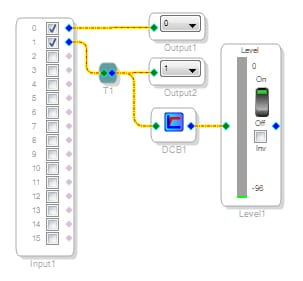
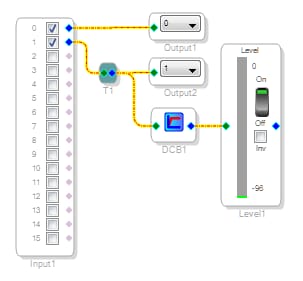
For your "analog in, analog out" test, I assume your project is straight-wire as shown here. If you haven't already done so, add a Level Meter to monitor the ADC level. This way you'll know for sure that you're operating at an optimum level, thus not suffering from transient clipping if too large, or resolution loss if too small. I show a DC Block filter ahead of the meter because these meters respond down to DC. Single-supply ADCs typically output a small DC offset to the DSP. Although this offset usually measures well below 1%, in dB terms it shows up alarmingly on the meter.
If available, try a S/PDIF audio input in order to isolate the difficulty between ADC and DAC.
The ADAU1452MINIZ does have one unfortunate limitation -- its AD1938 codec is hardwired to run at 48 KHz, forcing the whole thing to operate at this sample rate. Many high-end applications like yours run faster, although it could be argued that this is overkill. I wouldn't try this myself, but at least one brave soul has modified their ADAU1452MINIZ to allow programming its codec -- see https://ez.analog.com/message/76515#76515
I understand you're not complaining specifically about noise or frequency range. Also we often see measured specs used to deceive rather than to inform. However, it would help troubleshooting tremendously if your audible complaint could be quantified into something measurable. Thus you might consider running some usual performance tests on your board (the eval boards are 100% function tested, but perhaps not necessarily for audio performance). If like me you don't have a AP or similar analyzer available, the good news is that you can easily have your board measure itself! For example, try the Poor engineer's distortion analyzer at https://ez.analog.com/message/147007#147007
along with a 1/8" stereo cable to loop output back to input. You can also run a frequency response plot with the project I have attached below.
Best regards,
Bob
Guys,
Thanks so much for your responses, I'll answer the questions in order.
I'm using the evaluation board with the 1938 codec. In its simplest form i went from a high quality CD source, through an analogue volume control ( since one of the first problems i had was the analogue input stage clipping), then i wired the analogue inputs to the outputs in sigma studio as shown above. From here I went to a high quality class A hifi amplifier to the passive speaker. This was the simple implementation to try and determine the sound quality issue.
The main project is a stereo pair of two way speakers with FIR crossover filters and some IIR eq stages driving 4 power amp channels. Both projects shared the same characteristic loss in quality, which led me to believe there is some hardware issue.
Bob, I'll add the level meter as you suggest, we do have AP, also a DScope, i'll talk to our electronics guy about getting some measurements done in the next few days.
thanks again for all your help.
mat.
If you have an AP that would be the obvious tool to diagnose the problem. However, for engineers without access to tools like an AP, given that you have a digital source you can isolate the -1452 simply by sending and receiving your source via SPDIF. Given that you are using a CD, that will be a test of the ASRCs as I believe the eval kit runs off 12.288MHz.
Having received the output digitally back to your source interface, you can analyze it in comparison with the original using any number of software programs that are considerably less expensive than an AP. I am fond of Wavelab by Steinberg, but there are even free programs such as Rightmark.
Next, extend your test to include the -1938 I/O by creating a loop using your digital source to the -1938 output, routed back to the input and then again out via SPDIF back to your interface.
Thus you can test the performance of the -1452 ASRC and -1938 codec without needing any other analog components. I would recommend rather than attempting subjective listening tests that you use standard test signals instead, as the effects of SRC and ADC/DAC can be easily described by measurement.
You should also be aware that your application will require an analog volume control or at least a simple attenuator, as nearly all codecs operates on 3.3V or 5V supplies, not the +/-15V a professional analog line output stage will use. There are some exceptions such as ADAU1701 which has current-input ADCs, but even then the attenuation is merely implemented with a single rather than two resistors.
I implemented some output metering and had 20dB of headroom so that seemed fine.
I put the board on the Dscope which uses a swept stepped sine sweep, below is the response THD+noise, and idle noise. Nothing seems out of the ordinary here. Any thoughts?
Hello Mat,
Interesting, so explain what you have hooked up to the 1452 serial outputs? The sweep you just did, was that analog in to analog out using external ADCs and DACs or are you using SPDIF?
Dave T
Hi Dave,
This is using the eval board, analogue in straight wire to analogue out. I wanted to treat the board as a black box, same as the listening test.
mat.
If you are hearing audio performance that is reminiscent of data compression artifacts, I don't know that you will see that in a THD+N measure. You need to know what's in the noise & distortion spectrum. I would look at passband ripple & attenuation, aliasing or jitter products, impulse response.
Hi Jon,
Looking back I may have phrased my initial post badly, let me try and give you a bit more detail to work with.
Firstly it's probably good to say that I'm not an electronics guy, I'm a speaker designer so my electronics hardware knowledge is pretty limited.
My approach to electronics in general has been to assume that the digital part is probably working ok, and it's when things become analogue that problems can occur. Really this is a bias of mine because I work in an analogue domain, and asking around the office a straw poll reveals everyone to be suspicious of analogue implementations! However just because this bias exists doesn't necessarily mean it's the right answer.
So when I asked about an alternative DAC, what I really meant was 'a better analogue implementation' whether that's to do with the DAC itself, the analogue reconstruction filters, or the boards output stage. I kind of lumped it all together, and of course these comments can be applied to the input side as well.
My comment that the subjective sound loss is a bit like a lossy codec, could also have read: an output stage with low dynamic range, poor channel separation, high noise floor etc.
So my instinct is to say that this is an analogue problem, but as I say I have very limited experience with electronics, and of course I can listen to just the SPDIF through to validate this position.
Maybe you can comment further, now that hopefully I have been a bit more clear.
Thanks again for your help,
mat.
Hi mat,
I'm also using the ADAU1452 inside high power (mobile) audio system.
I also noticed this fatal distortion if the system fs is set to 96kHz on the evaluation board.
(Just switched it for consumption tests.)
Maybe this is your problem too? Don't forget (after changing the fs) to click the button next to the drop down to change the fs in your hole system, not only for a selected block.
With 96kHz none of the filter blocks (in my project) worked correctly. The filter corner frequency was far away, and the sound was like having lots of klirr.
Our target system uses CS5381 AD and CS4398 DA with differential in and output stage.
But also just running at 48kHz (512x oversampling).
2" compression driver, there is nothing >20kHz. Need the resources for other things ..
Just for fun, the one with the higher slew rate is a double precision 4 order LR at 2.8kHz at 48kHz FS.
The other one is a double precision 8 order LR at 3.2kHz (don't remember exactly) at 96kHz.
But as they told, the codec is hard wired to 48kHz.
Just a q&d measurement of an 1,75" compression driver (high smoothing).
As you can see, at 96kHz most of it is the natural roll off.
lasse
At this point you have a subjective evaluation of a loss in audio quality, and you have several steps in the process that could be at issue. If you are using the -1452 with analog I/O at its native 48kHz (or 96kHz) rate and thus bypassing its ASRC, you are testing its analog I/O as well as the -1938 codec. If you send SPDIF I/O at 44.1kHz, you are testing the -1452 ASRC and nothing else. That's why I suggested isolating those tests.
Data compression algorithms work by analyzing the content of blocks of audio and deciding for each block how much bandwidth needs to be allocated. When you get a quieter block without significant high frequency content, they will reduce bandwidth for that block. And there is the sound of that switching back and forth. This is of course dependent upon the compression rate set, but there is significant bandwidth limitation and inharmonic distortion with high data compression rates.
Nothing in -1452 is going to do exactly that because there are no processes that vary by content, but given your analogy I would suspect there was a bandwidth limitation or some inharmonic distortion. You are starting with a CD source, so you wouldn't expect a loss of bandwidth, especially if you operate the -1452 at 48kHz with the CD as an analog source. I would also not expect an increase in noise if you are feeding an analog input that peaks reasonably close to 0dBFS at the -1938 because your CD source will have less dynamic range than -1938.
Right now from your chart it looks like you have THD+N of about 0.01%, and broadband noise appears to account for most of that. That is a bit of a puzzle because -1938 should be closer to 0.001% noise input to output. There could be an analog stage on either side causing excess noise. I would try to isolate that by shorting the eval board's input and taking a SPDIF signal from that, then next testing its DAC into a known-quieter ADC for analysis. If you find that there is a analog stage creating 0.01% noise, that could solve your problem.
As for as channel separation, that's simple to measure, just perform your test above again with signal only in one channel, and analyze the other channel (again, terminate the empty channel's input).
Once you have sorted noise and crosstalk, if you look at the spectral content of your test rather than a single integrated figure, you can learn where the issue may be. Analog issues will show as harmonic distortion products which are multiples of the test frequency.
In the digital domain, both ADC/DAC and SRC are similar processes in that they involve filtering, possible aliasing, and for ADC/DAC, jitter. Digital sampling has to limit bandwidth rather strictly, and the quality of the filter employed can cause passband attenuation--that would really surprise me in -1452, and for -1938 that is stated in its datasheet, and it's very small. It was a more common problem in filters of 15 or 20 years ago, and in really low-grade consumer-oriented stuff. So I wouldn't suspect that, but you can check it by zooming in on your graph.
Digital conversion filters are usually FIR (finite impulse response), which are linear phase but have "pre-ringing", which means that they will spread some impulse energy *before* (and after) the impulse. Analog or digital IIR (infinite impulse) filters have only "post-ringing". There are various opinions on the audibility of this phenomenon, but it's straightforward to measure.
Aliasing is caused when a higher-bandwidth signal is downsampled without adequate bandwidth limitation. This is expressed as distortion products that are modulations of the sample rate and test tone (and are therefore inharmonic and much more audible if present). This can occur with ADC/DAC or SRC. Here is a website that publishes results of software SRCs, you can compare the aliasing, stopband, and impulse response performance of various routines--look at "Wavosaur" for a particularly objectionable response:
SRC Comparisons
Jitter is a problem of a digital clock that wanders; it is expressed as sideband modulations or it can lead to an increase in noise, or both. Here is probably more than you wanted to know on the topic:
http://www.audiophilleo.com/zh_hk/docs/Dunn-AP-tn23.pdf
Finally, you asked about alternative DACs, if your customers are very particular you can get better noise performance by using separate ADC and DAC rather than a codec like -1938. ADI has DACs that exceed -1938 by 10dB; they don't do as much with ADC, but there are others with similar performance. I work on the production side where noise performance is more critical; I can't imagine why playback should need more than 108dBA, but if you do it's available.
Hi Jon,
Thanks once again for your detailled reply. Looks like I will have to do some digging, I will reply back once I have some results.
mat.
Hi Heidi,
I double checked my sample rate and it's set to 48k.
Were you happy with the sound quality of the evaluation board?
For evaluation purpose, i think it is worth the money. Nothing special (in audio performance), but compared to 1701 with internal DAC significantly better.
I will do some measurements comparing evaluationbord (AD1938) to my implementation, but this will take some time, if you are interested.
If you are using high sensitivity driver there are differences between high quality output stages and the evaluation board with single ended and small output swing.
If you want to compare, you can just use the I2S (SDATA_0 / SDATA_1) stream from evaluation board to feed an external DAC. But first, you should clarify that this is not a soft- or hardware problem.
Hello Mat,
It is good that you are running this eval board at 48k fs. Just for anyone else who is reading this, the evaluation board can only run at 48k. The Codec is configured in standalone mode which is only at 48k. So if you run the DSP at a different sample rate you will get lots of distortion and audible artifacts from running the DACs and the ADCs at the wrong rate.
I have been looking at the design of the eval board and I need to do some tests in the lab. I will report back sometime next week with my findings.
Dave T
Thanks for your comments Heidi, I look forward to seeing your results.
Dave, thanks for looking into this, I will also try to make some more measurements next week.
mat.
WS = word select is the same as LRCK (Left/Right clock) it is the one who told the DAC if it is the left or the right channel data. You need to connect LRCK out from DSP to WS from DAC.
BCK ist the clock, it has the same frequency as the data. Every rising or falling edge the chip reads the data.
You must connect BCLK(ADAU datasheet) or CLKOUT (clock out) from DSP to BCK from DAC.
SDATA to data is correct.
GND connection is also correct and necessary.
Never heard from TWC, .. normally it is I2S, left-justified or right-justified, 16-24 bit.
Just take a look into the datasheet of the specific DAC, there is (always) a timing diagram that told you the right way.
Thanks for your help Heidi, it works fine now.
Just some measurements with "A Poor Engineer's Distortion Analyzer"
Singleended 0 dBV (=> 2VRMS diff) / 0 dBu (=> 1,55VRMS diff)
0.00066% (-103,6dB) / 0.00088% (-101,1dB)
Datasheet D/A -107dB THD+N
Datasheet A/D -110dB THD+N
Sound Quality is a subjective feeling, for my ears it sounds good, there are lots of more important things in the audio chain than THD performance of modern A/D D/A.
Will do some measurements in the laboratory (without switching supply and external spectrum analyzer).
But for me, in the end real world specs are more important than laboratory specs.
What is the best way to set 192khz sampling rate In adau1452 evaluation board?
As i sad on diyaudio, the codec is hard wired to 48kHz.
"What is the best way", .. for the evaluation board, there is only one way.
If you want to change the configuration take a look into this user guide: http://www.analog.com/media/en/technical-documentation/user-guides/UG-045.pdf
What is your intention of changing the sampling frequency?
Higher sampling rate ≠ better sound quality.
regards,
(Fio)
If i use audio flac 48kHz is very Low sampling rate and i think there is a poor quality
Hello Francesco,
To make this evaluation board as simple as possible we setup the codec in standalone mode. In this mode it can only run at 48kHz fs. The standalone mode is configured by tying most of the comm port pins to ground. One pin is to select master or slave operation. So on this eval board all the pins are tied to ground. If you have the equipment and skills to do what I call "micro surgery" then you can modify the board. codec pins 23, 24 , 26 and 27 would have to be cut away from ground and then wires soldered directly to the pins of the codec. Then wires would have to be connected to the SPI communication lines and the slave select tied to the second SS line of the USBi.
The good news is that the ground connections to the pins are not under the part so you can get to them. But, it is really close to the pins. This will not be easy to do but it is possible. Then you can use SigmaStudio to program the codec into any mode you like.
I can give you more specifics if you decide to attempt the modification. Do keep in mind that this modification will void the warranty for the evaluation board.
Dave T
This question has been assumed as answered either offline via email or with a multi-part answer. This question has now been closed out. If you have an inquiry related to this topic please post a new question in the applicable product forum.
Thank you,
EZ Admin
Please log in to reply.