1st-order filter implementation question
Hi forum,
I was wondering if there is anything wrong with the definition of the first-order filter in the help of SigmaStudio.
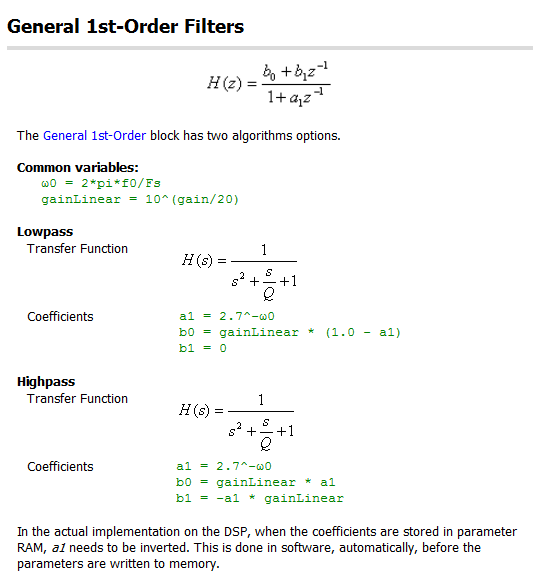
I found the following definition for the first-order filter:
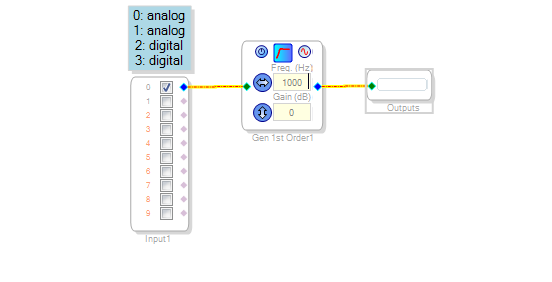
However when I am trying a high pass filter with a cut-off frequency at 1000 Hz then get the coefficients that appear below:
Now, if the definition of the implementation is right, then for a gainLinear operator of 1 (meaning gain 0), for a highpass filter, I should get a1=b0=-b1.
But clearly this is not the case as the 3 coefficients that are being produced in SigmaStudio are not all the same.
Could you please enlighten me on if I am missing something?
thank you


Moving to the SigmaStudio forum for discussion.
-Joe
Hello dimitris,
The formulas above are OK for lowpass, but Steven W. Smith's DSP book shows different ones for hi-pass (it also swaps the "a" and "b" coefficients compared to SigmaStudio's convention, besides flipping the sign of the "a" coefficient). Here's how to calculate the coefficients (these formulas cover only the case of gainlinear = unity):
fo (cutoff freq) = 1000 Hz
fs (sample rate) = 48000 Hz
First calculate w = 2*pi*fo/fs = 0.1308997
Then, calculate x = e^(-w) = e^ (-0.1308997) = 0.8773
Finally figure the coefficients: b0 = (1 + x) / 2 = 0.98365
b1 = - bo = -0.98365
a1 = x = 0.8773
One of the General Second-Order filters allows you to type in coefficients as shown above -- this is handy when troubleshooting coefficients.
Best regards,
Bob
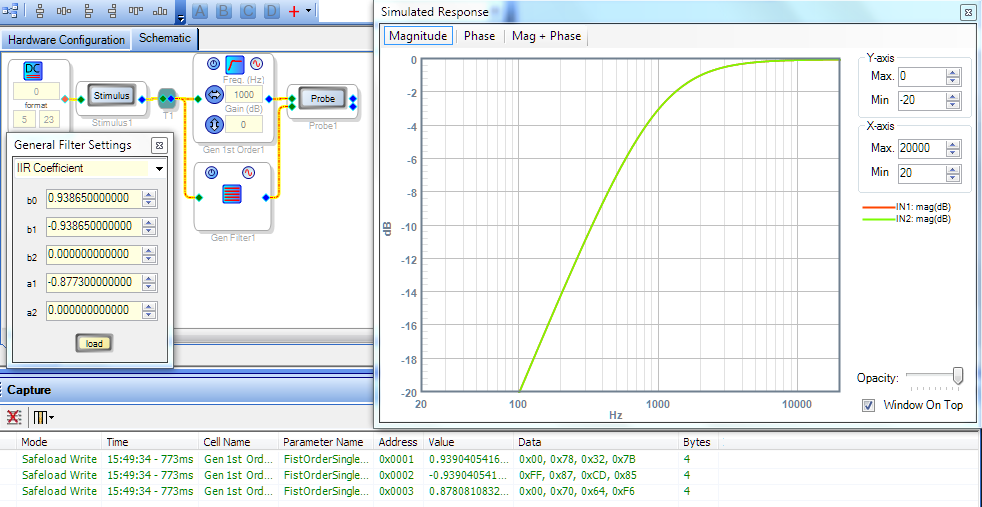
Hello once again,
The book I referenced for the above answer is available for download at:
The Scientist & Engineer's Guide to Digital Signal Processing
The particular chapter is Recursive Filters, at:
http://www.analog.com/media/en/technical-documentation/dsp-book/dsp_book_Ch19.pdf
Best regards,
Bob
Bob,
thank you very much for your replies and youre references, I will give them a look right away.
regards,
Dimitris
Please log in to reply.