Hand held device for "tuning/equalizing" a live band
I would like to request that this discussion remain confidential as it exists between myself and anyone willing to participate. Thank you.
i am looking to develop a specific device for use by musicians in live music venues.
The device is a hand held gauge with a digital display that would allow a user to view decibel levels and frequency values of a live band (rock band, jazz band, etc) in real time. The dB and frequencies will be read by an analog/stage microphone (Sure SM57, for example). While reading these levels in real time, i would like the device to have preset EQ setttings (rock, jazz, R&B, etc) that could be superimposed over the real-time dB and frequency values. The EQ settings would be stored in a digital library, within a computer, inside of the hand-held gauge. There would be a range of EQ settings that could be superimposed over the real-time dB and frequency data that would be specific to certain instruments and band configurations.
This is the general idea. I need help putting together the hardware necessary to achieve a device capable of doing these things. Can you help? Thanks
Hello,
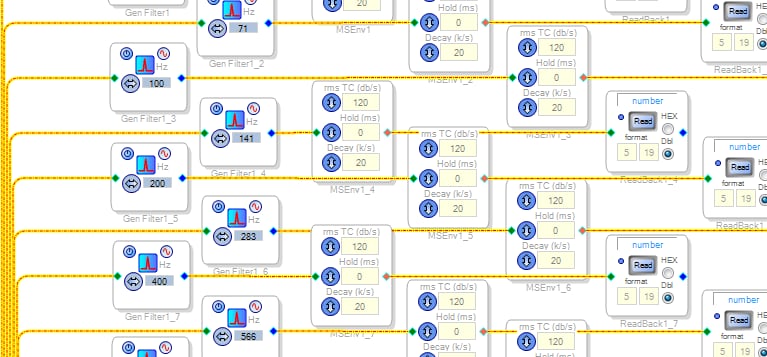
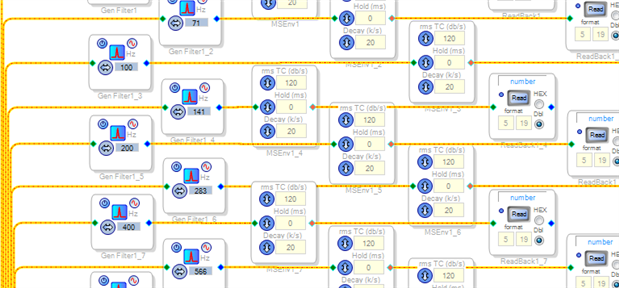
If you would like to build a "analog" filter-based RTA with perhaps half-octave bands covering the audio range, the ADAU1701 will do the job. It can handle about 18 -- 20 filters, each with RMS measurement. The SigmaStudio flow for such an arrangement is easy to make -- a portion of it appears below:
The -1701 has built-in analog to digital conversion, so you'll won't need a separate codec. It also has four analog D/A outputs, in case you wish to add a headphone output (etc). You'll need a preamp IC between the mic and the -1701 input, perhaps a SSM2166 will do. The ADAU1701 needs 3.3V at about 110 mA.
If you're looking for better frequency resolution (more than 20 frequency points in the display), other SigmaDSPs are available. For example, the ADAU145x series can handle more frequency bands in above fashion, or could do a FFT (Fast Fourier Transform). This provides many bands (up to 1024), but they're linearly spaced, while your final display would likely be log-spaced for a musical application. The -145x DSPs have no on-board A/D converters, so you'll also need a codec IC.
As you said, you'll need a computer (microcontroller) to read the audio values from the DSP over its I2C or SPI interface, then translate these numbers for display. The best uC to use is often from among those you're already familiar with, and for which you have or can easily obtain tools such as a C compiler. Finally, the LCD display itself, which tends to be expensive in small quantity.
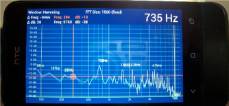
All this being said, any second-tier smartphone has the needed hardware already neatly packaged, with great economy of scale. Inexpensive RTA apps do most of what you're looking to design -- missing only the recommended curves. True, the dynamic range of the phone's built-in mic is generally not up to live-band sound levels (at least, not with my phone), but it should be possible to interface a good mic to the phone. The SM57 is an excellent choice.
Best regards,
Bob
Bob,
this is all incredible information, i really appreciate the input. i'm a mechanical engineer by trade so my electrical skills are limited and you have been a great help. for some reason i had not considered using a phone as an interface...
would you have any suggestions towards assembling a bluetooth device to allow communication between a phone with this program and any microphone with an XLR output?
Hi,
Thanks for your reply. I'm afraid I have no experience with Bluetooth, perhaps someone else on this board does. I was thinking simply of going analog -- adapting the mic directly to the phone's headset/mic jack.
Bob
Bob,
could you explain further what you mean by "adapting the mic directly to the phone's headset/mic jack"?
Do you mean bridging the output of an analog mic and the input of the XLR cable leading to a mixer board with a device that communicates back to the display interface?
Hello,
Come to think of it, a direct cable connection from an existing mic line at a mixer input to another device is probably not a good idea. As you know, mic level is very low, thus these signals can be degraded by hum and such. Plus, since your application is handheld, a wire connection would be inconvenient. My answer above was deliberately vague because I really don't know the kind of connection phone input jacks need, or how consistent this is among phone manufacturers. Thus, "adapt" means you would need to do the research to see whether it's feasible, and the engineering to make it work.
Your Bluetooth idea could solve these issues, although again this is another area I have no experience with. Since this forum page is for SigmaDSP processors, not many engineers who read posts here may be able to assist you with this.
Best regards,
Bob
KJBob is a SigmaDSP genius, but as a microphone guy I have to object to the SM57 being used for RTA. As a cardioid dynamic mic, it has poor high frequency response and poor farfield low frequency response. Also, since it is a dynamic mic with a low output you'd need a significant amount of gain from the amplifier before the ADAU. Mics used for RTA are almost universally small omnidirectional condenser microphones.
Just about any $1 omnidirectional electret element will be far superior to an SM57 for RTA, and they are small enough to include in your device, perhaps via a wand connector if you want to minimize the effect of the case on the response of the microphone (you will find products like that for smartphones). You should take care to design a proper circuit for the microphone capsule as the circuits shown in most datasheets will not yield high SPL handling.
I recommend Primo as the best available capsules, but they are a bit more expensive than their competitors and for your use you really don't need sound quality, just flat response. That will be common to most small omni electret capsules. You don't want the user to select any random microphone as you will have to correct for the response of that microphone; and for directional microphones, also the angle of incidence and distance to source, as both factors affect their frequency response.
I can offer more advice but I don't have a sense of your product's niche--you might be caught between cheap RTA apps for smartphones and rackmount RTAs like the dbx Driverack system. I don't understand what you want the device to do once it has performed its analysis.
Hello jon71,
You're absolutely right as to what to use for a self-contained RTA -- my impression was that Elements.Instruments wanted to tap into an existing mic already on the stage.
You're also right about the positioning of his proposed equipment in the marketplace, as smartphone apps have taken over the accessible end in this and tons of other applications. Thank you very much for your clarification.
Best regards,
Bob
Bob, I suppose that could be appropriate if the user wanted to EQ the signal from individual stage instruments, which is a typical application for the SM57. That would require that either the device be placed as an insert in the mixing console, or a split run off the mic to the device. In either case, the device could recommend but not detect any EQ changes made because the PA system output must be relatively small at the microphone compared with the instrument signal, otherwise positive feedback would be an issue.
Again, we need clarification as to the goal of this device.
The specific application for this device is for the garage-band/touring musician who only has access to the "sound guy" that doubles as a door man and bus boy. In this case, the band or performer will almost always end up mixing the stage sound themselves, if there is even a mixer board. This situation is more common than you might think for the working musician.
I was mainly suggesting ideas when i mentioned using an SM57 because it is one of the most available, general use mics in these live music situations. Ideally, a smart-phone interface with an external plug-in mic would be the way to go. Working musicians can afford a free/minimal cost phone app and a cheap external mic. The value for the musician, especially older musicians that have lost certain frequency ranges in their hearing (also more common than you might think), is that they could "tune" a particular setup from standing in front of the stage and using this system. Using this system, they should be able to tell another musician on stage that they are too loud for the overall mix, there's too much mid-range in their bass sound, the kick drum should be the only drum mic'd up, etc.
They would achieve this by matching frequency ranges, picked up by the phone and mic, to "filter" presets that show frequency and decibel charts on the phone interface; this would not be unlike choosing an EQ setting on your car stereo.
Thanks for all of your help with my inquiry. Let me know if i need to clarify anything else
I am very familiar with broke musicians as I am one, and I market my products towards them as well I also have little hearing above 8kHz in one ear, but up to 16kHz in the other, and tinnitus in both. So I know what hearing loss is like while also knowing what good hearing (for my age) should be. Long ago I also used to play while doing monitor and FOH mixes from stage and sending a 4-channel output to a cassette recorder. So I've been there too.
But I don't think the product you are describing will be inexpensive. In particular, this statement:
Using this system, they should be able to tell another musician on stage that they are too loud for the overall mix, there's too much mid-range in their bass sound, the kick drum should be the only drum mic'd up, etc.
Requires coding an expert system with analysis on the level of the most sophisticated tools currently on the market. First, you have to receive the signal through a microphone with defined response--that's the easy part. Next, you have to isolate the various instruments on stage through spectral and/or harmonic analysis. Then you have to figure out what instrument that is (or have the user tell you). Finally, you have to have not a single EQ curve for comparison, but multiple EQ curves by musical style and instrument for comparison.
Needless to say this is probably beyond SigmaDSP territory--you should investigate products like Melodyne, spectral editing plug-ins, the Driverack system, mastering plug-ins like Har-Bal and Ozone, the UAD DSP system plug-ins, to see what they are able to accomplish. UAD in particular uses multiple SHARCs in their DSP solutions.
A SigmaDSP could analyze a signal by a limited number of frequency bands and correct in a dynamic fashion based upon a number of preset curves, as KJBob illustrated. I have thought about doing a tool like that for my userbase, many of whom are unsophisticated and not knowledgeable about proper EQ, and need very small, simple solutions to process a stereo mix only. It would work for room correction on a stereo mix.
You couldn't easily inject a SigmaDSP in between a full stage of instruments and a PA, at least not without upscaling the system to enough ADC and DSP to handle at least 16 inputs, and having on the analog side the capability to handle pro-level input and output. You would be competing with digital mixers like the Presonus StudioLive series, which have the ability to be remotely controlled via iPad.
In between would be something like an Android app where the user selects the style of mic and the instrument, has each instrument play one at a time, and the program recommends EQ and volume changes for each instrument. There isn't really a need for a SigmaDSP to get involved in that process because you would be making all of the changes on the analog mixer. You just need a high-SPL handling omnidirectional electret capsule and a good coder for your app. And of course, you have to know what the EQ curve and levels for all of the combinations should be.
This question has been assumed as answered either offline via email or with a multi-part answer. This question has now been closed out. If you have an inquiry related to this topic please post a new question in the applicable product forum.
Thank you,
EZ Admin
Please log in to reply.