ADAU1701 WP pin always high?
Hi,
On a project I'm doing with the ADAU1701, I'm implementing a touch-controlled volume push button with the GPIO's pins of the chip.
The design will not save the volume that was setted when powering down the device. In other words, the ADAU will start always with the same pre-defined volume level.
To implement this in SigmaStudio, I saw I have to add an interface read/write to be able to compile the project (in order to not leave the yellow pins of the PushVolM1 unconnected (picture attached)).
In the evaluation board, the WP pin of the ADAU1701 is always HIGH. The WP of the E2PROM has a switch to pull it down while burning and then pull it HIGH for protecting overwrittings when running in selfboot.
The WB pin on my design is always LOW, so the writeback to the E2PROM is disabled.
And now the question: if in the SigmaStudio project there is an interface read/write but in hardware design the WB is LOW, and both ADAU and E2PROM WP pins HIGH (running in selfboot mode), will there be any problem?
I hope I explained myself.
Thank you,
Marti
Audio Signal Processors
SigmaDSP Audio Processors
adau1701
Hello Marti,
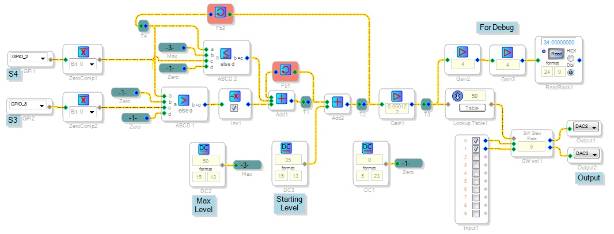
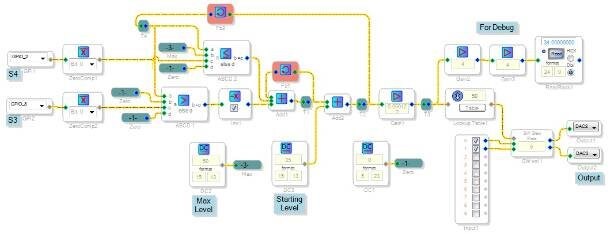
If you would rather avoid the interface write altogether, you could build your own push-button volume control from basic blocks. An example is shown below
Pressing S4 increases the volume, S3 decreases it. The ABCD Comparators serve as "limit switches" to prevent the count from going negative or above 50, the size of the volume LUT. Upon power-up volume starts at the preset level.
Best regards,
Bob
The ADAU1701 evaluation board has a built in WB trigger. It will initiate a WB upon power loss, however the design sucks and is inconsistent at best. The WP pin on the board can be switched between states, pull down to enable writing to the EEPROM, Pull up to enable WP and protect your data. In either case the WB trigger will take control of the WP pin, when WP is switched low, disabling the WP, the DSP can WB the EEPROM. If the WP is switched high, upon a WB trigger, WP is pulled low (From DSP), allowing the EEPROM to be written.
So if your using the eval board, and you don't want the WB feature, you need to lift the WB pin and ground it. Take the transistor out of the circuit. Also, the WP pin on the ADAU1701 is used to pull the WP pin on the EEPROM low, so it should not need to be connected if not in use.
As far as I know, WB is mostly a hardware feature, with some register control. I don't think your SigmaStudio configuration will have much influence on the WB if through hardware, you disable the feature.
Hi twidget,
Thank you for your answer. Yes, the evaluation board it's sometimes a bit confusing.
In my hardware setup I have the WB pin connected to ground. So, for waht I need, I understand I can left the WP pin on the ADAU always HIGH, and change the WP of the E2PROM with a jumper (for example) when I need to burn it. I will control when the E2PROM (via the jumper) can be written, not the ADAU.
Thank you,
Marti
Hi Robert,
Thank you very much for your answer and for the time you spend writting that project in SigmaStudio.
I'll make the hardware setup like twidget suggested. I have to build a prototype, and I need to minimize the risk of errors, as we are a recent company of students and we don't have much resources.
I'll will also avoid the interface write as you suggest and I will try your design.
I also wanted to ask you for a value. What it does the number '9' in the SW vol 1. By default it comes with a 12.
Thank you so much,
Marti
Hello Marti,
The Slew External Volume Control's parameter controls how slowly volume moves from one level to another. The higher the number, the slower it reacts to changes at its control input. The default value of 12 smooths out abrupt jumps in volume, but since the push-buttons already operate slowly, a lower number is adequate. Thanks for marking my answer as correct, and wishing you success in your new business.
Best regards,
Bob
Please log in to reply.