What is max PWM frequency and resolution in ADAU1701?
Hello,
I am figuring out some ways to use the VCO pulse block to generate PWM. What is the maximum frequency it can produce? Also, what is its resolution?
Thanks!
Audio Signal Processors
SigmaDSP Audio Processors
adau1701
Hello ssanchez,
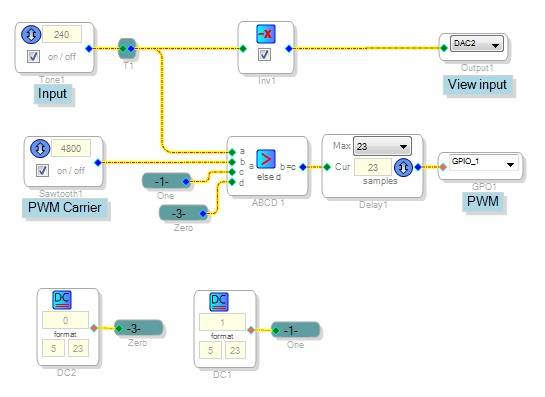
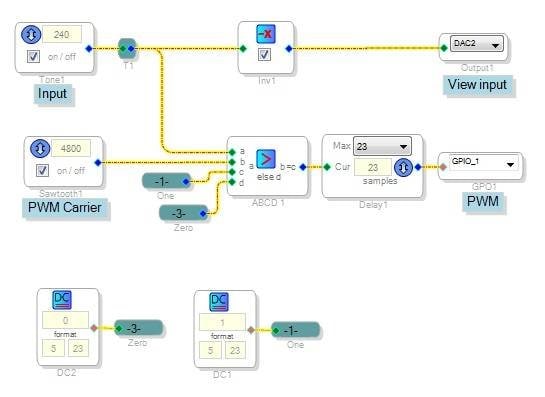
In SigmaDSP everything happens at sample intervals, which severely limits the available PWM resolution. At the -1701's maximum sample rate of 192K, the PWM output can only update at 5.2uS intervals. This makes it difficult to pick a good PWM carrier frequency, because the number of samples per carrier period ultimately determines your resolution. Consider the circuit below, where a carrier rate of 4.8 KHz was chosen. With the circuit operating at a 48K sample rate, 10 PWM transitions occur during the time that the PWM ramp goes from -1 to +1. The -1 to +1 range is thus divided into ten voltage bands, resolving only to the nearest 0.2 volt. Meanwhile, the Nyquist frequency for this arrangement is half the carrier rate, or only 2.4 KHz -- not enough for audio. Increasing the carrier frequency only worsens the voltage resolution.
The delay and signal inversion shown below compensate for the DAC's delay and inversion.
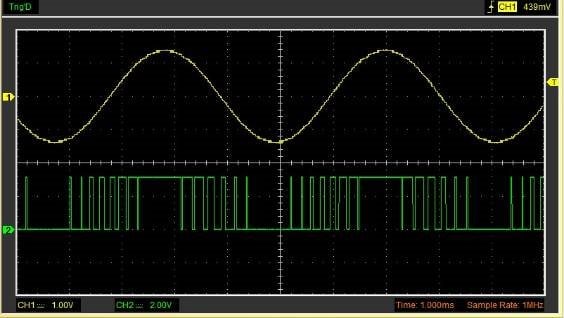
The circuit's waveforms demonstrate these effects -- the PWM output cannot resolve the tops and bottoms of the sine wave, resulting in visible "dead spots".
Thus, a -1701 cannot do audio PWM (as for a Class-D amp) on its own. Lower frequency PWM such as for motor control may be feasible. Also please see these posts:
https://ez.analog.com/message/12246#12246
https://ez.analog.com/message/49197#49197
Best regards,
Bob

Thanks a lot. I was not thinking in Class-D amplification (today it is still better to do it analog) but for motor control, etc, with a PWM frequency below 1KHz. That gives 48 possible speed steps at 48KHz Fs.
What is max PWM frequency and resolution in ADAU1451?
Hello Francis,
The 1451 can operate the core at a higher sampling rate. You can run it at 384kHz or 768kHz but the problem becomes the serial ports cannot run that fast. You can run a GPIO to get the PWM output but getting analog audio in or out at that rate would be a problem. That said, you could use sample rate converters and you can do some tricks with the serial ports to get a higher rate but that is a subject of a much longer involved thread.
Dave T
Please log in to reply.