Allowable Sample rates for the ADAU1701
Hello All
The ADAU1701 has a maximum sample rate of 192kHz. However the datasheet does not specify a minimum sampling rate (that I can see anyway). If I use a lower crystal input frequency or select a lower divide ratio, I can clock the device at a lower rate. I realise I cannot get any more instructions due to memory restrictions but I need a lower sampling rate for improved accuracy at lower frequencies.
Is it allowed to run the A/D and D/A systems at 24kHz on the ADAU1701? I know this cannot be done on the evaluation hardware but it can easily be arranged on custom hardware.
The only clue is in the datasheet. The normal 12.288MHz clock is used in the 256 x Fs configuration. 12.288MHz is 81.38ns clock period which is within the 73-488ns allowed for this configuration on the datasheet (page 7).
For the 64 x Fs mode the maximum clock period is 1953ns equating to a clock of 512032 kHz. Dividing this by 64 gives 8000.512Hz which tends to indicate that the converter can work down to 8kHz?
Thanks
John
Audio Signal Processors
SigmaDSP Audio Processors
adau1701
Hello John,
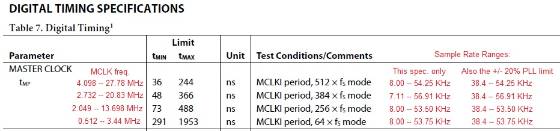
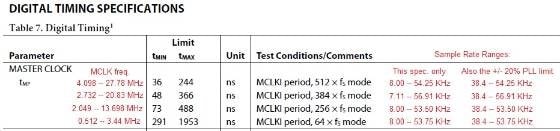
Based solely upon the MCLK period specifications, your math is correct. However, these specs appear to conflict with the PLL lock range:
When taking both specifications into account, the allowable sample rates fall into narrow bands around the nominal 48/96/192KHz. Posts such as https://ez.analog.com/message/7712#7712 support the narrower figures shown in the last column below:
Best regards,
Bob


Thank you Bob!
You are correct that the PLL in this part does not offer great flexibility for sample rate. In order to guarantee operation under all conditions, I would recommend that you stick to the range of 44.1 - 48 kHz (+/- 20 %).
Best regards,
Coleman
Hi Coleman,
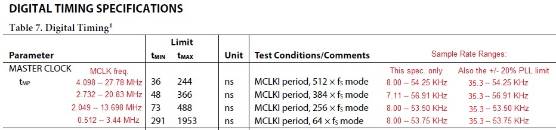
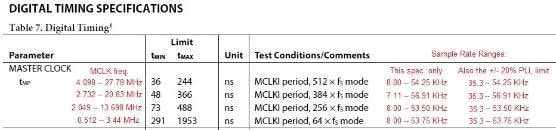
Thanks for the clarification. Since 44.1K extends the lower tolerance range (rather than merely being included in it) the permissible lock range is wider on the low end than I described above. Revised numbers are shown below:
Best regards,
Bob
Thanks for your clarification on this. I can't help thinking that it would not be unreasonable for the datasheet to clearly state the sampling rates that can be obtained using this device.
Regards
John
Since you can run at normal, double, or quadruple rates, I guess we can extrapolate and say that the (worst case) allowable frequencies are:
35.3 kHz to 53.50 kHz
or
70.6 kHz to 107 kHz
or
141.2 kHz to 214 kHz
...right?
Yes - I think those are the sample rates that do not violate any of the datasheet parameters.
John
This question has been assumed as answered either offline via email or with a multi-part answer. This question has now been closed out. If you have an inquiry related to this topic please post a new question in the applicable product forum.
Thank you,
EZ Admin
Please log in to reply.