ADAU1452 for Digital Volume control
Hey Guys,
I have been doing a bit of reading on digital volume control and the good/bad, now i seem to run across dithering used as a solution and talk of 32bit devices doing this without interfering in the 24bit audio stream. Would the 1452 be a possible solution to solving the issues?
Can i pull a 192/24 signal into the 1452 real time attenuate and spit it back out in 192/24 with no loss in quality?
Im new to the whole digital world so any explanations would be gratefully recieved
Thanks Guys
Audio Signal Processors
adau1452
SigmaDSP Audio Processors
Can any one explain this?
Hello Graeme
Dithering can typically add a bit or two of additional resolution when digitizing an analog signal -- see Chapter 3, page 38 of Steven W. Smith's book The Scientist and Engineer's Guide to Digital Signal Processing, available here: http://www.analog.com/en/content/scientist_engineers_guide/fca.html
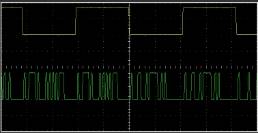
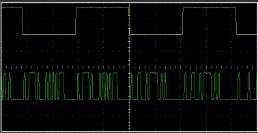
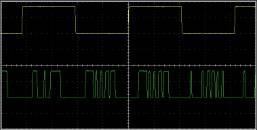
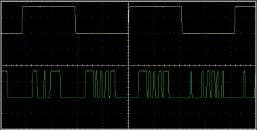
I'm afraid I'm not familiar with its use in volume control. However, I don't see how it's possible to attenuate the 24-bit stream you described while maintaining full quality. Regardless of the processor's word length, the 24-bit serial link limits your resolution to 24 bits at full volume. Each 6 dB of attenuation inactivates a high-order bit -- at 24 dB attenuation you have a 20-bit signal remaining. This becomes very clear if we examine two I2S streams, the left one at full volume, the second attenuated. We see less activity in the attenuated stream:
If you could share the dithering reference you mentioned, that may help me understand the issues involved.
Best regards,
Bob
Hi Bob
I have attached the article
Its based on 16 bit signals and you can see he explains when you add an 8 bit gain factor it becomes a 24bit word length, I'm guessing at the time the article was written the 24 bit DAC's were in their infancy.
My question is if we take the same 8 bit gain factor and add it to the 24 bit signal am i correct in thinking that the word length would be 32 bits?
If thats correct can i process this in the 1445 to leave me a signal thats both attenuated and still at its core a 24 bit signal?
My digital background os pretty limited so I'm probably missing something here I'm sure
Graeme
Hi Graeme,
In theory you can do this. The ADAU1452's hardware supports 32 bit audio I/O on the serial ports, but it's my understanding that the corresponding input/outputs have not yet been integrated into SigmaStudio.
Still, you would need a 32-bit DAC on the output side. Otherwise, you're losing bits (and signal integrity along with it), like KJBob mentioned.
Remember, attenuation effectively bit-shifts the signal. This means that bits containing information are shifted down, and that information will be lost if those bits are not output by the serial port.
I can make a diagram if you're still having trouble picturing this. Let me know.
Thanks Yagami
I thought this might be the case, the whole system would need to be 32bit. I was hoping there was maybe a way to re package the signal after attenuation.
Im curious how this is done from computer based software. A lot of studios are going all computer based and using digital outputs to monitors.
Graeme
Hi Graeme,
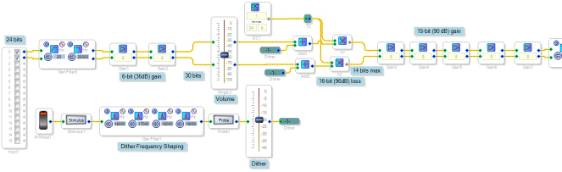
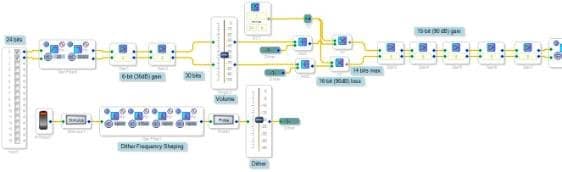
Thank you for sharing the article, it's interesting. The author got a surprising amount of benefit from high-frequency dithering the eight-bit samples. You can partially demonstrate this effect with your -1452 mini eval board. The circuit below boosts the audio level to 30 bits (I left two extra bits for headroom). Then you adjust attenuation as desired, after which the dithering is added. Next it purposely decimates this signal by shifting the last 16 bits overboard. If you set the attenuator to -60 dB or so, there aren't many bits left and you can hear the quantization effect. Switching the noise (dither) source ON makes it sound better, although the dither in this case is in-band and thus audible. The eval board's AD1938 codec is hardwired for 48KHz, thus we cannot explore the further benefit of 192KHz operation with ultrasonic dither.
Note that many A-D and D-A converters, though accommodating 24 bits-wide signals, do not actually perform to that level. 24 bits implies a dynamic range of about 144dB, but for example the AD1938 codec is rated for about 110dB (about 19 bits worth). Thus in practice you can lose a few bits and not hear the difference at all.
Best regards,
Bob
Robert Blowsky wrote:
Note that many A-D and D-A converters, though accommodating 24 bits-wide signals, do not actually perform to that level. 24 bits implies a dynamic range of about 144dB, but for example the AD1938 codec is rated for about 110dB (about 19 bits worth). Thus in practice you can lose a few bits and not hear the difference at all.
Good point, KJBob. I was about to mention that as well.
16 bit audio has a theoretical noise floor of -96 dBFS, and most ADCs and DACs can out-perform that. However, the theoretical noise floor of 24 bit audio is -144 dBFS, and most ADCs and DACs don't even come close! Thanks to thermal noise (electrons moving around due to heat) and all of the electromagnetic noise in our environment (radio, solar interference, EMI/EMC in electronics, and so forth), 24 bits is pretty much always overkill. Going for 32 bits in an audio application doesn't really make sense to me.
This question has been assumed as answered either offline via email or with a multi-part answer. This question has now been closed out. If you have an inquiry related to this topic please post a new question in the applicable product forum.
Thank you,
EZ Admin
Please log in to reply.