Spectral limiter
Hi,
Firstly, I am newbie in the Audio Processing world, sorry in advance if I am wrong in some questions.
I need to design a dynamic limiter for audio spectrum, known as spectral limiter at least 1/3 octave resolution (Does it mean 30 frequencies total?).
An old model that I saw (20 years old), includes a microphone as a sensor to collect the sound in real time and equalize another input line for each frequency in a DSP (an old TMS320 series) and several RAM chips. The equalized line has a delay produced in the processing, and the resulting audio is the desired limited spectrum. I need to renew this device and would be fantastic that a sigma processor could do the job. Is it any way to do the limiter with certain model of sigma processor? or it is mandatory the use of a powerfull DSP. Somebody point to me in the direction of the optimal solution for this system?
Thank you in advance.
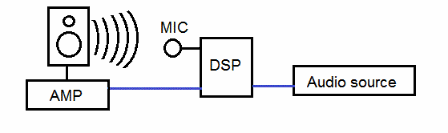
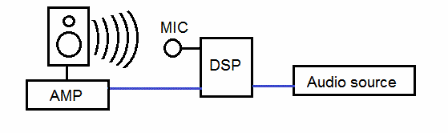
Hello again,
Yesterday I knew less of this audio world than today, and probably my question was generic and desperate, sorry.
I think that I can sample the MIC signal with another device and change audio parameters by SPI bus in the Sigma processor ADAU1702 (for example). My trouble is the time required to operate each frequency by commands, supposing arbitrary frequency limitation (in the 20Hz-20kHz span). It is a dynamic operation through an SPI of 6,5MHz of max. speed (4 bytes per instruction). I saw that this devices has a 40ms delayed memory, Is it means that I have 40ms to operate over signals before they be converted to analog at the output?
Hi Wallaby,
Sorry your questions have been sitting around for awhile. Let's start with the easier ones:
The "40mS delay memory" refers to the pool of available data memory, used for various purposes such as filters and (of course) delays. Some applications such as reverb need more than that, but 40mS is enough for many projects. The actual delay through the chip (from analog in to analog out) is about 1mS, plus any purposefully added delay.
1/3 octave does suggest about 30 total frequencies for the full 10 octave audio range.
Use the safeload method to write any parameters into a running SigmaDSP. This avoids audible artifacts during loading, but adds overhead to the I2C or SPI data transfer.
Best regards,
Bob
Hi Robert,
You are right, is the starting point of my calculations: 30 freq * 4 bytes command (min) * 20Khz = 19.2Mbps at least for a dynamic and real time response. In this time I learned that this kind of device is based on real time fft calculations and then adapting the coeffs to the output. I am more familiarized with this kind of calculus. I think that my first approximations were in the time domain, but in the frequency domain seems more friendly.
Thank you for your response.
Best regards.
Please log in to reply.