High THD on ADAU1701MINIZ eval board normal?
Testing out a new (Mouser) ADAU1701miniz eval board and have a concern about high THD. THD exceeds 0.2% at high audio frequencies at input levels 3dB below full scale. See attached. Configuration is a straight stereo in-out. no processing. Have disabled the on-board class d amp, reset, etc.... My 1761 eval is 10dB better and a "MINI-DSP" version of the 1701 is 15dB better. Do I have a bad unit or ??????
Hello, and welcome to the forum!
The EVAL-ADAU1701MINIZ's design placed emphasis on compactness, low cost, and ease of evaluation. Therefore, less priority was placed on audio performance, and as a result, the noise and distortion of that evaluation board are worse than what you would find in a design that placed priority on performance.
One of our forum members compared his own prototype board's performance to the EVAL-ADAU1701MINIZ and found that his prototype performed significantly better. You can see his results here: https://ez.analog.com/message/75252#75252
We have started an FAQ describing some PCB layout best practices that will help to improve audio performance.
Hello,
For reference, I'm reading about the same on my -1701 board: 0.15% at 5KHz.
Best regards,
Bob
Robert,
Thanks for confirming the problem.
I purchased another demo board and THD was the same. While I appreciate Brett's comments I would like Analog to take a more proactive approach to the problem. The demo board's performance is an order of magnitude worse than the spec with regard to THD. I understand that compromises were made in laying out the demo pcb but can the designers specifically address those compromises and their contributions to the poor performance? My suspicion is co-mingling of the various grounds is the primary cause but need I invest many man hours and dollars on prototypes to confirm this? I have to believe that someone at AD can provide a little more analysis of the problem and some solid recommendations so potential customers will have confidence that the part will perform to spec.
Hi John,
The increased THD that you are seeing is likely caused by the ceramic AC coupling capacitors on the ADC side of the ADAU1701. I used this type of capacitor because it is popular in many low cost designs, because of cost and space considerations. If you replace these parts with an electrolytic equivalent, you will probably see the THD+N drop to numbers that you will find in the datasheet. I wrote an FAQ (published by my colleague JeradL) about different types of capacitors, and I apologize that we do not include this information in the User Guide for this board:
https://ez.analog.com/docs/DOC-1442
In my experience, a single, solid ground plane along with a parts placement that avoids crossing current return paths, is the best way to design a circuit board that is low noise, high performance, with good signal integrity and good EMI performance. My design of the EVAL-AD1955EBZ DAC board uses a single, solid ground plane and these boards routinely measure better than 120 dB SNR and -112 dB THD+N.
Our EVAL-ADAU1401AEBZ eval board should demonstrate the part in its best light, and will also allow you to use the GPIO ports when you plug in the GPIO expansion boards that is included in the kit.
https://www.analog.com/en/evaluation/EVAL-ADAU1701/eb.html
Thank you for considering our parts. Please do not hesitate to post again if other questions come up.
Best regards,
Coleman
Hello Coleman,
Thank you for your reply.
I replaced C35 and C36 (the 10uF cer coupling) with good quality 47uF electrolytics. Distortion curves virtually identical. These caps are clearly not the main cause of the distortion.
Do you have any other recommendations I might try?
Regards,
John
Hi John,
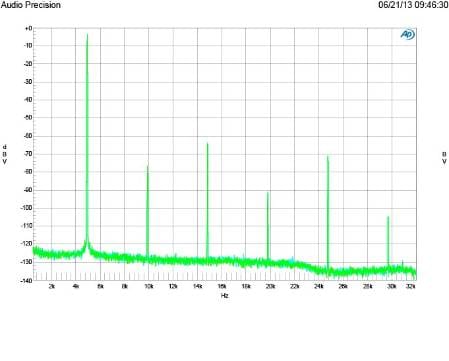
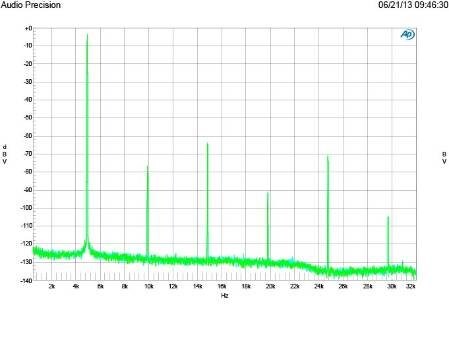
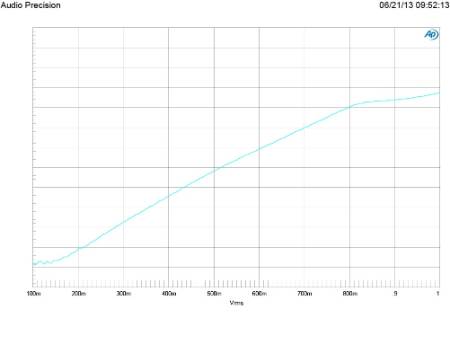
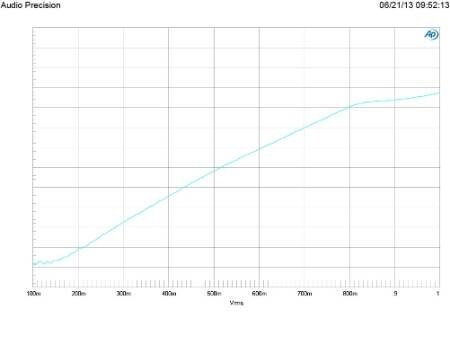
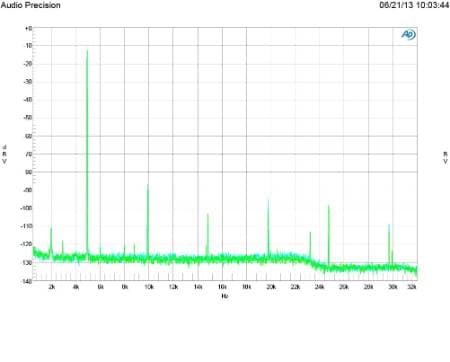
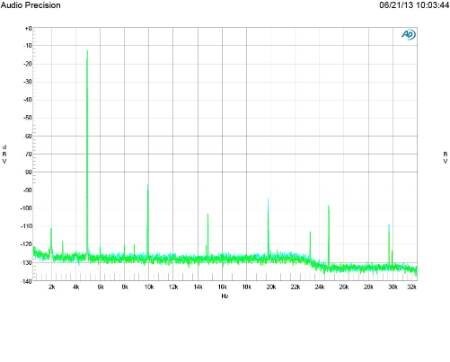
I have duplicated your results, shown below. These sweeps were done with a 500 mV, 5 kHz signal on the EVAL-ADAU1701MINIZ. my SigmaStudio program simply connects ADC0 and ADC1 to DAC2 and DAC3, with no algorithms in between. I did not find any significant differences running the AP in either grounded or floating, and the USBi-supplied 5 V appears to add a tiny amount of extraneous noise, but nothing significant.
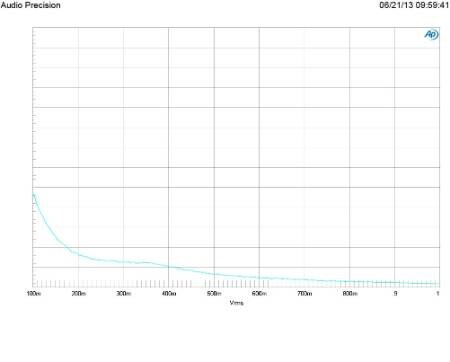
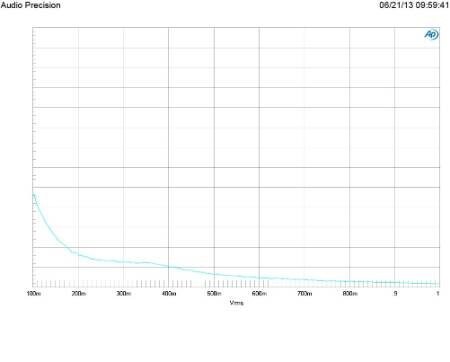
The next sweeps were done on the EVAL-ADAU1401AEBZ, same SigmaStudio program, same levels.
I do not have time this morning to break the ADC and DAC apart to see which side is causing the trouble, but I suspect now that the DAC output of the ADAU1701 is having trouble driving the cable directly on the MINIZ; the large 3rd harmonic content in the first sweep suggests this. The EVAL-ADAU1401AEBZ has an active filter on the DAC, reducing the load on the DAC output to almost nothing. I will try to run more tests soon and post my results.
Best regards,
Coleman
Hello All,
With cap changes on the input providing no improvement in THD I'm going to start on the DAC output. RC low pass filter on the output consists of a 56.2 ohm (sic) resistor and 56nF cap. This leaves the DAC output driving an impedance of something around a couple hundred ohms at 20kHz. Seems low to me. Maybe they were thinking headphones. This is also an order of magnitude lower than the RC filter on the 1401 eval board. I'll scale these components and post results as soon as I get time.
Regards,
John
Hi John,
I believe you're right about the ADAU1701MINIZ's output jack being set up for headphones. I use mine that way all the time. I guess they could have made a separate output stage with active filter, but likely there wasn't enough room on the board.
Bob
Hello All,
Coleman's suspicions turned out to be correct. I replaced the 56 ohm / 56nF low pass with 1k / 3.3n. The reduced loading on the output stage resulted in 0.005% THD pretty much across the audio band. A couple minor bumps in the audio band likely caused by beats. Some artifacts in the vicinity of the sampling frequency but down around -80. This exercise certainly builds the case for a higher impedance passive lo-pass filter or, even better, that third order active filter / buffer Analog recommends.
Regards,
John
Hi John,
Thanks for posting your results. I will look into changing the output filter to reduce the loading, while providing a low source impedance and an HPF around 150 kHz.
Best regards,
Coleman
This question has been assumed as answered either offline via email or with a multi-part answer. This question has now been closed out. If you have an inquiry related to this topic please post a new question in the applicable product forum.
Thank you,
EZ Admin
Please log in to reply.