Digital pre-amp using SigmaDSP
Hi,
I am planning to design a digital pre-amp using SigmaDSP, this project is still under concept study.
The design spec for input and output would be as following::
Input
- 1 Stereo audio input
- 1 Mic input
Output
- 1 Stereo audio output + 1 subwoofer
Other rotary controls
- Rotary control for Tripple
- Rotary control for Bass
- Rotary control for Middle
- Rotary control for Balance
- For Mic:
- Rotary control for Echo
- Rotary control for Delay
- Rotary control for Feedback
I am thinking to use ADAU1701 in this design. However, I am not sure if it is good enough to deal with 1 stereo audio input + 1 mic input.
Another worry is rotary controls for several parameters. It is mentioned in the datasheet that there are only 4 Aux ADCs available for the rotary control. How can I do to achieve additional rotary control?
Afterall, is ADAU1701 suitable to be considered in the project above?
Audio Signal Processors
SigmaDSP Audio Processors
adau1701
As my previous study, 1701 can not support reverb(echo) due to small size of internal RAM. I tried reverb algorithm on 1701, it is not acceptable for music application.
What does 'Feedback' mean?
Jackie
The "feedback" is for the reduction of feedback effect between mic and speaker.
I see, I am also interested to know how to recognize/seperate the feedback and adjust it? 1701 does not support this algorithm. Can you share your idea?
I haven't had any idea on how to do this. Nevertheless, this is what i would like to achieve in this project. So, I am seeking advice from expert on the possibility to use SigmaDSP in the project i have described above.
I tried to get help from ADI expert on MEMS microphone. The answer is to use more microphones to setup a array. You can refer to AN-1140. Except this, I don't have any idea either.
I am not sure that you can use so many rotary controllers if you are going to connect them directly to the 1701. The idea is it has 4 auxiliary ADCs and you are definitely looking for more. You will most probably need to use some external ADCs. Also, 1701 has only one pair of built in 24-bit ADC. So either a microphone, or some stereo, unless, again, you are going to use external ADCs. All the functions you described here, to me, seem to be perfectly realizable in SigmaStudio. What is about microphones, I would really advise you to use some mems (which has suitable frequency response for your task) + ada4084-2 on the same board (!!). This will minimize noises + the ada4084-2 is the most beautiful and tiny amplifier I have encountered.
I uploaded one simple block diagram on using 2 ADA1701s to achieve what describe in the project requirements.
Please forgive me as I am still very new to SigmaDSP and the project is still under concept study.
Please indicate if the block diagram can work and what are the other things I should take care too.
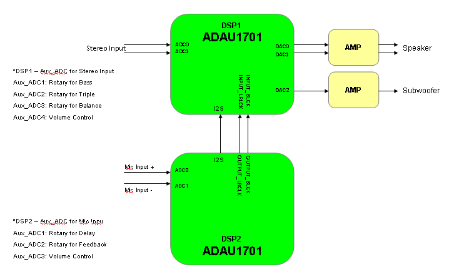
I have never used several DSPs at the same time, so can not advise you here. But, instead of using two 1701, why not using one ADAU1442? With additional ADCs?
I would guess that using 2x 1701 would be less expensive than using any solution with a 1442. Also note the 1442 isn't just missing ADCs it also has no DACs. I would guess that the 1701 solution would take up less board space as well.
I agree with Natan. Also remember that if you have two ADAU1701s in the system, you'll need to configure their address pins so that they each have a unique I2C address. This will allow the host controller to address them independently when it is booting the system.
Hi Brett,
So the block diagram I have uploaded should work for the project I involve in, right?
My idea is using two DSP for each analog input, then use the i2s output from DSP2 to mix with DSP1.
I am planning to use 3 or 4 rotary control for each DSP to control each function. Understand that "ECHO" function is out of the picture for ADAU1701.
Besides the address pins, what should I take care for the i2s input/output? I am not really quite sure about the master/slave of those CLKs pins.
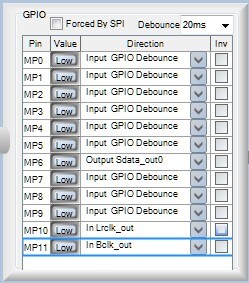
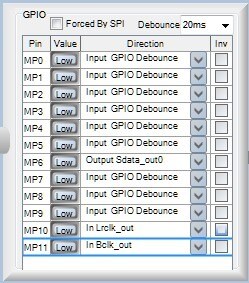
Yes, this block diagram looks OK. It appears that you have DSP2 configured as the master and DSP1 configured as the slave.
DSP1 can be set up like this, as a serial port slave:
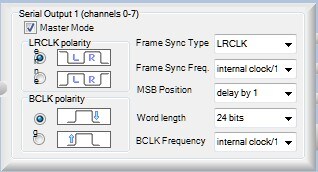
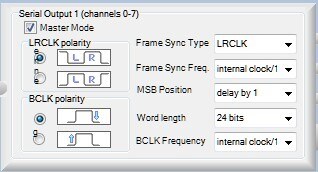
DSP2 can be set up as the master:
Make sure to check the Master Mode checkbox:
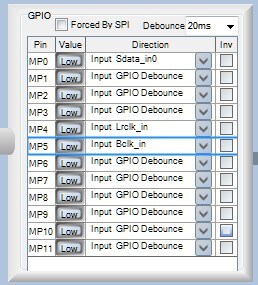
This question has been assumed as answered either offline via email or with a multi-part answer. This question has now been closed out. If you have an inquiry related to this topic please post a new question in the applicable product forum.
Thank you,
EZ Admin
Please log in to reply.