Can I create extra auxiliary ADC by using a external analog mux to a ADAU1701?
I need more than the 4 available auxiliary ADC inputs and would like to use an external analog mux controlled from the sigmaDSP ADAU1701. Is it possible to control the external mux from the digital GPIO, connect the mux to one auxiliary ADC input and do demultiplexing in the 1701? I would like to scan all the external analog voltages and use all the values in my DSP program.
/Tore
Audio Signal Processors
SigmaDSP Audio Processors
adau1701
Hello,
The SigmaStudio software that generates code to run in the SigmaDSP core will only allow you to poll the auxiliary ADCs once per audio frame, and it will only allow you to add 4 instances of the auxiliary ADC input cell, so you'll need an external microcontroller to do a bit of work in order to make this possible.
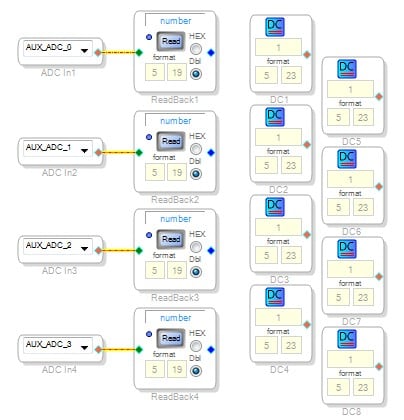
My suggestion would be to do something like this:
The microcontroller would have to follow these steps:
Read ReadBack1
Write that value to DC1
Read ReadBack2
Write that value to DC2
Read ReadBack3
Write that value to DC3
Read ReadBack4
Write that value to DC4
Toggle the signal that controls the multiplexer for the ADC signals
Read ReadBack1
Write that value to DC5
Read ReadBack2
Write that value to DC6
Read ReadBack3
Write that value to DC7
Read ReadBack4
Write that value to DC8
Toggle the signal that controls the multiplexer for the ADC signals
Repeat
By repeating this process over and over in the microcontroller, you will have 8 cells in the project (DC1 through DC8) that will contain the values of the 8 analog signals external to the SigmaDSP.
Hi Brett,
That's a neat idea to vart "DC" sources via serial control from a uC. Can one take it a step further and use the microcontroller's own ADCs for the analog inputs?
Hi Bob,
Yes, you could certainly do that. A "DC" source in SigmaStudio just acts like a variable that gets an address in parameter memory assigned to it. You can have the microcontroller update that memory location with whatever it's reading in on its own ADCs.
Brett.
Thanks for your help! This means we can pass quite a large set of numbers from a uC into a SigmaDSP and use them just about anywhere in the schematic! I did not even suspect such a possibility till now.
Bob
Yes, the DC Source cells simply act as (input) memory placeholders that you can write from an external uC as needed.
Similarly, the DSP Readback cells act as (output) memory placeholders that can be read by an external uC and used for anything imaginable.
I would like to read from e.g. eight potentiometers and it is not a problem if I can't read every audio frame. Is it possible to, for each radio frame, connect the external analog mux to a different potentiometer and store the different results internally in different places e.g. by using some synchronized switching function?
/Tore
Hi Tore,
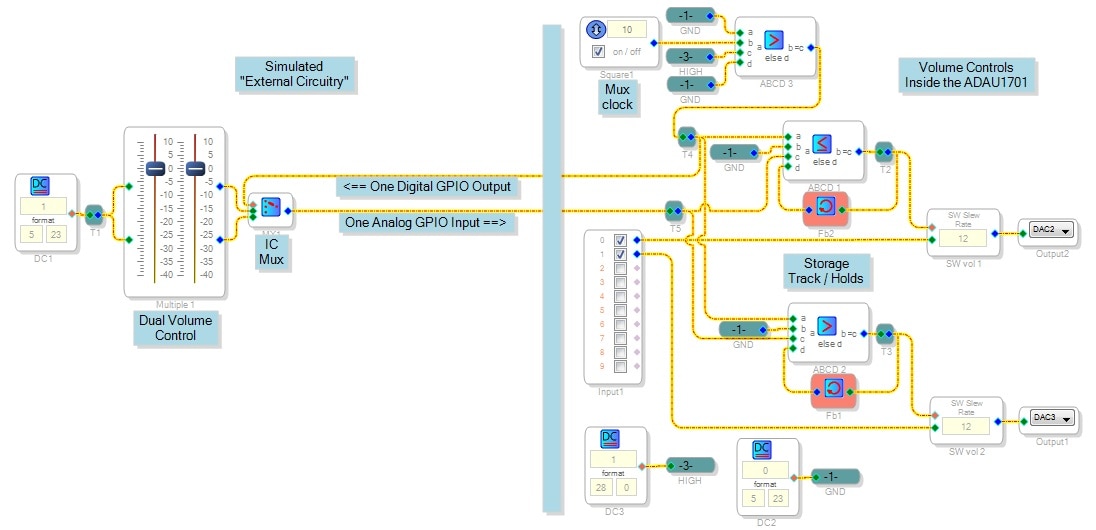
One way to store a variable within SigmaDSP is with a block that feeds back to itself. For example, you can use feedback around an ABCD comparator to build a "track-hold" to store levels in between refreshes. The circuit below uses two of these track-holds to independently control Left and Right volume with just one "input". Here the external mux and controls are simulated inside the SigmaDSP; of course this is where you would connect your external signals and mux.
Hope this helps,
Bob
Please log in to reply.