ADAU1701 Sampling Frequency
Hi everybody, I found some topics about Master clock configuration and limitations very useful to figure out better how ADAU1701 works.
What I didn't uderstand yet is the use of dropdown menu about Sampling Frequency in the SigmaStudio, I mean, If I select a different Sampling Frequecy from the menu above, where this information is written in the DSP? From what I've seen, no registers change when a new Fs has been set.
I have just to remember taking into account the limitations of the clock and Rate Modes, that is, if I wanna work with Fs=92kHz the "512 operations per sample" must be set in the core Register and if I wanna work with Fs=192kHz the "256 operations per sample" must be set in the Core Regiter.
1) But when I change the sampling rate from SigmaStudio Dropdown menu, what really happens?
2) And what should happen if I write a operation in RAM program at index 530, for instance, when I'm working with "512 operations per sample"? No operation exucution since the last op executed should be 511, isn't it?
Thanks for help.
Regards,
leonxp.
Hi leonxp,
As you have noticed, when you adjust SigmaStudio's sample rate drop-down box, nothing immediately changes. You're merely telling the program to configure any blocks you then add for this sample rate. For example, new filters will get the appropriate coefficients. Blocks already in your project remain figured for the old sample rate unless you also press the Set System Sampling Rate button to the left of the sample rate drop-down box. As you also pointed out, to get the hardware to actually run at the desired rate, you also need to set the core register for the "2x" (96KHz) or "4x" (192KHz) modes. The FAQ below describes how to change this in SigmaStudio:
http://ez.analog.com/docs/DOC-1431
One might expect as you noted, that when running at a 2x or 4x sample rate (where fewer instructions are usable), that much of the -1701's program RAM would be unoccupied. I'm not sure, however, if all instructions for a higher-speed project are confined to the bottom of program RAM. As an experiment I compared the TxBuffer export files for a small 48KHz project with those of the same project re-compiled at 192KHz. Resulting program data occupies much more of this second listing than does the first. Thus, the exact program format is not clear to me. In any event, having your uC (or self-boot flash) write whatever code SigmaStudio generates should work fine.
Best regards,
Bob
Hi Bobb,
I should like to use ADAU1701 in my amateur TRX project.
I have an EVAL-ADAU1701MINIZ. I can use it with SigmaStudio.
The incoming signal goes into ADAU is well band limited by an XTAL filter in IF chain.
So ADAU would work on audio baseband signals (I &Q).
Functions what I want to implement:
1: Image cancelling (It works well),
2: AGC (works, but some adjustable is needed in a future),
3: Wideband filtering for 300Hz to 3kHz band.
4: Narrowband filtering for 500Hz to 1kHz.
5: other as possible.
For good sound quality I would like to use a FIR filter. For filter design I use a T-Filter SW.
Unfortunately too many taps filter is needed at 48kHz sampling rate.
Q1: Could the ADAU1701 run at lower sampling rate than 44kHz, for example on 12kHz?
Q1A: Can I bypass the PLL of ADAU1701? (MCLK would be the same as fXTAL)
Q2: If Yes, how I can set it with SigmaStudio?
Q3: Can I test it with EVAL-ADAU1701MINIZ?
Regards,
Gabor
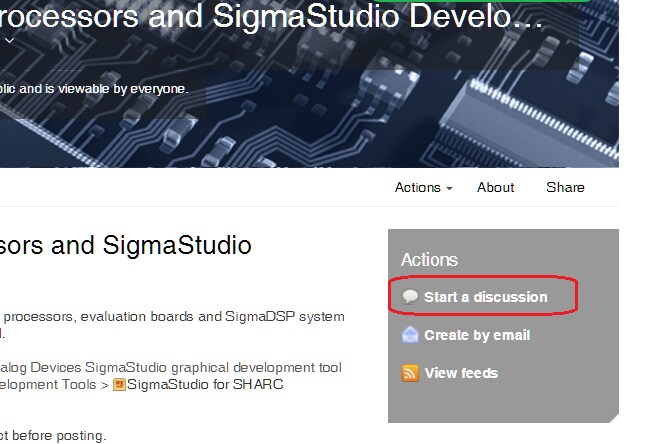
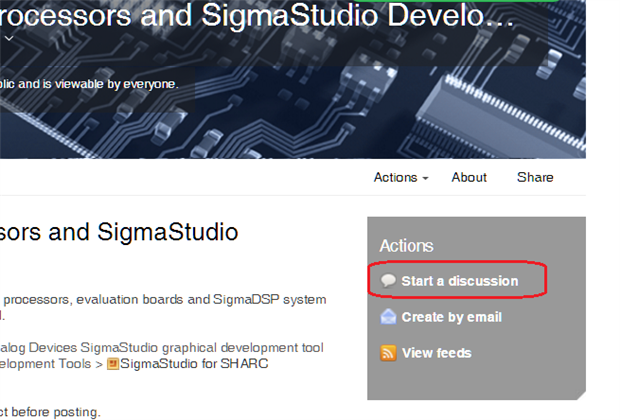
(p.s. How can I open a new topic?)
Hello Gabor,
You can open a new topic in the SigmaDSP space by clicking the button pictured below:
The ADAU1701 data sheet does allow a 12 KHz sample rate. The -1701 unfortunately does not have s/w selectable PLL scaling or bypass (as does, for example, the ADAU1761). Any rate other than 48 / 96 / 192K does require a hardware mod -- by setting the clock multiplier at pins 38, 39 and/or supplying a different MCLK (external oscillator or crystal). The ADAU1701MINIZ eval board's switch S1 can select an external MCLK, which you could then supply from a 3.072 MHz. packaged oscillator.
In addition, you need to calculate and replace the three ADC resistors on the board, as described on page 20 of the data sheet. In SigmaStudio you simply select the 12 KHz choice in the top window, and power down the internal oscillator if desired.
All other register settings remain the same.
As you know, IIR filters are efficient and easily implemented in SigmaStudio. I played around with a FIR filter at:
https://ez.analog.com/message/108627#108627
finding no improvement in sound quality. Of course, your application may yet benefit from a large 12 KHz FIR -- but.knowing what's involved with the 12 KHz mod, you may wish to try some multi-section IIR filters first.
Best regards,
Bob


Hello Bob,
Thank's for ans's.
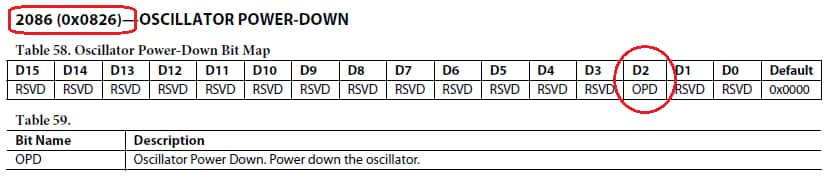
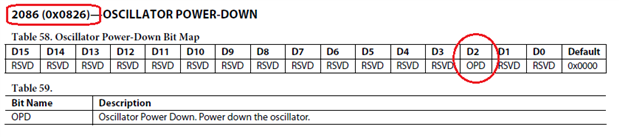
About Q1 (12kHz sampling rate) : The effect of OPD bit is not clear for me.
Does the OPD bit switch off the internal VCO and virtually bypassed it (normally locked by PLL),OR disable XTAL oscillator and 'switches' the pin to MCLK input?
I read datasheet and try to understand it, the VCO can lock their nominal frequency (approx. 50MHz?) +- 20%.
So the proper selection of fXTAL and PINs 38, 39 is requied for locking the internal VCO.
For example: I keep the originally built in 12.880MHz XTAL, pins 38, 39 settings , and set the OPB bit, the sampling rate will be 48/4=12kHz.
Is this correct?
How does parameters (SNR, THD..) of ADC depend on different fs?
Can I have data for ENOB of ADC vs. fs?
FIR or IIR filters:
I will try Bessel type IIR filter for narrowband first. I know, this filter is not sharp but less ringing is observable on output signal (This effect was, why I should like to use a FIR filter).
ADI's analogue filter design SW support up to 10 stage only.
Is there other SW accessable at ADI, can design more stage filter?
Br,
Gabor
All the OPD bit does is power down the crystal oscillator to save power. It won't do what you're looking for.
All filter programs I know of also stop at N = 10, likely because they are for analog design -- where component choices get rough for higher order filters.
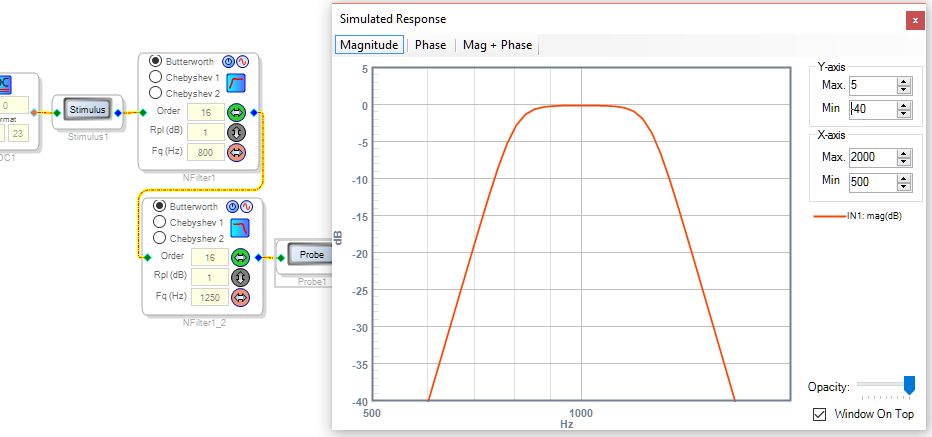
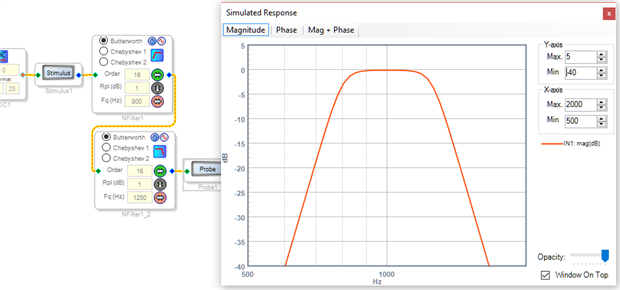
Perhaps you could try the Nth-Order Filter which can make filters up to order 20. There's no Bessel filter (perhaps Butterworth will do). It doesn't do bandpass, but you can cascade a lowpass and highpass like this:
Please start a new thread for any additional questions.
Best regards,
Bob
Please log in to reply.