Digital Lock-In amplifier implementation into stereo codec with DSP (like the ADAU 1761) ?
Dear All,
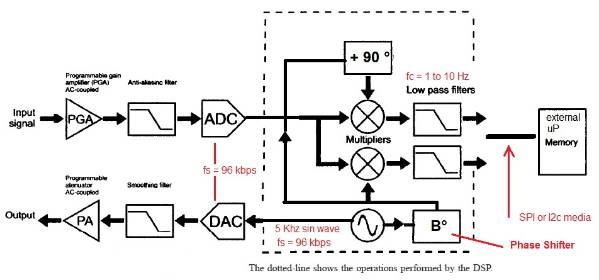
I need to build an accurate sensor processing system for our laboratory and I consider to build an digital Lock - In amplifier based on DSP technology.
I am new in the field of the DSP and before dealing with the learning curve of new processor ( SHARC or other ),
I wonder myself if an stereo codec with intergrated mini DSP will not be a solution ?
My problem is that I dont know the capacity of the internal DSP of this kind of codecs :
- is there a way to build an internal sin wave generator for external and internal reference ?
- is there a way to shift a sinus signal by 90° ?
- is there a way to shift dynamicaly a signal (+ - 180 °) ?
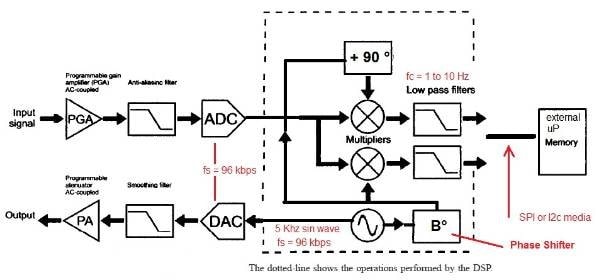
So, here after is a slightly modified shematic found on web.
Thank you for your opinion and advices,
Jean
Hello,
- SigmaStudio has sine tone generators (as well as other function generators) included in the library.
- To answer the question about phase shift...
Please check these three discussions for more information on this topic:
https://ez.analog.com/message/12996#12996
https://ez.analog.com/message/18805#18805
https://ez.analog.com/message/11254#11254
The simple answer is that SigmaDSP can implement group delay (that is, delay for all frequencies). This can also be used as a variable phase delay for a single frequency. However, since you're using a range of input frequencies, the phase delay for a single delay cell will be frequency-dependent.
So, as far as I know, what you're trying to do is not possible in SigmaDSP.
Actually, I have an update. It seems like the Hilbert Transform can be used to implement a 90 degree phase shift. Please take a look at this post for details:
Dear Brett,
I wish to thank you infinitely for your kind and valuable answer and link.
In the meantime, I have buy the starter kit for the ADAU 1761 and downloaded Sigma Studio .
So, I have implemented a lock – in design into the ADAU and the first tests are very encouraging.
The phase shift was implemented simply by delay ( since the sinus generator was always constant in amplitude ).
The big problem was the SNR of the ADAU but averaging seems to be a good solution.
My last problem is a little amplitude drift in time at the output of the ref signal DAC ( +- 40 µV ) and consequently at the measured signal but I think that all will be fixed the next week by some tricks.
So, I know that the ADAU is not intended to do what I make but I must say that this wonderful little chip is incredible and that I am verry pleased to use it.
Thank you again Brett
Thank you Jean. Feel free to post here if you need additional help.
This question has been assumed as answered either offline via email or with a multi-part answer. This question has now been closed out. If you have an inquiry related to this topic please post a new question in the applicable product forum.
Thank you,
EZ Admin
Please log in to reply.