Purpose of the evaluation board?
Hello!
I'm new to this forum, and very beginner to DSP and digital circuits.
I'm developing loudspeakers, with passive and active crossover, but now I want to take it to the next step, so I would like to learn about DSP.
My plans is to make a loudspeaker with a digital crossover and, maybe a room correction filter. So I found the ADAU1701 which seems very intresting with the Sigma Studio software and the ADAU1701 evaluation board.
1.My question is, What the purpose of the evaluation board is, is it that you as a designer can use the evaluation board to transfer coder from the software(Sigma Studio) in the computer to the, (in this case) the ADAU1701 processor,and test how the processor and the circuit will perform?
2. If we say that I make a digital crossover in the Sigma studio, can that project or what you call it, be exportet so I can massproduce the digital circuits?
My plans is to make a DSP loudspeaker series, like genelec 82 series.
What is your though about that?
Best
//Matte
Audio Signal Processors
SigmaDSP Audio Processors
adau1701
Hello, and welcome.
1. Yes, the purpose of the evaluation board is to test how the SigmaDSP and supporting circuit will perform in your system. You can use this to prototype your product. You could, for example, place the evaluation board between the audio source and the loudspeaker, in order to perform listening tests and tweak the processing parameters in real time.
2. Yes, the project file will output compiled data files that can be loaded onto the SigmaDSP either via a microcontroller or the Self-Boot EEPROM mechanism.
Hello!
Okay It sounds interesting. My plans is make a digital crossover for loudspeaker which will use the SigmaDSP engine (ADAU1701?).
1. I want to make a digital crossover, but, if I want to use this DSP engine as the crossover to use it in the loudspeakers, so each loudspeaker contains it's own filter inside the loudspeaker enclosure. But if I want to make a series of say,100 loudspeakers, what would be the best solution?
Since I just will need the engine for the filtering, so I don't need the whole evaluation board/circuit for my project if you understand my question.
Can I export the file from Sigma studio to make a circuit just out of that?
2. Do you have any tips of literature for making this circuits with DSP, on the more harware level, not so much code level?
Since I have some experience of passive, and active filters.
Best
//Matte
Hi Matte,
Sorry it took me so long to get back to you. The ADAU1701 and ADAU1442 processors can self-boot from an EEPROM, so technically you could use SigmaStudio to make the self-boot EEPROM image and then burn that to the EEPROM manually. However, that requires a standalone EEPROM programmer and also requires some intermediary steps to convert the format of the image file. So, yes, you could develop your system without evaluation hardware.
An evaluation kit for the ADAU1701 includes the ability to burn the EEPROM directly from SigmaStudio and allows you to immediately listen to the results. So, I think it is very valuable as a development tool. It also costs less than most EEPROM programming kits, so I think in the end, the cost should not be a limiting factor.
Each loudspeaker unit would need a small PCB with an ADAU1701, EEPROM, and basic input/output filtering circuitry. You can follow the evaluation board design or the datasheet for details about the supporting passive circuitry required in the design.
Once you are satisfied with the processing program, you can send off the EEPROM image to a manufacturer and they can send programmed EEPROMs directly to you for mass production of your system. You can burn the EEPROMs, place them on your custom PCBs, and then integrate them into the speaker systems.
For help with hardware design, take a look at the 1701 mini board user guide: http://www.analog.com/static/imported-files/eval_boards/EVAL-ADAU1701MINIZ.pdf
You can also take a look at figure 37 in the ADAU1701 datasheet: http://www.analog.com/static/imported-files/data_sheets/ADAU1701.pdf
By the way, the ADAU1702 is a lower cost version of the ADAU1701 that has less memory and fewer program instructions. If your processing program is simple enough, you can use the ADAU1702 instead of the ADAU1701 and save some money on your design!
Dear BrettG!
I would like to know, how can I implementing a Room correction filter into a Sigma Studio? I would like to "linearizing" my active speaker systems. It is possible?
Thank You for Your Help!
Best Regards!
Csabi
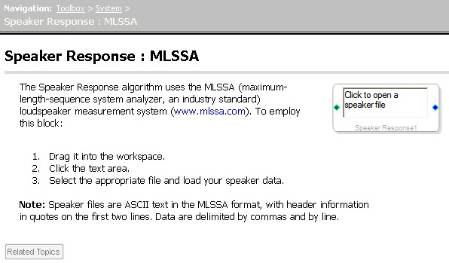
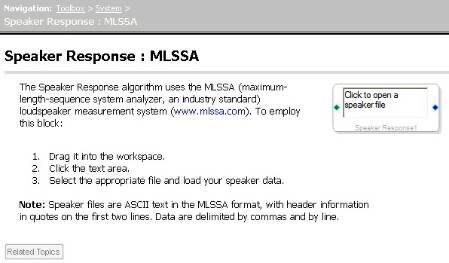
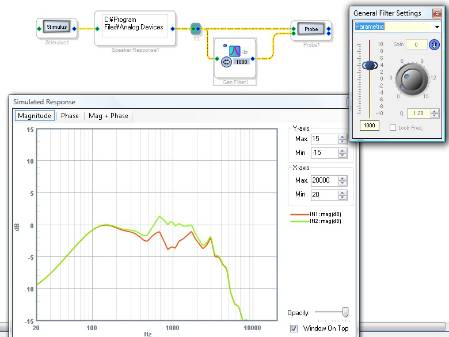
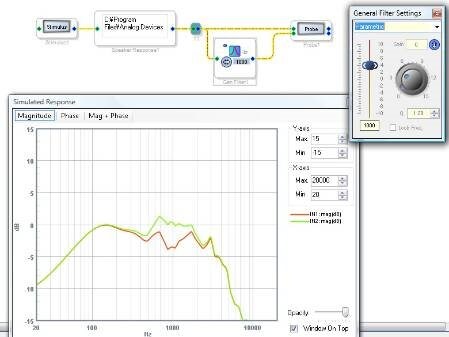
Yes, using the Speaker Response cell, you can load in a measured response from a speaker. You can then insert filters into the signal flow to correct for the frequency response.
Here's a simple example with a speaker response (in red) and the modified response after the filter (in green).
This question has been closed by the EZ team and is assumed answered.
Please log in to reply.