Problem with subtractor block
I was trying to make a subtractive-delay crossover (i.e. Lipshitz - Vanderkooy type) in Sigma studio using a Butterworth lowpass, the "Signal Subtract" (from Basic DSP/Arithmetic Operations) and a delay.
The derived highpass wasn't a highpass at all - it was looking like a low-shelf filter. Just as if the subtractor wouldn't subtract but add the signals instead ! I then replaced the subtractor with the "Signal Add" function and the result looked exactly the same ! I.e. my assumption is that the "Signal Subtract" doesn't do what it is supposed to - it does rather add than subtract.
I then inserted a "Signal Invert" before the adder stage - et voila: The crossover worked exactly as it should.
Is there a known problem with the "Signal Subtract" in Sigma Studio 3.4, build 0, Rev 724 ?
Regards
Charles
Hi Charles,
I just tested the Subtract and Add blocks, and everything looks fine. My results are attached.
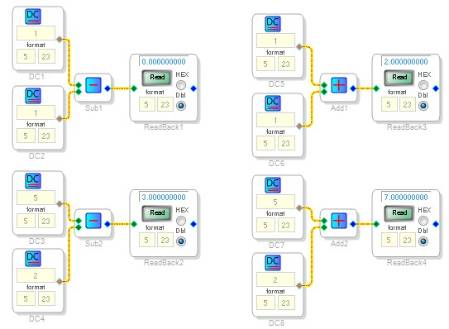
Hi Brett
Thanks for your effort !!
That looks indeed good and as if it would work as expected. I will repeat my filter trial and post the result here.
Regards
Charles
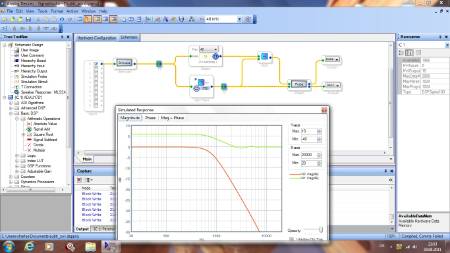
As promised the crossover simulation results below.
First the result using the subtractor block (certainly not what one would expect) :
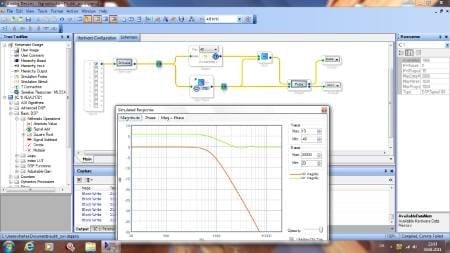
And now using an inverter and an adder - resulting in the perfect response (with the derived highpass being 3rd order as predicted for a 2nd order Butterworth lowpass):
Did I do anything wrong ?
Regards
Charles
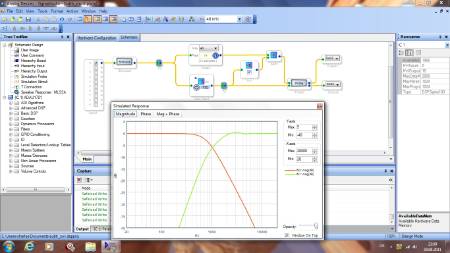
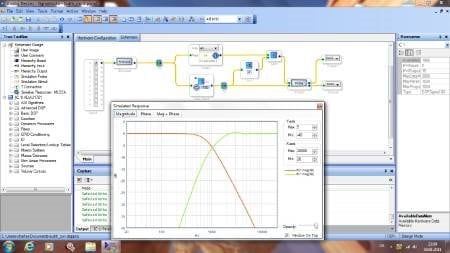
Charles, thanks for the details. Were you able to test the actual audio outputs? Is the filter functioning correctly, but simply showing up incorrectly on the frequency response calculator? Or is the filter actually behaving incorrectly?
Hi Brett
So far it is only the simulation. I will do some speaker measurements today and then I will have a look at this filter once more and then we will know for sure.
Regards
Charles
Hi Brett
Both versions work as intended - the one that simulates well and the one that doesn't simulate correctly !
But there is another problem with the one that simulates well: Right after opening not even this one simulates well !!!!!! The simulation looks like the classic subtractive crossover without delay at first. Only after the delay has been stepped up and down (or vice versa) by one step does the simulation work well.
I don't know wheter the newer versions of SigmaStudio work better. Maybe I will try the latest beta since there is another problem with this version here as well: After some link-complile-download cycles the communiucation to the evaluatioin board stops working.
If you like I can send you the .dsproj file of the topology in question.
Regards
Charles
I have noticed some strange results on the frequency response simulation block lately. It's possible that there is some bug that needs to be worked out. I will check with the software team. In the meantime, I would request that you rely on the measured results of the system, as inconvenient as that may be. For the moment I think it's safe to say that the simulator block may not be totally accurate!
If you wouldn't mind, could you post a simple example project and the mathematical expected response so we can give it a try?
Hi Brett
Enclosed you will find the topology file (I was using 48 ks/s BTW, otherwise the delay would be incorrect or needed finetuning).
The derived highpass should be 3rd order, the crossover frequency is 1 kHz approx (-6dB point). The whole filter is behaving in a pseudo-noncausal way and offers flat group-delay response at the cost of increased total delay. The enclosed file uses the metod of invert and add rather than the subtractor. But this can easily be changed.
Regards
Charles
Hi Charles:
I just checked and I believe you are correct, the substraction calculation of the Transfer function is not correct. It is inverted. You see, the assembly code and the calculation of the transfer function (simulation) are calculated separately. This bug definatively escapted.
This will get solved in the next version of SigmaStudio.
Best regards
Miguel
Hi Miguel
Thank you for the news.
Kind regards
Charles
Please log in to reply.