FFT on SigmaDSP Processor?
In most materials about SigmaStudio is written that in can handle:
"FIR and IIR filters, dynamics processors, mixers, low level DSP functions, and third-party algorithms for fast development of custom signal flows".
It is possible to compute FFT on any of available SigmaDSP Processor?
No, the SigmaDSP does not support FFT processing. The SigmaDSP core is targeted for stream-oriented, not block-oriented, processing. Its architecture makes it very efficient for this type of processing, which is ideal for many audio applications whose processing can be done in the time domain. This architecture also lends itself to an easy-to-use programming model in SigmaStudio.
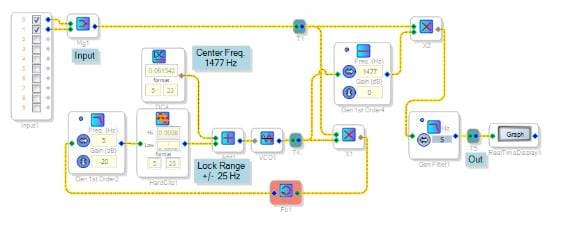
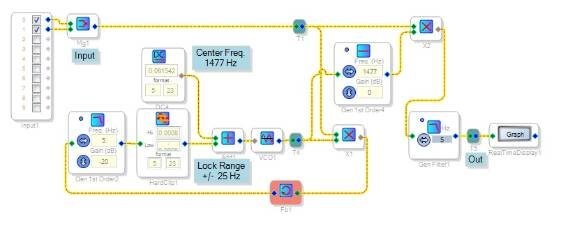
While the Sigma DSP products aren't up for FFT, they can perform a few common FFT applications, such as tone decoding. Before DSP was as accessible as it is today, tone decoding was often done with a NE567 phase-locked loop. SigmaStudio has everything you need to implement this function as shown. The output is a DC level proportional to the tone level. The PLL is more selective than, for example, cascaded peaking filters.
KJBob,
That's really cool! I bet that project could be really useful for some people. Would you mind making a few more annotations that explain what all of the blocks do? I would be happy to post it on our tutorials page so other people can use it: https://wiki.analog.com/resources/tools-software/sigmastudio/tutorials
(Of course, the Wiki can be edited by anyone, so feel free to add it yourself!)
Brett,
Thanks! I know you're busy with lots of stuff at AD yet you do a great job keeping up with the forum. The project as set up below decodes 1477 Hz, half of the DTMF tone pair for "#". Of course to make a full DTMF decoder one would have to add the other frequencies and perhaps additional filtering to reject harmonics, as described in literature on this subject. We only needed to make a "hit # to continue" function, so it worked nicely for us. The project as shown / attached runs directly on the little ADAU1701 evaluation board. One could test it with an external generator connected to its input, but I say, get lazy and replace the input with a built-in oscillator. SigmaStudio is really spoiling me. A few days ago I had to solder together a breadboard with a transistor, a few diodes, caps, etc. I was thinking to myself, "Why can't I just draw this into a computer and burn a chip?" Back in my youth I used to use analog multipliers (from AD, of course) at $30 a pop. Here I can get 1024 of them for about $6!
May I ask you to place this one on the wiki, that way I can see how it should look there.
Bob
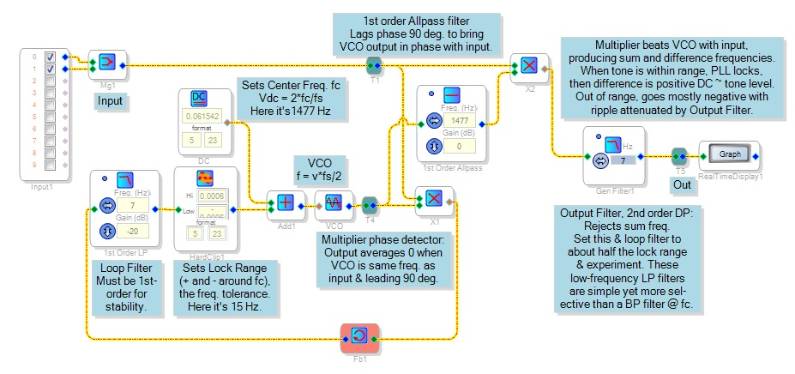
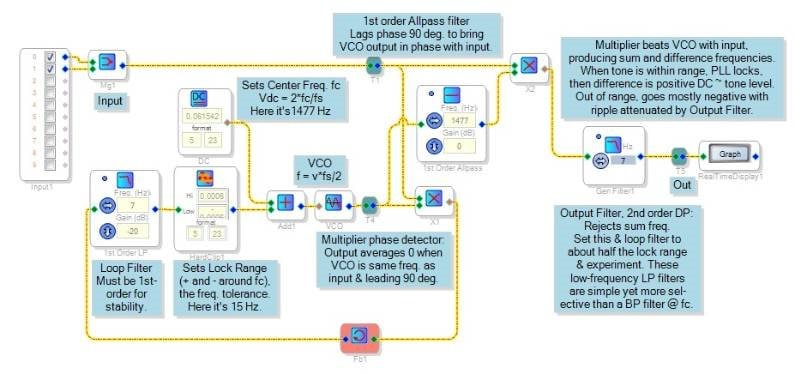
Excellent, thanks! I just renamed the zip file to match our (somewhat) standardized format.
partnumber_type_description.zip
In the case of your project I called it
adau1701_misc_tone_decode_pll.zip
You can find it here:
I hope the description is accurate.
That's great, thanks! Edit: FFT is now possible with SigmaStudio for the ADAU1452 and similar.
Please log in to reply.