ADAU 1452 Delay wrongly implemented?
Some delay blocks / functions in Sigma Studie do not work properly.
The simple Delay block works as expected.
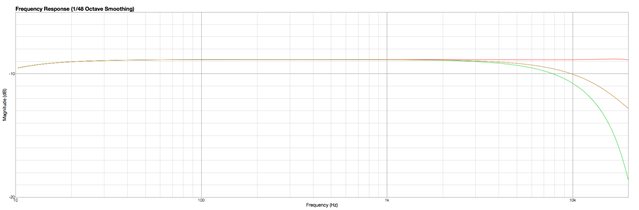
The Voltage Controlled Delay and the Voltage Controlled Fractional Delay, however, show a severe frequency response drop at higher frequencies (10kHz to 20 kHz).
At delay zero everything is correct. Also the delay times are correct for any setting. But the delay blocks add a severe amplitude frequency response drop if the delay is set to a value other than zero.
The image shows the amplitude frequency response in dB for different delay settings.
Are there more information on the used algorithms available? Anything known about the described effect?
Reinhold Lutz
AudioChiemgau Bavaria
Audio Signal Processors
adau1452
sigmastudio
SigmaDSP Audio Processors
Hello Reinhold,
Let me look into this. Which revision of SigmaStudio are you using?
What sample rate are you using? ( So I test this under similar conditions ).
The fractional delay will be using some filtering to get the interpolated value that is between sample periods. So that filter might be the issue.
I do not think there is a filter on the voltage controlled delay but I will investigate and ask the programmers. I think it may be to reduce the zipper noise when the control input is changed. However, this should be noted and explained if this is the case.
Dave T
Hi Dave,
thanks for your quick reaction.
I use version 4.5 at 48 kHz - all standard.
I observe the strong amplitude frequency response also for the F Delay block, where you input %-values.
There I get a flat frequency response for the values 0% and 50%. All other settings lead to a different, but strong drop of the amplitude frequency response starting at about 3 kHz.
Reinhold
Hi Dave,
is there any new information available?
Best regards
Reinhold
Hello Reinhold,
I did find out that we use a linear interpolator for the fractional part of the delay. These filters will have a large error at frequencies close to Nyquist and the roll-off will start fairly early. It will depends on the factor used. If it is 0.1% then the response looks fine. For a 20kHz input I measured -10dB when you set it for 0.11%. 0.12% shows -4dB of loss at 20kHz. So it will depend on the factor that is being used.
This linear interpolator is efficient when it comes to MIPS so that is why it was used. To make this better would need a high order polynomial fit to predict the value of the signal between sample points. Oversampling is another way to do it but I do not have this worked out right now. I am working on it.
Dave T
Hi Dave,
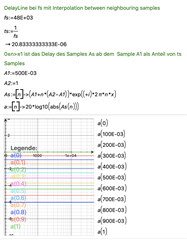
I made a few simulations and have the following proposal for the implementation of the fractional delay lines:
You do a linear interpolation between the amplitudes of adjacent samples proportional to the delay relative to the sample period and you add a frequency dependent phase proportionally to the delay relative to the sample period (phase = 2π*n*fsample with n is the delay fraction relative to the sample period). This results in constant frequency responses up to the Nyquist frequency. Can this be implemented?
Hi Dave,
is there anything new, or even a solution for the fractional delay problem?
Best regards
Reinhold
Please log in to reply.