SigmaStudio filters
Hello friends.
The filter General (2nd-Order / Index Selectable) Graphical requires more precision in the Gain1 parameter up to hundredths after the decimal point.
software
4.7
sigmastudio
Hello DenisT,
Your post is really too vague. Please include more information so we are not guessing as to what you are referring to.
What DSP are you using?
I think I guessed as to the correct cell you pulled out of the library.
I used a ADAU1452 and took the second order, double precision, Clickless SW Slew, General Eq 2nd order Slew Ext.
In this device I do not see a parameter named "Gain 1". So again, I am forced to guess.
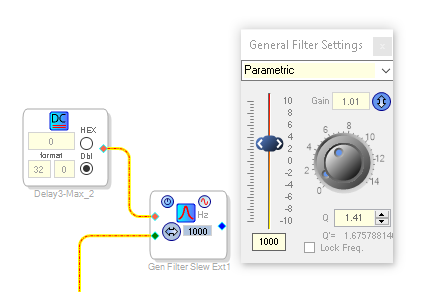
Here is a screenshot of what I pulled out of the library.
Note that I was able to set the gain to 1.01dB so it does allow for a gain of 1/100 of a dB. It will not allow for a gain of 1.001 which is 1/1000 of a dB. This is reasonable because there is no application that I know of that would require that small of an adjustment. An adjustment this small would be difficult to measure with the best test equipment in the world. It is usually into the noise at that point.
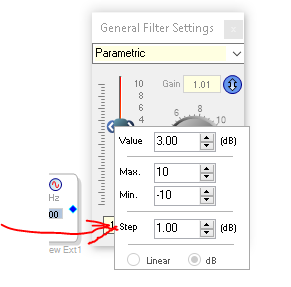
Regarding the filter's gain at the selected frequency. The default is 1dB steps but it can be adjusted. This is done intentionally because grabbing the slider with a mouse and moving it would result in too many messages going out via SPI/I2C if the adjustment is too granular. However, you can adjust this. Hover the mouse over the control and right click and you will see this:
Adjust the step size and you can make it a more precise adjustment.
Again, you can adjust this down to 1/100 dB.
I hope this answers your questions.
Dave T
Hello Denis,
Sorry, I don't think you can achieve what you have asked for. It only allows two digits no matter where the decimal point is. I can enter 10dB but not 10.1dB. I can enter 1.1dB but not 1.01dB. It also rounds off when you give two digits after the decimal point. ex, if you enter 6.89 then it will give you 6.9. So all you can have is only two digits in that parameter.
If it's an individual parameter that is stored in an individual address means you can externally write your values to that address, but unfortunately that is not the case here. The individual parameters for this block that are stored in an individual addresses are slew mode, co-effs ,etc and this gain value is used to calculate those co-effs. You can access those co-effs externally, but you can't separately access the gain value externally. (The gain value is the part of the co-effs)
So you can access the gain value only in the window which results in overall two digits.
Regards,
Harish
Hello Denis,
To add to what Harish mentioned. If you really need to have this level of granularity, then use the blocks I showed in my earlier post. Grow the sections of the EQ and then place a Stimulus and Probe blocks on either side and you will be able to see the resulting curve from all the EQs.
Dave T
Only this block solves my problems, I use 36 curves and all have different parameters, are there developers here who can expand this parameter in the next release?
What's the problem with expanding one parameter?
Hello Dennis,
I can put in a request but this is a very low priority and not likely to be elevated. The programmers will question it. This is because I challenge you with a double blind test to hear the difference with 1/100th of a dB of difference in the setting of two EQs. It is next to impossible to hear 1/10th of a dB so this is why I asked you why do you need this level of granularity? If it is because you are switching between many of the filters and you do not want zipper noise? The indexed filters do have a slew between the output level of one filter verses the next filter to make the transitions smoother. You can probably go with a 1/10dB change and use 18 filters and get the same result as the 36 curves you are using.
I have not done this but I am guessing that if you take two filters and change the boost/cut level in one of them by 1/100th of a dB and calculate them in MatLab. Then look at the result once you transform them into a 32 bit coefficient, the difference will be truncated. That would be an interesting test.
Dave T
Please log in to reply.