1-in / 4-out crossover using Dayton Audio DSPB-K DSP
Seek suggestions on a 1-in / 4-out crossover using just the Dayton Audio DSPB-K board (and not the KE daughter-board). I'm considering a low pass filter for a large woofer, a high pass filter for a tweeter, and two bandpass filters for a smaller woofer and midrange.
My current solution splits the signal into two signals that map to two 3-way crossovers. 1st XO connects high and mid to DAC0 and DAC1. low pass is not connected. 2nd X0 connect mid to DAC2 and low to DAC3. High pass is not connected. May not be the best way to utilize two bandpass filters.
I'm still hunting and pecking to find discrete filter types. Suggestions welcome. Thanks,
Audio Signal Processors
Sigma Studio for ADAU1701
software
sigmastudio
SigmaDSP Audio Processors
crossover
adau1701
Show More
Hello ChazB,
Sounds like a good project. Keep experimenting, it is lots of fun.
The way you are doing it with two 3-way crossovers is not all that far off and certainly is a solution. But, I think just using one 3-way and then splitting up one of the outputs further with a 2-way would be better.
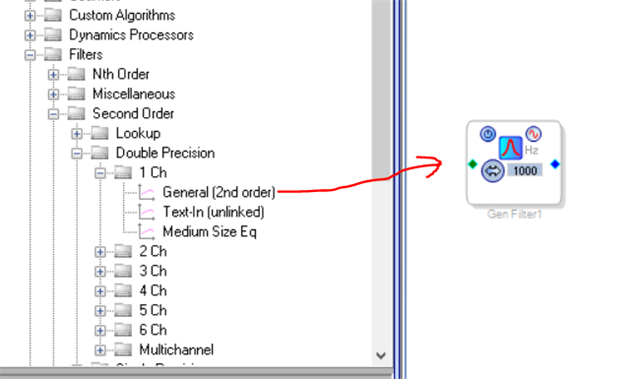
Here is where you will find the most useful filter in the future when looking for general filters.
I just put together this project from an earlier example I had done.
ADAU1701 Crossover Mono 4-way Output.dspproj
This will give you a starting point. There are no limiters in this project. You might want to do that and no general EQ for personal preference.
I used a single precision 3-way crossover since you will not need to go too low for the low end out. If you end up going much lower than 500Hz then you may want to change it to a double precision. The 2-way is a double precision because it is for the sub-woofer filter.
By the way, you should attach your projects in these posts. Often there are other things we notice and can comment on.
Dave t
Dave t,
Wow. That is really great. I thought about splitting the low end 'downstream' of the first XO. I really like the use of the alias cell referencing....makes it easier to read.
I also like the use of the Oscillator, White Noise and Pink Noise generators. I take it that rather than using source material, then tones with certain input frequency can be generated to see how the XO responds and how the driver responds to the input. Then I guess tweak the gain to get uniformity.
Do you have a preferred approach/sequence for using the signal generators? I also noticed that you had the output of the white noise as an input to pink noise. Is it that there's only a white noise generator and you're 'creating' a pink noise derivative?
How much to do you refer to published driver frequency response and sensitivity specs in tuning the system.
FYI, if this works, I will duplicate it with a second DSP Kernel board to have a stereo setup. A 12 channel amp will drive the system. Each speaker will have 2 channels bridged for the 15" sealed sub, 2 channels bridged for the 7" woofer in a TL cabinet, 1 channel each for the mid and tweeter.
I will publish results and images as I plod along. Thanks again to all.
Please log in to reply.